Heatwave Impacts and School Closures Across Indian States
Source:Indian Express ↗
Why It Matters
The increasing frequency and intensity of severe heatwaves in India require robust local governance and proactive disaster management strategies (such as revising schedules and distributing ORS) to protect vulnerable populations like school children, reflecting a necessary shift from reactive to proactive disaster mitigation.
Summary
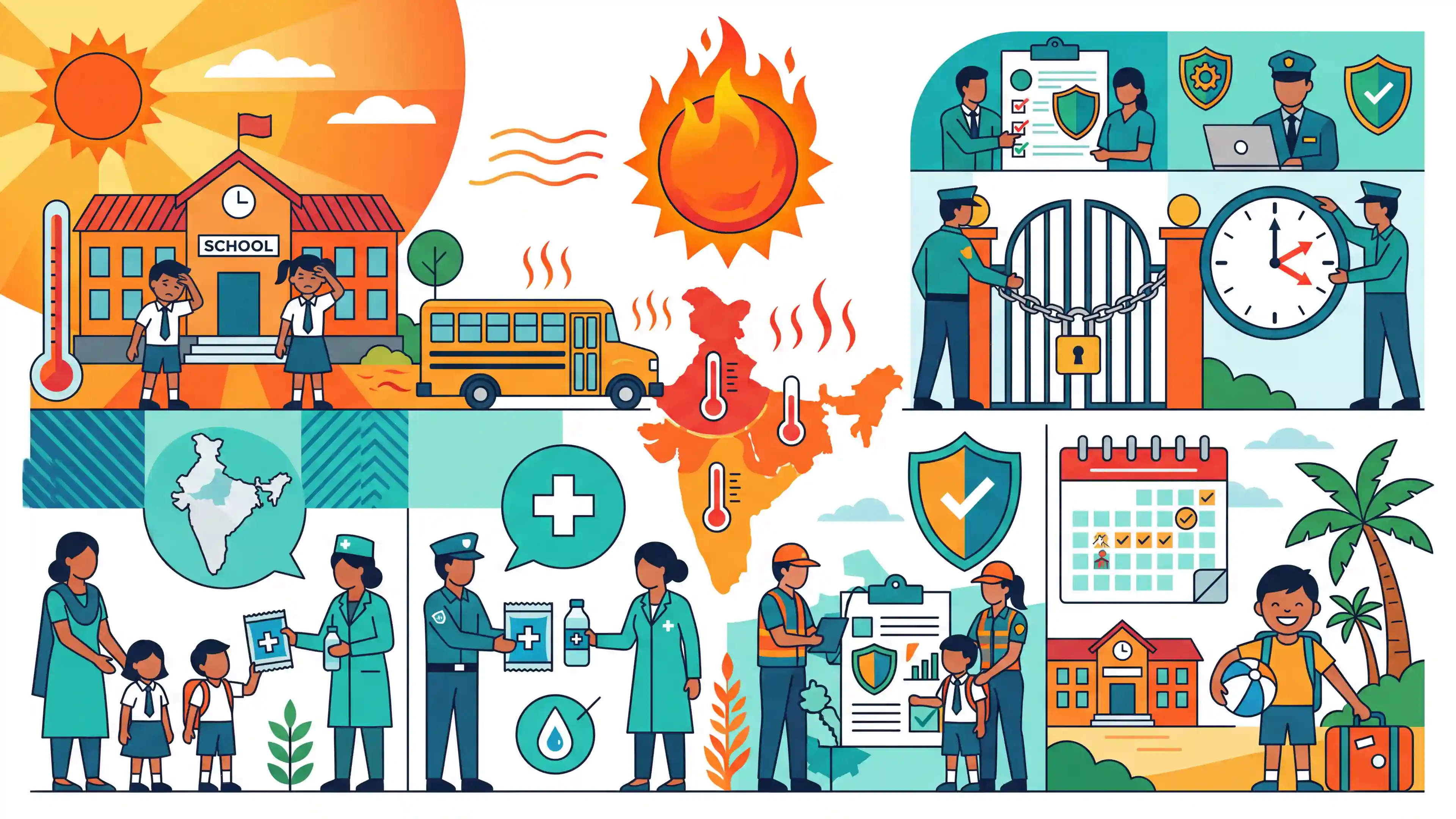
Several Indian states, including Bihar, Uttarakhand, Rajasthan, Delhi, Uttar Pradesh, Jharkhand, and Odisha, have announced school closures or revised timings due to severe heatwave conditions. District administrations in places like Patna, Dehradun, and Sikar have curtailed school hours to mitigate health risks for children. The Delhi government has advised providing ORS solutions to students, while Odisha has declared early summer vacations. These measures highlight the growing impact of extreme weather events and the role of local disaster management authorities in executing proactive strategies to safeguard vulnerable populations.
Key Points
- Severe heatwave conditions across India have prompted multiple state and district administrations to revise school timings or order closures to protect public health.
- In Patna (Bihar) and Sikar (Rajasthan), school hours have been restricted to function only until 11:30 AM to avoid peak afternoon temperatures.
- Dehradun has completely closed all schools and Anganwadi centres from April 27, with the local District Disaster Management Authority citing extreme weather conditions.
- Delhi Chief Minister Rekha Gupta advised schools to provide ORS solutions to students to prevent dehydration during commutes.
- Odisha announced an early start to summer vacations from April 27 following recommendations from the School and Mass Education Department.
Important Terms
District Disaster Management Authority (DDMA)

A local body established under the Disaster Management Act, 2005, headed by the District Magistrate. It coordinates planning and response for disasters, including issuing safety mandates during heatwaves.
UPSC context
GS Paper 3: Disaster Management. Tests knowledge of the institutional framework and local administrative powers under the DM Act.
Central Board of Secondary Education (CBSE)
A national-level board of education in India for public and private schools, controlled by the Union Government. It sets uniform standards and follows the NCERT curriculum.
UPSC context
GS Paper 2: Social Justice/Education. Relevant for questions on national education policy and administrative coordination between central and state entities.
School and Mass Education Department
The state-level administrative body responsible for regulating primary and secondary education. It manages schools and implements government policies regarding academic schedules and student safety.
UPSC context
GS Paper 2: Governance. Essential for understanding the state’s role in social sector delivery and local educational regulation.
ICSE (Council for the Indian School Certificate Examinations)
A private national-level board of school education in India. While autonomous, it complies with local government health and safety directives during emergencies.
UPSC context
GS Paper 2: Education. Illustrates the diversity of education boards and the extent of state regulatory power over private boards.
UP Board
(Madhyamik Shiksha Parishad) The state board of Uttar Pradesh, responsible for secondary education and examinations. It represents one of the world's largest regional educational bodies.
UPSC context
GS Paper 2: Education. Demonstrates the significant scale and jurisdictional authority of state-specific boards in India’s federal structure.
International Baccalaureate (IB)
An international foundation offering standardized global curricula. In India, IB schools must adhere to local administrative orders regarding public health and environmental safety.
UPSC context
GS Paper 2: Education. Shows the intersection of international educational standards and local governance mandates during disasters.
Prelims Trap
"IMD declares a heatwave solely when the absolute temperature crosses 45°C anywhere in India."
IMD criteria depend on region (40°C plains, 37°C coastal, 30°C hills) AND a departure from normal (at least 4.5°C), not just an absolute flat threshold.
Static Concepts Connected
What are the IMD criteria for declaring a heatwave in India?
- Plains: Maximum temperature must reach at least 40°C.
- Hilly Regions: Maximum temperature must reach at least 30°C.
- Coastal Areas: Maximum temperature must reach at least 37°C.
- Departure from Normal: The temperature must also be at least 4.5°C to 6.4°C above normal for that specific region.
What is the statutory role of the DDMA under the DM Act, 2005?
- Composition: Chaired by the District Magistrate/Collector, with an elected local authority representative as co-chair.
- Statutory Role: Formulate district disaster management plans, coordinate grassroots relief, and issue immediate protective local orders.
Cross-Topic Patterns
Climate Change & Public Health Intersections
Heatwaves link geography to biology. UPSC often tests climate impacts alongside public health concepts, such as ORS's sodium-glucose co-transport mechanism and vector-borne disease spread.
Urban Heat Islands & Micro-climates
Concrete infrastructure creates localized micro-climates. Expect questions linking the UHI effect to extreme weather anomalies in cities, often paired with urban flooding vulnerabilities.

A multi-statement question combining IMD heatwave criteria, UHI effects, and NDMA Heat Action Plan guidelines is highly likely in 2026.
Linked PYQs · 3
Linked PYQs · 3
- 2020MainsGS3
Discuss the recent measures initiated in disaster management by the Government of India departing from the earlier reactive approach.
- 2024MainsGS3
What is disaster resilience? How is it determined? Describe various elements of a resilience framework. Also mention the global targets of Sendai Framework for Disaster Risk Reduction (2015–2030).
- 2013MainsGS1
Bring out the causes for the formation of heat islands in the urban habitat of the world.
