Administrative Modernization and Governance Reforms in India
Source:The Hindu ↗
Why It Matters
This development is relevant for UPSC aspirants as it provides practical examples of governance reforms aimed at improving administrative efficiency, cost rationalization, and structural modernization (GS-II). Furthermore, the repurposing of colonial-era buildings ties into cultural preservation and heritage (GS-I), while grassroots infrastructure development addresses local self-governance (GS-II).
Summary
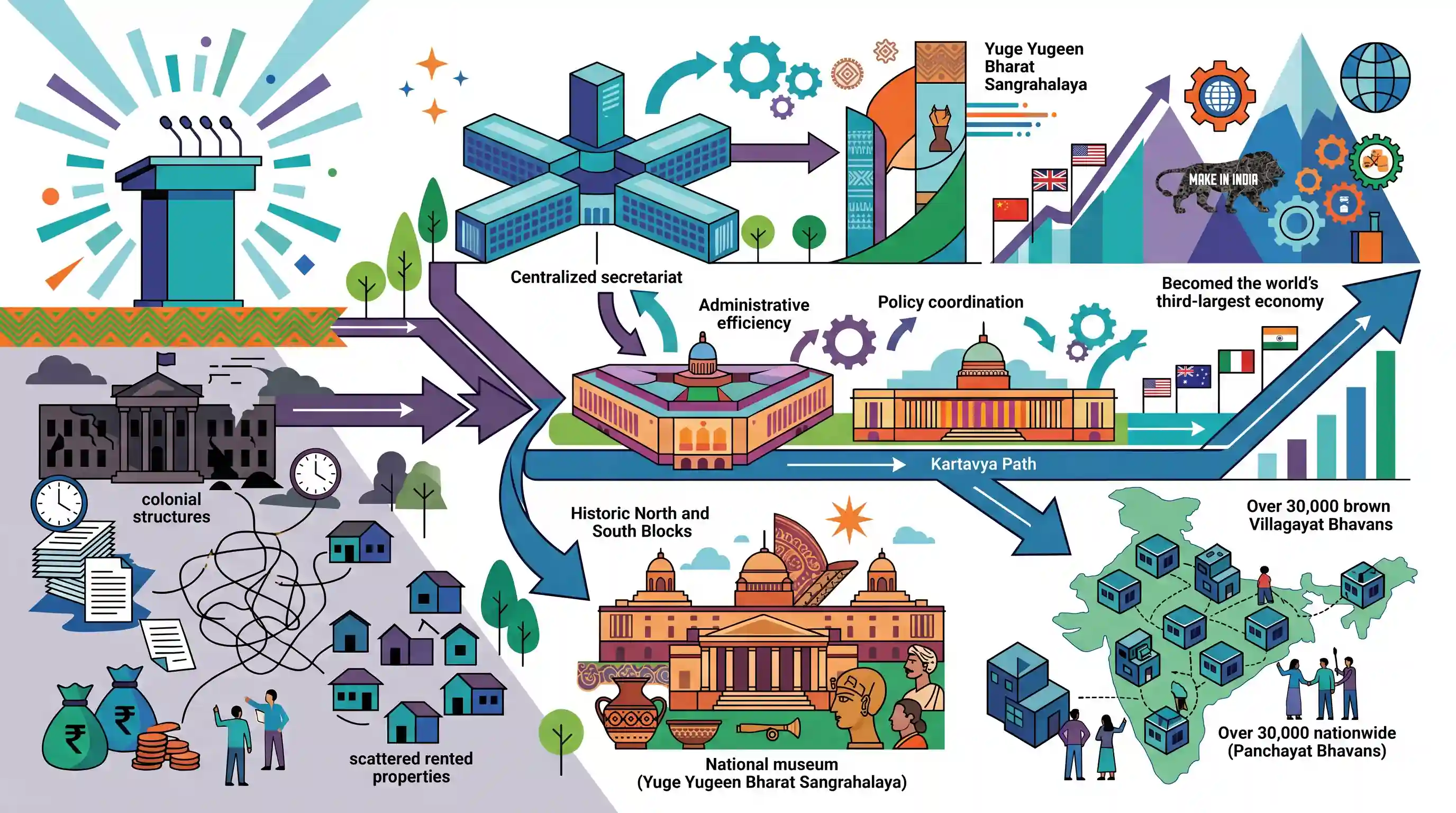
Prime Minister Narendra Modi addressed the inauguration of the Kartavya Bhavans in New Delhi, asserting that India has transitioned to a more transparent and sensitive governance model over the last 11 years. He stressed that improved physical infrastructure—such as the Kartavya Path, new Parliament Building, and the centralized secretariat complex—is vital for increasing administrative efficiency and policy coordination. The previous system, relying on colonial-era structures and scattered rented properties costing ₹1,500 crore annually, is being entirely overhauled. In a blend of modern development and cultural preservation, the historic North and South Blocks will be transformed into a national museum, the Yuge Yugeen Bharat Sangrahalaya. Modi also noted a holistic vision extending to the grassroots, highlighted by the construction of over 30,000 Panchayat Bhavans nationwide, framing these infrastructure updates as foundational for realizing the 'Make in India' vision and making India the world's third-largest economy.
Key Points
- PM Modi emphasized that India's administrative machinery is being modernized with transparent and sensitive governance through the inauguration of Kartavya Bhavans in New Delhi.
- The consolidation of ministries into new central secretariat buildings aims to replace the colonial-era setup, saving ₹1,500 crore annually in rent previously paid across 50 separate locations.
- Historic structures like the North and South Blocks are slated to be converted into the Yuge Yugeen Bharat Sangrahalaya, a grand public museum highlighting India's heritage.
- Alongside central infrastructural boosts like the new Parliament, the government is adopting a holistic approach by constructing over 30,000 Panchayat Bhavans to enhance local governance.
- These administrative improvements are pitched as critical steps toward scaling national productivity and making India the world's third-largest economy, aligned with 'Make in India' and 'Atmanirbhar Bharat'.
Important Terms
Make in India

A flagship initiative launched in 2014 to transform India into a global manufacturing hub by boosting domestic production, attracting foreign investment, and fostering innovation across 27 sectors.
UPSC context
GS III (Economy); evaluates industrial policies, manufacturing-led growth, and Ease of Doing Business (EoDB) reforms.
Atmanirbhar Bharat
The mission to make India self-reliant through five pillars: Economy, Infrastructure, Systems, Vibrant Demography, and Demand, aiming to strengthen domestic supply chains and reduce import dependency.
UPSC context
GS III (Economic Development); core concept for current economic strategies, self-sufficiency, and post-pandemic recovery policies.
Central Vista Redevelopment Project
A comprehensive project modernizing New Delhi’s administrative core, including the new Parliament Building, Kartavya Path, and a common central secretariat to enhance administrative efficiency and coordination.
UPSC context
GS II (Governance/Infrastructure); relates to executive reforms and modernizing national administrative facilities.
Yuge Yugeen Bharat Sangrahalaya
Set to be the world’s largest museum, located in Delhi’s North and South Blocks; it will showcase 5,000 years of Indian civilization through an Indo-French collaborative effort.
UPSC context
GS I (Art & Culture); relevant for cultural heritage preservation and national museum initiatives.
Panchayati Raj Institutions (PRI)
A three-tier system of rural local self-government constitutionalized by the 73rd Amendment Act, 1992, to ensure grassroots democracy and local-level development.
UPSC context
GS II (Polity/Governance); essential for understanding democratic decentralization and local administrative efficiency.
Good Governance
An administrative concept characterized by transparency, accountability, responsiveness, and efficiency, aiming to prioritize citizen welfare through effective service delivery.
UPSC context
GS II (Governance); tests principles of effective administration and the ethical delivery of public services.
Prelims Trap
"North and South Blocks are slated for demolition to build the new Secretariat."
The historic North and South Blocks are not being demolished; they are being preserved and converted into a national museum (Yuge Yugeen Bharat Sangrahalaya).
Static Concepts Connected
Who were the chief architects of New Delhi's colonial administrative buildings?
- Edwin Lutyens: Designed the Viceroy's House (Rashtrapati Bhavan) and India Gate, heavily utilizing indigenous motifs like chhatris and red sandstone.
- Herbert Baker: Designed the central Secretariat buildings (North and South Blocks) and the old Parliament House (Council House).
What are the core structural bottlenecks in Panchayati Raj Institutions (PRIs)?
- Infrastructural deficit: Lack of dedicated Panchayat Bhavans, computing devices, and reliable internet connectivity hinders daily governance.
- Financial dependence: Heavy reliance on devolved state/central grants with minimal internal revenue generation through local taxation.
- Functionary shortage: Absence of dedicated support staff, such as Panchayat secretaries and technical assistants, leading to poor scheme execution.
Cross-Topic Patterns
Architecture as Decolonization
The transformation of Lutyens' structures aligns with broader state efforts to shed colonial markers, echoing the adoption of the new Naval Ensign and replacing the IPC with the BNS.
E-Governance & Physical Silos
Consolidating 50 scattered ministries into the Kartavya Bhavans eliminates physical bottlenecks, directly boosting inter-ministerial data sharing platforms like PM Gati Shakti and lowering overall administrative costs.

Expect a GS-1 Mains question in 2026 on how post-independence infrastructure projects balance decolonization with cultural preservation.
Linked PYQs · 4
Linked PYQs · 4
- 2023MainsGS3
Faster economic growth requires increased share of the manufacturing sector in GDP, particularly of MSMEs. Comment on the present policies of the Government in this regard.
- 2023MainsGS2
e-governance, as a critical tool of governance, has ushered in effectiveness, transparency and accountability in governments. What inadequacies hamper the enhancement of these features ?
- 2024MainsGS2
Analyse the role of local bodies in providing good governance at local level and bring out the pros and cons merging the rural local bodies with the urban local bodies.
- 2018MainsGS1
Safeguarding the Indian art heritage is the need of the moment. Discuss.
