Poverty Reduction and Household Financial Security in India
Source:Indian Express ↗
Why It Matters
It highlights the transition needed in India's development paradigm from mere poverty alleviation to ensuring robust financial security and resilience for households against economic shocks, crucial for GS3 Inclusive Growth.
Summary
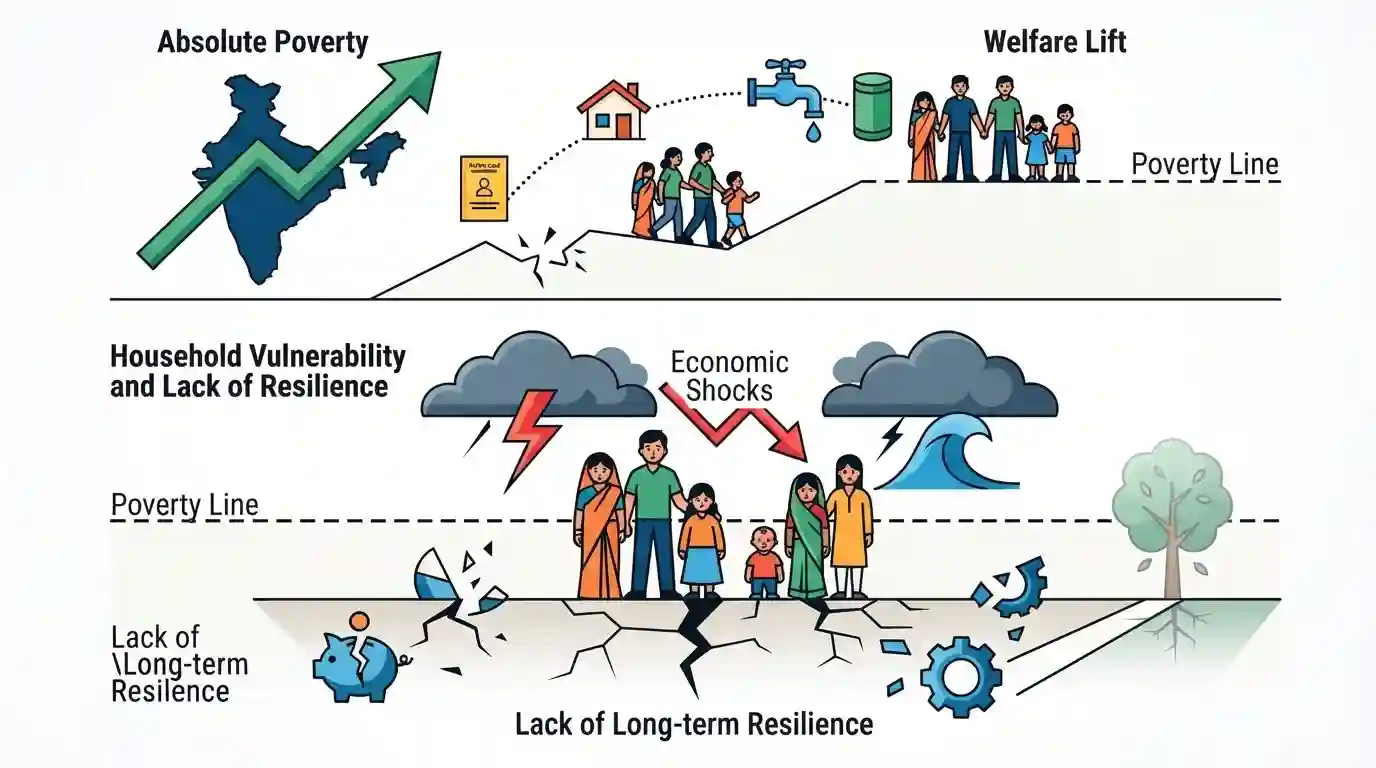
The article examines the gap between absolute poverty reduction and true household financial security in India, highlighting that while welfare measures have lifted millions above the poverty line, families remain highly vulnerable to economic shocks and lack long-term resilience.
Key Points
- India has made significant strides in reducing absolute poverty through welfare schemes and food security programmes.
- However, millions of households remain vulnerable to economic shocks due to a lack of genuine financial security and asset ownership.
- Poverty alleviation metrics often focus on bare minimum consumption thresholds rather than resilience against shocks like medical emergencies or job losses.
- Achieving sustainable inclusive growth requires moving beyond poverty reduction to build robust household financial resilience and social protection.
Prelims Trap
Reduction in absolute poverty guarantees long-term financial security and resilience against economic shocks for vulnerable households.
Aspirants often assume that crossing the official absolute poverty line implies household financial security, ignoring high vulnerability to sudden economic shocks like health emergencies.
Static Concepts Connected
What is the difference between absolute poverty and relative poverty?
- Relative Poverty: Measures poverty in relation to the economic status of other members of the society; measures inequality rather than bare minimum needs.
- Absolute Poverty: Defined as the inability to access a minimum standard of living, measured using a fixed baseline poverty line (e.g., calorie intake or consumption expenditure).
What are the key dimensions and indices used to measure Multidimensional Poverty in India?
- MPI Methodology: Calculated by NITI Aayog using the Alkire-Foster methodology across health, education, and standard of living dimensions.
- Core Indicators: Includes 12 indicators such as nutrition, child mortality, years of schooling, cooking fuel, sanitation, and bank accounts.
Cross-Topic Patterns
Poverty Reduction & Fiscal Federalism
Poverty alleviation relies heavily on direct benefit transfers and food security, which form a major fiscal component of the Centre's social sector expenditure.
Financial Resilience & Public Health Outlays
Household vulnerability to out-of-pocket health expenditures links financial security directly to the gaps in India's public healthcare infrastructure and Ayushman Bharat coverage.

UPSC loves distinguishing absolute poverty thresholds from multidimensional vulnerability; expect statement-based questions on household financial resilience.
Linked PYQs · 1
Linked PYQs · 1
- 2022MainsGS3
Is inclusive growth possible under market economy ? State the significance of financial inclusion in achieving economic growth in India.
