United States India Bilateral Trade Talks and Tariff Legislation Risks
Source:The Hindu ↗
આ શા માટે મહત્વનું છે
Highlights the complex tension between India's energy diplomacy (importing Russian oil) and its strategic/economic partnership with the U.S. It is highly relevant for GS-2 and GS-3 topics covering trade barriers, extraterritorial sanctions, and the maintenance of strategic autonomy in a multipolar world.
સારાંશ
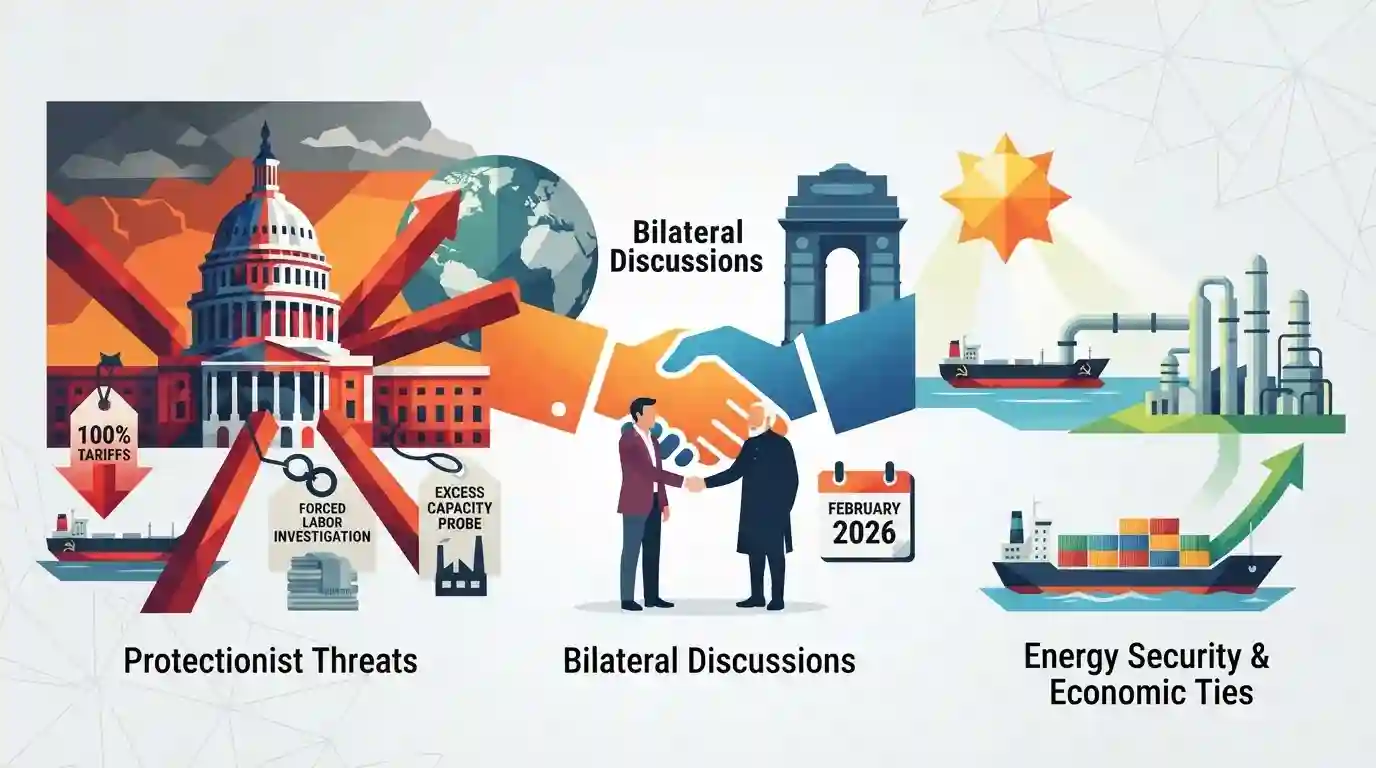
Recent U.S.-India trade discussions have provided reassurance to New Delhi despite looming protectionist threats from Washington. The U.S. Senate passed the Lindsey O. Graham Sanctioning Russia and Iran Act of 2026, proposing tariffs up to 100% on nations heavily importing Russian oil—directly impacting India. Additionally, existing U.S. tariffs related to forced labor investigations and potential excess capacity probes pose bilateral trade challenges. Nonetheless, Commerce Secretary Rajesh Agrawal affirmed that both nations remain committed to a February 2026 trade deal focused on preferential market access, underscoring efforts to balance India's energy security strategy with robust economic ties.
મુખ્ય મુદ્દા
- The U.S. Senate passed the Lindsey O. Graham Sanctioning Russia and Iran Act of 2026, threatening up to 100% tariffs on countries like India that heavily import Russian oil.
- India currently faces a 10% U.S. tariff on 55% of its exports following an investigation into forced labor, with another probe regarding excess capacity underway.
- Despite these protectionist measures, Indian officials report that recent bilateral trade talks have been "reassuring".
- Both countries remain committed to a February 2026 trade agreement aimed at providing reciprocal preferential market access.
મહત્વપૂર્ણ શબ્દો
Lindsey O. Graham Sanctioning Russia and Iran Act of 2026

A 2026 U.S. legislative bill proposing up to 100% tariffs on the major importers of Russian oil and gas, while extending sanctions on Iran, to defund Russia's war in Ukraine.
UPSC context
GS Paper 2 (IR). Tests understanding of extraterritorial sanctions, CAATSA-style pressures, and implications for India's strategic autonomy and energy security.
U.S.-India Trade Deal (2026)
A proposed bilateral economic framework aimed at reducing tariffs, ensuring preferential market access, and resolving U.S. Section 301 investigations into India's labor practices and alleged excess capacity.
UPSC context
GS Paper 2 & 3. Crucial for bilateral relations, export competitiveness, and navigating non-tariff barriers and protectionist trade policies.
U.S. Senate
The upper chamber of the U.S. Congress. In the context of U.S.-India relations, it wields significant power over foreign policy, recently passing the 2026 sanctions act threatening tariffs on India.
UPSC context
GS Paper 2 (IR). Relevant to how U.S. domestic legislative actions and sanctions directly impact India's geopolitical and economic interests.
પ્રિલિમ્સ ટ્રેપ
India's Foreign Trade Policy strictly avoids domestic import bans based on labor standards to preserve its WTO negotiating stance.
While India historically opposes linking labor standards to trade at the WTO, it pragmatically amended its own FTP (Paragraph 2.20B) to ban forced-labor imports to mitigate US trade retaliation.
સંલગ્ન સ્થિર ખ્યાલો
What is Section 301 of the US Trade Act of 1974?
- Unilateral Action: Unilateral trade tool authorizing the USTR to retaliate against foreign trade practices deemed unfair or discriminatory.
- Bypasses WTO: Allows the US to impose trade sanctions and tariffs without waiting for or relying on WTO dispute settlement mechanisms.
- Systemic Tension: Creates significant friction in bilateral relations, as target nations view it as a violation of multilateral trading norms.
How do Secondary Sanctions differ from Primary Sanctions?
- Primary Sanctions: Primary sanctions restrict US citizens and companies from trading with sanctioned targets (e.g., Russia, Iran).
- Extraterritorial Reach: Secondary sanctions target foreign third-parties (e.g., Indian firms) that engage in transactions with the primary target, threatening to cut them off from the US financial system.
- Strategic Impact: Directly tests India's 'strategic autonomy' by forcing a choice between national strategic interests (such as energy imports) and global financial integration.
આંતર-વિષય પેટર્ન
Energy Security vs Secondary Sanctions
How India balances energy imports from sanctioned nations (Russia/Iran) with high-value Western export markets amid rising secondary sanction threats.
Labor Standards as Trade Barriers
India's strategic shift to include labor standards (FTP Paragraph 2.20B) to bypass Western non-tariff barriers while opposing WTO labor linkages.

US secondary sanctions vs India's strategic autonomy (Russian oil) likely to be framed as a GS-2 Mains question on trade-security trade-offs.
સંલગ્ન PYQ · 2
સંલગ્ન PYQ · 2
- 2012MainsGS2
Discuss the likely negative impact of the protectionist measures proposed by the US on India's software industry.
- 2025MainsGS2
"Energy security constitutes the dominant kingpin of India's foreign policy, and is linked with India's overarching influence in Middle Eastern countries.” How would you integrate energy security with India's foreign policy trajectories in the coming years?
