AI Driven Breast Cancer Screening in Public Health
Source:Indian Express ↗
Why It Matters
Provides an excellent case study for GS2 (Public Health/Governance) and GS3 (Science & Tech) on how indigenous innovation and AI can address systemic healthcare shortages and shift the focus toward preventive care for non-communicable diseases.
Summary
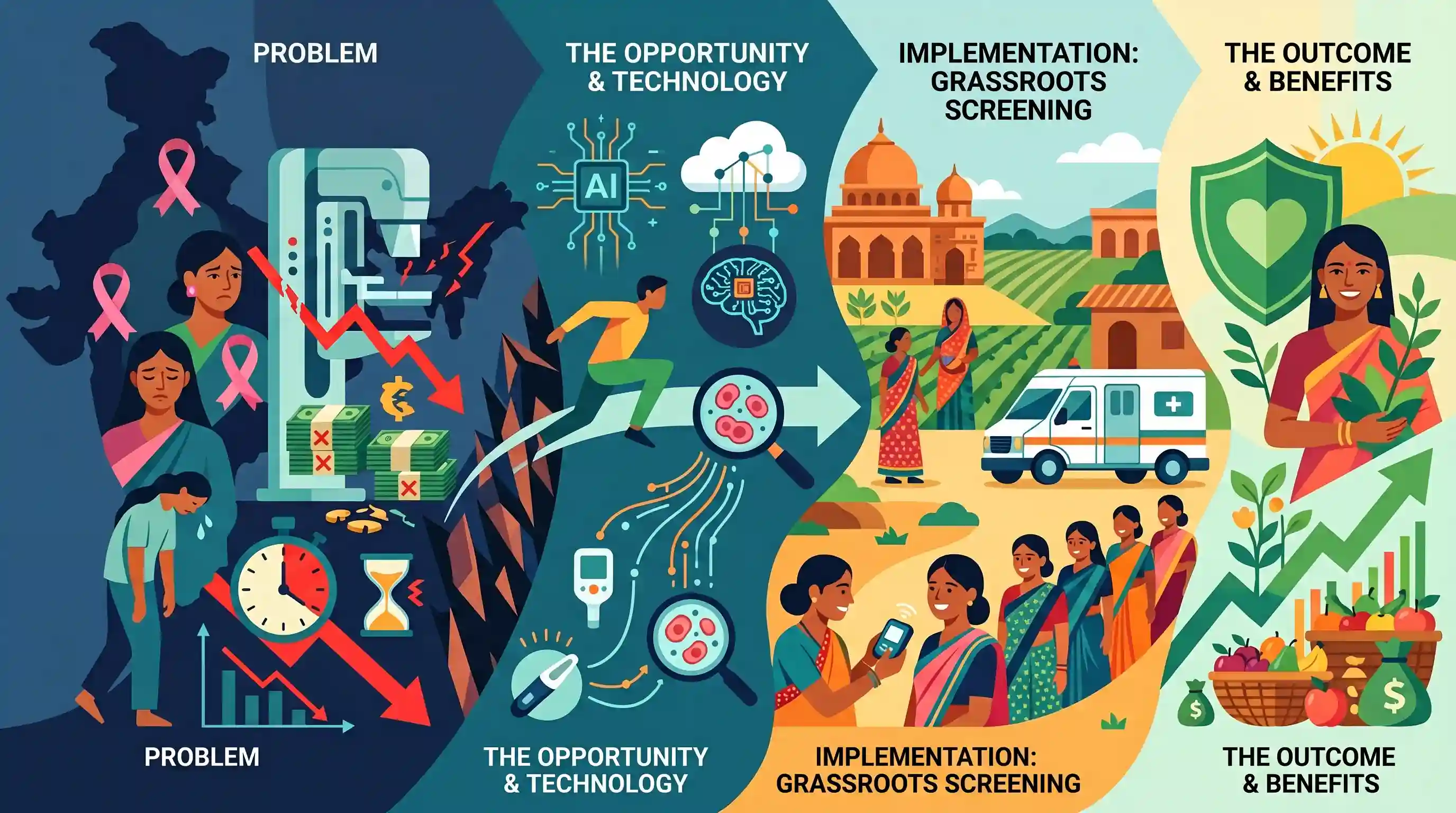
India faces a severe public health challenge with high mortality rates from breast cancer, primarily due to delayed diagnosis and a lack of accessible screening. While traditional mammography is hindered by cost and infrastructure deficits, the article highlights an opportunity to leapfrog these barriers using innovative, AI-driven diagnostic technologies. By deploying cost-effective, portable screening tools at the grassroots level, India can transform its approach from curative to preventive healthcare, improving survival rates and reducing the economic burden of non-communicable diseases.
Key Points
- Breast cancer is the leading cause of cancer-related mortality among Indian women, largely driven by late-stage detection due to poor screening coverage.
- Traditional screening infrastructure, such as mammography, is expensive, resource-intensive, and culturally sensitive, making it difficult to scale in rural and semi-urban India.
- India has a unique opportunity to leapfrog these infrastructural deficits by adopting indigenous, AI-powered screening technologies (like thermal imaging) that are portable, radiation-free, and cost-effective.
- Integrating advanced, decentralized screening tools into primary health centers can successfully shift the national health focus from curative treatments to preventive care.
Important Terms
Ayushman Bharat

India's flagship health initiative launched in 2018 to achieve Universal Health Coverage. It features two pillars: Ayushman Arogya Mandirs for primary care and PM-JAY for secondary/tertiary insurance coverage.
UPSC context
GS Paper II (Social Justice/Health). Vital for questions on public health policy and India's progress toward SDG 3.
National Programme for Prevention and Control of Non-Communicable Diseases (NP-NCD)
A rebranded national initiative (formerly NPCDCS) focusing on the screening, early diagnosis, and management of cancers, diabetes, and cardiovascular diseases through infrastructure strengthening and behavioral change.
UPSC context
GS Paper II (Health). Relevant for addressing the epidemiological transition and rising chronic disease burden in India.
Ayushman Arogya Mandir
The rebranded name for Ayushman Bharat Health and Wellness Centres (AB-HWCs); these frontline facilities provide comprehensive primary healthcare, including screenings for common cancers and NCDs.
UPSC context
GS Paper II (Governance). Represents the shift from curative to preventive healthcare at the community level.
Accredited Social Health Activist (ASHA)
Trained community health volunteers who bridge the gap between rural populations and the formal health system, now increasingly trained for NCD risk assessment and screening mobilization.
UPSC context
GS Paper II (Governance). Evaluates the role of human resources in last-mile health delivery and community health management.
Non-Communicable Diseases (NCDs)
Chronic, non-infectious conditions such as cancer, diabetes, and heart disease that contribute to over 60% of deaths in India, primarily driven by lifestyle and environmental factors.
UPSC context
GS Paper III (S&T/Health). Important for discussing the economic impact of disease on national productivity and demographic dividend.
Universal Health Coverage (UHC)
A global goal (SDG 3.8) ensuring that all people have access to necessary health services without suffering financial hardship; the core vision of India’s National Health Policy 2017.
UPSC context
GS Paper II & III. A recurring theme in discussions on social security, equity, and sustainable development.
Ministry of Health and Family Welfare (MoHFW)
The apex administrative body responsible for national health policies, the National Health Mission (NHM), and coordinating with states to implement public health programs.
UPSC context
GS Paper II (Governance). Fundamental for understanding the institutional framework and administrative leadership in India's health sector.
Prelims Trap
"AI-based thermal imaging for cancer screening utilizes low-dose ionizing radiation."
Thermal imaging is strictly non-invasive and radiation-free, distinguishing it from traditional mammography (which relies on X-rays/radiation), making it safer for frequent screening.
Static Concepts Connected
What is the National Programme for Prevention and Control of Non-Communicable Diseases (NP-NCD)?
- Core target diseases: Focuses on Cardiovascular Diseases (CVDs), Cancer, Diabetes, and Chronic Respiratory Diseases (CRDs).
- Screening integration: Aims to provide opportunistic and population-based screening for common NCDs at the primary healthcare level via Ayushman Arogya Mandirs (HWCs).
- Preventive shift: Focuses on health promotion, early diagnosis, management, and referral to higher facilities for complicated NCD cases.
What is the role of ASHA workers in NCD management?
- Risk assessment: Filling Community Based Assessment Checklists (CBAC) to assess NCD risk factors at the household level.
- Task-shifting: Equipping frontline workers with simple or AI-assisted diagnostic tools helps bypass the shortage of specialized doctors (radiologists/oncologists) at primary centers.
- Community mobilization: Mobilizing the community for regular screening of hypertension, diabetes, and common cancers (oral, breast, cervical).
Cross-Topic Patterns
Indigenous Deep Tech + Rural Health
Deployment of Indian AI-thermal imaging tools highlights the GS-3 theme of 'indigenization of technology' to bypass expensive, imported medical infrastructure.
NCD Burden + Women's Economic Output
High mortality from late-stage female NCDs severely impacts the care economy and women's labor force participation, bridging GS-2 Health with GS-3 Economy.

Expect a multi-statement prelims question combining Ayushman Bharat NCD screening targets with the application of AI diagnostics.
Linked PYQs · 3
Linked PYQs · 3
- 2023MainsGS3
Introduce the concept of Artificial Intelligence (AI). How does Al help clinical diagnosis? Do you perceive any threat to privacy of the individual in the use of Al in healthcare?
- 2023PrelimsGS1
Consider the following statements: Statement-I: India's public sector health care system largely focuses on curative care with limited preventive, promotive and rehabilitative care. Statement-II: Under India's decentralized approach to health care delivery, the States are primarily responsible for organizing health services. Which one of the following is correct in respect of the above statements?
- 2020MainsGS2
In order to enhance the prospects of social development, sound and adequate health care policies are needed particularly in the fields of geriatric and maternal health care. Discuss.
