Anusandhan NRF Aims to Bridge India Research and Development Deficit
Source:Indian Express ↗
ఇది ఎందుకు ముఖ్యం
The structural design and mandate of the Anusandhan National Research Foundation (ANRF) directly address the persistently low GDP-to-R&D ratio in India, which is a core theme in the GS3 Science & Technology syllabus. Furthermore, the push towards developing indigenous critical tech capabilities is essential for discussions on national security, industrial policy, and global competitiveness.
సారాంశం
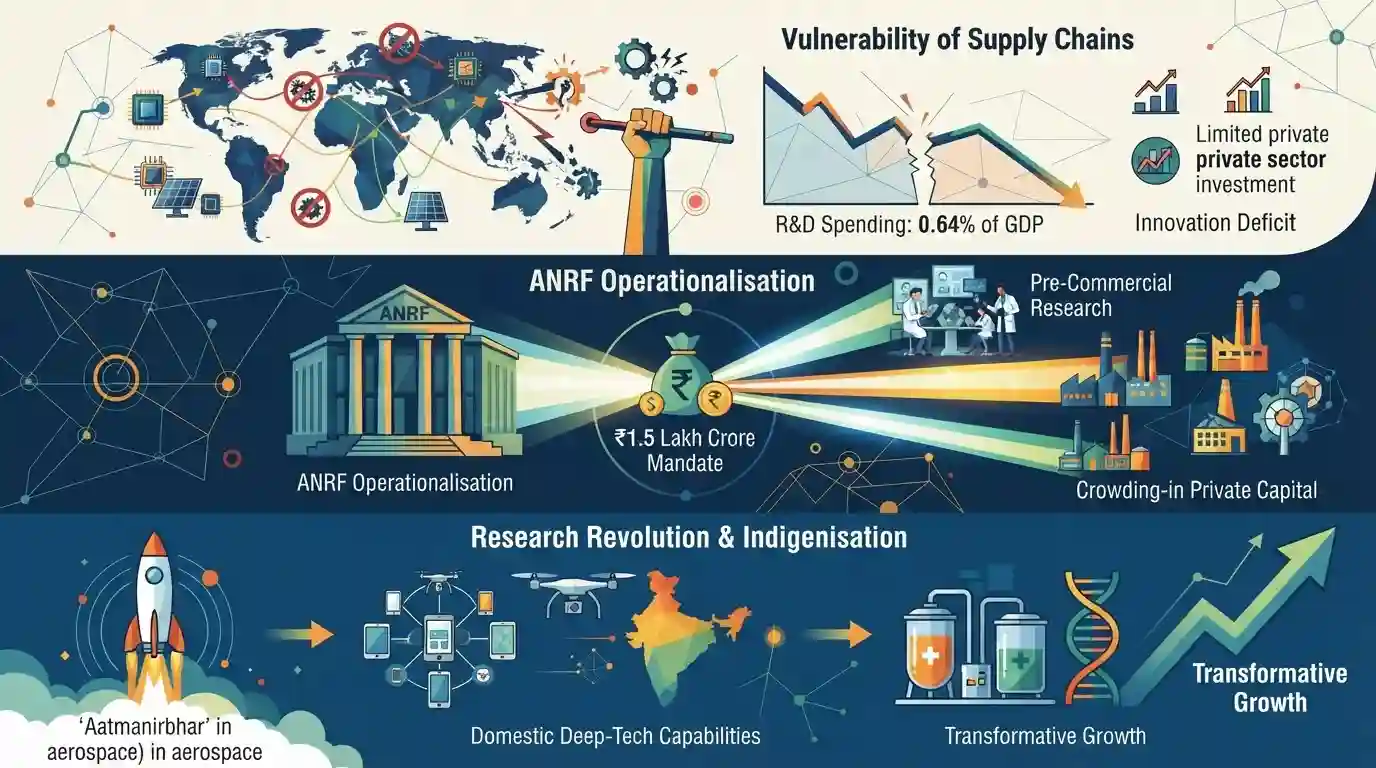
The article argues that building domestic technological sovereignty is essential for national resilience in a geopolitical climate where global supply chains are routinely weaponised as policy levers. To bridge a severe innovation deficit—where India’s R&D spending lags at just 0.64% of GDP with low private sector participation—the Anusandhan National Research Foundation (ANRF) has been operationalised. Endowed with a ₹1.5 lakh crore mandate designed specifically to crowd-in private capital and fund critical pre-commercial research, the ANRF aims to act as a catalyst. The authors call on Indian industry to institutionalise deep-tech capabilities and spearhead a research revolution, much like the historic transformation of India's pharmaceutical sector following the WTO TRIPS regime.
ముఖ్య అంశాలు
- Geopolitical disruptions, such as the Strait of Hormuz shutdown, highlight the weaponisation of supply chains and the urgent need for nations to build 'indispensability' through technological sovereignty.
- India's gross R&D expenditure is stagnant at 0.64% of GDP with the private sector contributing barely two-fifths, whereas in countries like China and the US, private enterprises fund 75% or more of R&D.
- The Anusandhan National Research Foundation (ANRF) was established as a statutory body (chaired by the Prime Minister) to provide ₹1.5 lakh crore in catalytic capital to reverse this trend.
- ANRF functions as a fund-of-funds, allocating ₹1 lakh crore for an Innovation Fund aimed at the private sector, and ₹50,000 crore for core, basic science research.
- The foundation models itself to crowd-in private capital (expecting a 5-10x multiplier on public investment) by partnering with start-ups, GCCs, and leveraging CSR funds.
- The authors urge Indian industry to build institutional capacity for critical pre-commercial research, likening this inflection point to the transformation of the Indian pharma sector after the WTO TRIPS patent regime.
ముఖ్యమైన పదాలు
Anusandhan National Research Foundation (ANRF)

A statutory apex body established to catalyze and fund India's R&D ecosystem. It aims to bridge the innovation gap by channeling private capital into deep-tech, pre-commercial research, and institutionalizing domestic technological capabilities.
UPSC context
GS Paper 3 (Science & Technology). Essential for analyzing India's strategies to boost its low R&D spending and achieve technological sovereignty.
Trade-Related Aspects of Intellectual Property Rights (TRIPS)
A foundational WTO agreement setting minimum international standards for intellectual property protection. It mandates product patents, impacting pharmaceutical manufacturing, while providing flexibilities like compulsory licensing for public health emergencies.
UPSC context
GS Paper 3 (Intellectual Property Rights). Key to understanding India's transition to a product patent regime and its generic drug industry.
Global Capability Centers (GCCs)
Enterprise-owned offshore facilities established by multinational companies to handle specialized operations. In India, GCCs have evolved from basic back-office cost centers into strategic R&D, artificial intelligence, and core innovation hubs.
UPSC context
GS Paper 3 (Indian Economy). Relevant to India's shifting position in global value chains, high-skill employment, and foreign direct investment in tech.
World Trade Organization (WTO)
The principal international organization regulating global trade. It provides a framework for negotiating trade agreements, resolving disputes, and enforcing multilateral rules to ensure predictable, smooth, and fair international commerce.
UPSC context
GS Paper 2 & 3 (International Relations, Economy). Crucial for topics on multilateral trade negotiations, economic sovereignty, and weaponization of supply chains.
ప్రిలిమ్స్ ఉచ్చు
"The private sector contributes the majority of India's Gross Expenditure on R&D (GERD)."
Aspirants often assume India's IT boom translates to high private R&D. In reality, India's R&D is structurally inverted: government funds ~60%, while private sector lags at ~36-40%.
అనుసంధానమైన స్థిర భావనలు
What are the key statutory features of the ANRF Act, 2023?
- Statutory replacement: Established as a statutory body, dissolving and subsuming the older Science and Engineering Research Board (SERB, 2008).
- Apex leadership: The Prime Minister of India serves as the ex-officio President of the ANRF Governing Board.
- Catalytic funding: Operates a dual-fund model: ₹1 lakh crore for an Innovation Fund targeting private capital, and ₹50,000 crore for core basic science.
How did the WTO TRIPS agreement alter India's patent regime and pharma R&D?
- Pre-TRIPS era: The 1970 Patent Act only allowed process patents, enabling Indian firms to reverse-engineer drugs and build a massive generic manufacturing base.
- Post-TRIPS transition: Under WTO obligations (fully implemented in 2005), India transitioned to product patents, forcing domestic pharmaceutical companies to heavily institutionalize their own R&D.
అంతర-అంశ నమూనాలు
Tech Sovereignty & Supply Chain Resilience
The weaponisation of chokepoints links R&D indigenisation directly to IR initiatives like the Supply Chain Resilience Initiative (SCRI) and Quad critical tech frameworks.
GCCs as R&D multipliers
Global Capability Centres (GCCs) in India are evolving from back-office support to core R&D hubs, representing a crucial lever for crowding-in private capital under the new ANRF mandate.

Expect a multi-statement Prelims question comparing ANRF's statutory structure (PM as head) with the structural inversion of India's GERD.
అనుసంధాన PYQలు · 3
అనుసంధాన PYQలు · 3
- 2015PrelimsGS1
Which of the following statements is/are correct regarding National Innovation Foundation-India (NIF)? 1. NIF is an autonomous body of the Department of Science and Technology under the Central Government. 2. NIF is an initiative to strengthen the highly advanced scientific research in India's premier scientific institutions in collaboration with highly advanced foreign scientific institutions. Select the correct answer using the code given below.
- 2026PrelimsGS1
Which of the following statements with regard to the National Quantum Mission (NQM) is/are correct? 1. It aims at developing intermediate-scale quantum computers with 50-1000 physical qubits. 2. Its implementation includes setting up of four Thematic Hubs (T-Hubs) in academic and national R&D institutes across India. Select the answer using the code given below :
- 2025MainsGS3
India aims to become a semiconductor manufacturing hub. What are the challenges faced by the semiconductor industry in India? Mention the salient features of the India Semiconductor Mission.
