Global Value Chain Integration via Bilateral Free Trade Pacts
Source:Indian Express ↗
Why It Matters
Understanding trade pacts with major economies is vital for UPSC aspirants, as it connects bilateral diplomacy (GS2) with economic outcomes like export growth, manufacturing integration, and supply chain resilience (GS3) amidst a shifting global world order.
Summary
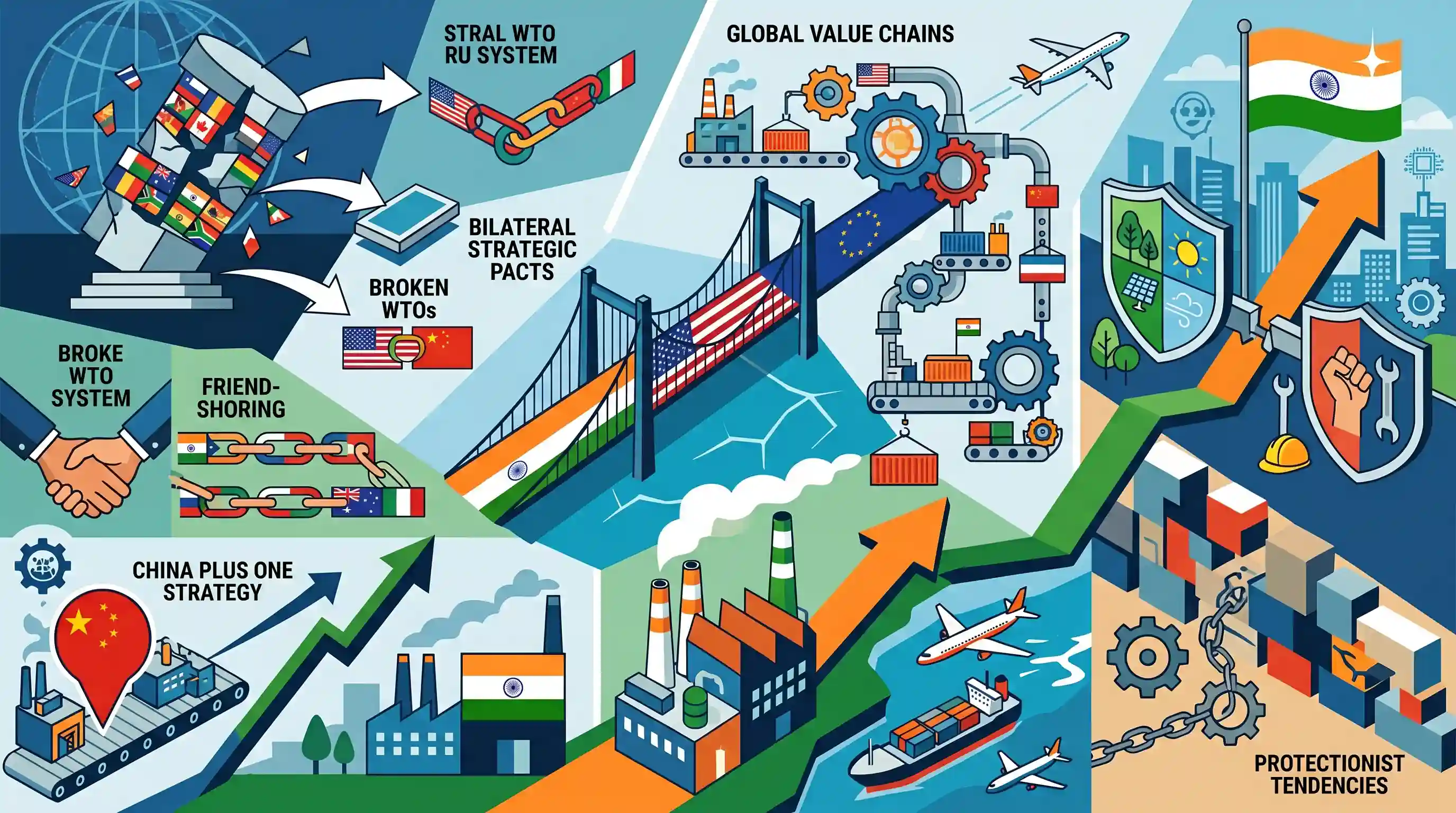
The article analyzes the strategic opportunities arising from India's renewed trade agreements and economic frameworks with the European Union and the United States. Driven by the global shift towards friend-shoring and the "China Plus One" strategy, these partnerships offer India a vital pathway to integrate deeper into Global Value Chains (GVCs) and boost its domestic manufacturing and export sectors. As the global trading system fragments away from WTO-led multilateralism towards bilateral strategic pacts, India stands to gain significantly. However, maximizing this potential will require India to overcome historical protectionist tendencies and adapt to modern non-tariff barriers, such as new environmental and labor standards imposed by Western economies.
Key Points
- Strategic trade engagements with the EU and the US present India with a unique window to capitalize on friend-shoring and the global 'China Plus One' diversification strategy.
- These trade pacts are crucial for integrating India's manufacturing sector into Global Value Chains (GVCs), thereby boosting labor-intensive exports and economic growth.
- The agreements underscore a structural shift in international trade from multilateralism to strategic bilateralism, requiring India to remain agile.
- To fully exploit these opportunities, India must proactively navigate emerging non-tariff barriers, including stringent Western environmental standards (such as the EU's Carbon Border Adjustment Mechanism) and labor regulations.
Important Terms
Free Trade Agreements (FTAs)

Formal treaties between countries to reduce or eliminate tariffs and non-tariff barriers on goods and services, promoting cross-border trade and economic integration.
UPSC context
GS Paper II/III: Tests understanding of trade diplomacy and balancing domestic industry protection with global market access.
Trade and Technology Council (TTC)
A high-level strategic platform between India and the EU launched in 2023 to coordinate on trade, critical technologies, and security challenges.
UPSC context
GS Paper II: Vital for India-EU bilateral relations and cooperation in emerging tech like semiconductors and AI.
Indo-Pacific Economic Framework (IPEF)
A US-led regional economic initiative launched in 2022 focusing on supply chain resilience, clean energy, and fair trade across the Indo-Pacific region.
UPSC context
GS Paper II/III: Important for Indo-Pacific geopolitics and India's role in alternative global economic architectures.
World Trade Organization (WTO)
The only global international organization dealing with trade rules between nations, aiming for smooth, predictable, and free global trade flows.
UPSC context
GS Paper II/III: Focuses on the crisis in multilateralism, dispute settlement, and trade issues affecting developing nations.
China Plus One Strategy
A global business strategy where companies diversify supply chains by establishing manufacturing operations in countries other than China to reduce over-reliance.
UPSC context
GS Paper III: Relevant for India’s industrial policy, FDI attraction, and the "Make in India" initiative.
Global Value Chains (GVCs)
The international fragmentation of production where different stages—like design, assembly, and marketing—are carried out across multiple countries.
UPSC context
GS Paper III: Critical for analyzing India's manufacturing competitiveness and its integration into the global economy.
Friend-shoring
A trade strategy where supply chains are relocated to values-aligned or politically stable countries to minimize geopolitical risks.
UPSC context
GS Paper II/III: Tests knowledge of shifting trade paradigms and India’s positioning as a reliable strategic partner.
Prelims Trap
"The Indo-Pacific Economic Framework (IPEF) is a comprehensive Free Trade Agreement that includes market access and tariff reductions."
IPEF is an economic framework, not a traditional FTA. It explicitly excludes market access and tariff reduction provisions, focusing instead on supply chains, clean energy, and fair trade.
Static Concepts Connected
What are Non-Tariff Barriers (NTBs) in contemporary global trade?
- Definition: Trade restrictions not involving customs duties, including import quotas, embargoes, sanctions, and complex licensing regimes.
- WTO Framework: Traditional NTBs are often regulated under the WTO's SPS (Sanitary and Phytosanitary) and TBT (Technical Barriers to Trade) agreements.
- Emerging Forms: Developed nations are increasingly using environmental compliance (e.g., carbon taxes) and strict labor laws as de facto NTBs.
How does 'Friend-shoring' differ from 'Near-shoring'?
- Friend-shoring: Relocating global supply chains to countries with shared political and strategic values to minimize geopolitical and security risks (e.g., China Plus One).
- Near-shoring: Moving production geographically closer to the final consumer market to reduce transport costs and transit time, regardless of deep political alliances.
Cross-Topic Patterns
Climate policies as Trade Barriers
The EU's CBAM bridges GS-3 Environment and Economy, showing how domestic climate goals (like carbon pricing) can transform into international non-tariff barriers that threaten exports from developing nations.
Shift from WTO to strategic mini-laterals
The structural decay of the WTO's dispute mechanism is accelerating the shift toward strategic pacts and mini-laterals like the US-India TTC, fundamentally blending geopolitics with international trade.

Expect a 2026 Prelims statement differentiating traditional FTAs (tariff cuts) from IPEF's non-tariff pillars and EU's CBAM requirements.
Linked PYQs · 3
Linked PYQs · 3
- 2025MainsGS3
What are the challenges before the Indian economy when the world is moving away from free trade and multilateralism to protectionism and bilateralism? How can these challenges be met?
- 2023MainsGS2
‘The expansion and strengthening of NATO and a stronger US-Europe strategic partnership works well for India.’ What is your opinion about this statement ? Give reasons and examples to support your answer.
- 2017MainsGS3
Account for the failure of manufacturing sector in achieving the goal of labour-intensive exports. Suggest measures for more labour-intensive rather than capital-intensive exports.
