India eases tax rules for foreign firms supplying equipment
Source:Indian Express ↗
Why It Matters
Demonstrates how targeted tax reforms (like removing Permanent Establishment risks) can overcome structural bottlenecks in technology transfer and capital deployment, which is crucial for the success of domestic manufacturing initiatives and export-led growth.
Summary
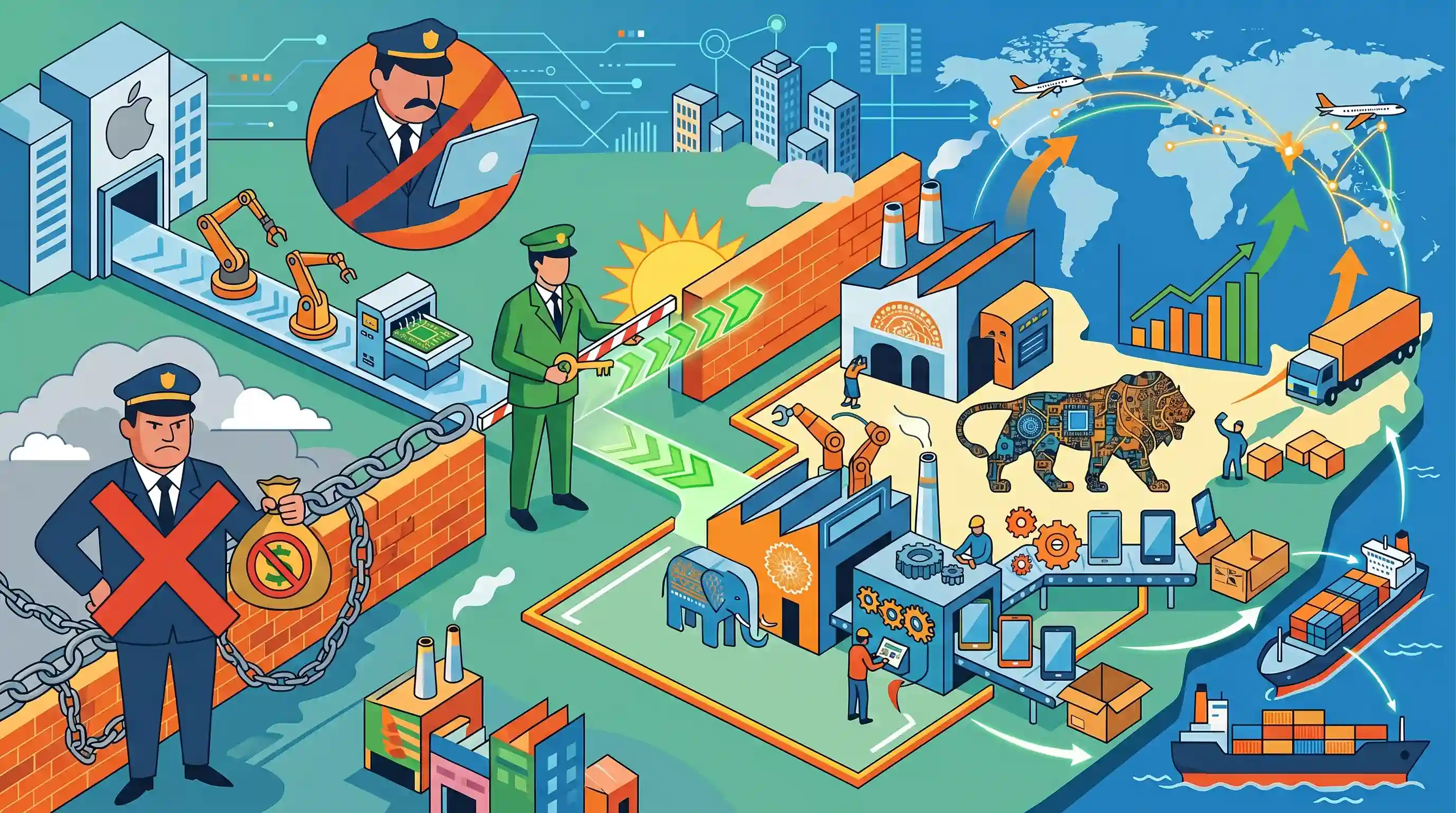
In a significant policy move to boost domestic electronics manufacturing, India has eased its income tax rules to allow foreign companies like Apple to provide capital equipment to their Indian contract manufacturers without facing 'business connection' tax risks. Previously, foreign firms supplying machinery could be classified as having a Permanent Establishment (PE) in India, subjecting them to domestic taxes. By waiving this risk in customs-bonded areas, the government aims to facilitate the transfer of high-end manufacturing technology and capital. This tax clarity reduces the cost of doing business, encourages deeper integration into global supply chains, and strengthens India's position as an export-driven alternative to China in the electronics sector.
Key Points
- India has amended tax regulations to allow foreign companies to provide manufacturing equipment to their Indian contract partners without triggering domestic income tax liabilities.
- The exemption waives the 'business connection' or Permanent Establishment (PE) tax risk for foreign entities supplying capital goods in customs-bonded areas.
- This regulatory relaxation specifically benefits global electronics leaders like Apple, enabling them to upgrade the capabilities of local manufacturers like Foxconn and Tata without adverse tax consequences.
- The policy aims to deepen India's integration into global supply chains, moving the country from basic assembly to high-value electronics manufacturing and boosting export competitiveness.
Important Terms
Business Connection

A concept under Section 9 of the Income Tax Act, 1961, where income is 'deemed to accrue or arise in India' through domestic activities or relationships, subjecting non-residents to Indian taxation.
UPSC context
GS-III (Economy): Relevant for international taxation, ease of doing business, and legal frameworks governing foreign investments in India.
Permanent Establishment (PE)
A fixed place of business (office, factory, or site) in India through which a foreign entity operates. Having a PE allows India to tax the entity's profits attributable to Indian operations.
UPSC context
GS-III (Economy): Key concept in Double Taxation Avoidance Agreements (DTAA) and Base Erosion and Profit Shifting (BEPS) discussions.
Production Linked Incentive (PLI) Scheme
A flagship government scheme offering financial incentives (4-6%) on incremental sales of goods manufactured in India to boost domestic production and attract global supply chains.
UPSC context
GS-III (Economy/Manufacturing): A critical pillar of 'Atmanirbhar Bharat' and 'Make in India' for sectors like electronics and semiconductors.
Customs-Bonded Area
A secured area where imported goods are stored and processed without immediate payment of customs duty until they are removed for domestic sale; often used for export-oriented manufacturing.
UPSC context
GS-III (Economy/Investment): Important for understanding the MOOWR scheme and trade facilitation measures to reduce the cost of capital for exporters.
Income Tax Act, 1961
The primary legislation governing direct taxes in India, including the assessment of non-resident income deemed to arise from Indian sources under Section 9.
UPSC context
GS-III (Economy): The statutory basis for India's direct tax regime, fiscal policy, and international tax compliance.
Contract Manufacturer (EMS)
Companies (like Foxconn or Tata) that manufacture goods for other brands (like Apple). They provide the manufacturing infrastructure while the parent brand provides design and technology.
UPSC context
GS-III (Economy/Industry): Vital for understanding global value chains (GVCs) and India's potential as a 'Global Factory' alternative to China.
Prelims Trap
Foreign firms supplying equipment to Indian manufacturers are now entirely exempt from domestic income tax under the PLI scheme.
The policy waives the 'business connection' (PE) tax risk strictly for capital goods supplied in customs-bonded areas. It is not a blanket income tax exemption, nor is it a feature of the PLI scheme.
Static Concepts Connected
What differentiates Business Connection from Permanent Establishment (PE) in taxation?
- Business Connection: A broad term under the Income Tax Act denoting an intimate relation between a non-resident's trading activity and India, triggering domestic tax liability.
- Permanent Establishment: A narrower concept under Double Taxation Avoidance Agreements (DTAAs) requiring a fixed place of business. DTAA provisions supersede domestic laws if they are more beneficial to the taxpayer.
- Tax Implication: If a foreign firm triggers a PE or business connection, the business profits directly attributable to its Indian presence become taxable in India.
How does the MOOWR scheme promote export-oriented manufacturing in India?
- Duty Deferment: Allows import of raw materials and capital goods into customs-bonded warehouses without the upfront payment of customs duties.
- Export Waiver: Deferred import duties are completely waived if the final manufactured goods are exported out of the country.
- Domestic Sales: If the finished goods are cleared for the domestic market (DTA), applicable import duties must be paid at the time of clearance.
Cross-Topic Patterns
China Plus One meets domestic tax policy
Tweaking core domestic tax concepts like 'Business Connection' is increasingly used as a geopolitical tool to anchor global supply chains (China Plus One) moving to India.
Shift from SEZs to Customs-Bonded Manufacturing
With the WTO-mandated phase-out of direct export subsidies in SEZs, schemes like MOOWR and targeted PE-risk waivers have become India's WTO-compliant engines for export promotion.

Expect a Prelims question differentiating 'Permanent Establishment' under DTAA vs 'Business Connection' under domestic IT laws in 2026.
Linked PYQs · 5
Linked PYQs · 5
- 2025MainsGS3
Discuss the rationale of the Production Linked Incentive (PLI) scheme. What are its achievements? In what way can the functioning and outcomes of the scheme be improved?
- 2016MainsGS3
Justify the need for FDI for the development of the Indian economy. Why there is gap between MOUs signed and actual FDIs? Suggest remedial steps to be taken for increasing actual FDIs in India.
- 2023PrelimsGS1
Consider the following statements: Statement-I: India accounts for 3.2% of global export of goods. Statement-II: Many local companies and some foreign companies operating in India have taken advantage of India's 'Production-linked Incentive' scheme. Which one of the following is correct in respect of the above statements?
- 2022PrelimsGS1
Which one of the following situations best reflects "Indirect Transfers" often talked about in media recently with reference to India?
- 2020PrelimsGS1
With reference to Foreign Direct Investment in India, which one of the following is considered its major characteristic?
