Tax Exemptions for Foreign Equipment in Electronics Manufacturing
Source:The Hindu ↗
Why It Matters
This article highlights the critical intersection of taxation policy and industrial growth. Understanding concepts like 'business connection' (Permanent Establishment) is important for international taxation topics. It also illustrates how fiscal incentives are actively deployed by the government to achieve macroeconomic goals like export promotion, supply chain relocation (China+1), and transforming India into a global manufacturing hub.
Summary
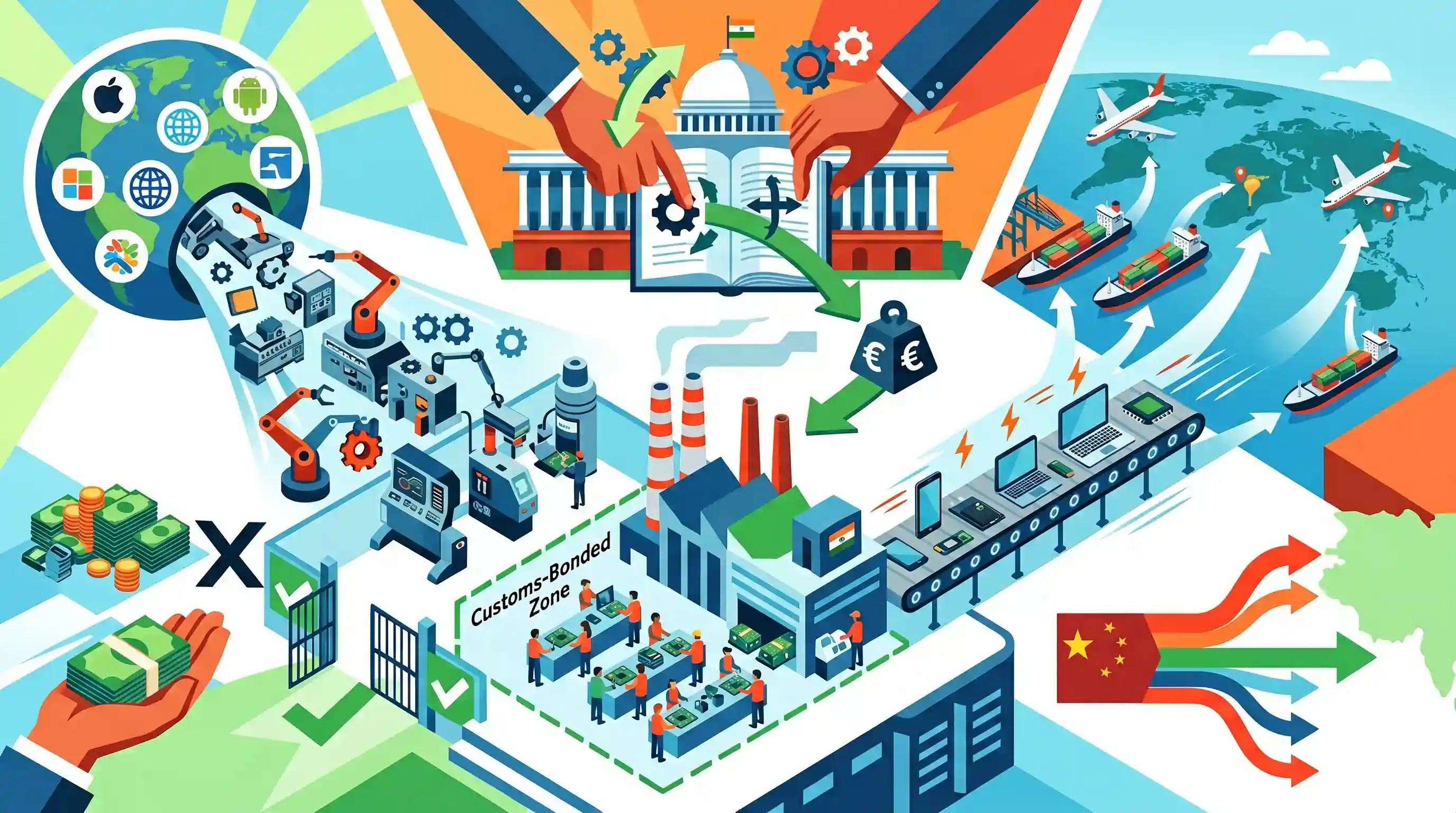
The Indian government has revised its tax laws to exempt foreign companies, such as Apple, from paying income tax on the manufacturing equipment they provide to their contract manufacturers (like Foxconn and Tata Group) in India. Valid for five years, this exemption applies to factories in customs-bonded zones focused on exports. It fundamentally clarifies that supplying machinery does not constitute a "business connection" under Indian tax law, thus preventing the taxation of profits generated from global sales of products assembled in India. This strategic fiscal adjustment is designed to accelerate electronics manufacturing, enhance export potential, and capitalize on the 'China+1' strategy by making India a more attractive destination for global supply chains.
Key Points
- The Indian government has exempted foreign companies from income tax on manufacturing equipment supplied to their Indian contract manufacturers.
- The exemption ensures that supplying machinery does not create a 'business connection' or Permanent Establishment, protecting foreign firms from being taxed on global product sales profits in India.
- This rule change is specifically applicable to factories operating within customs-bonded areas, which are largely dedicated to export manufacturing.
- The tax exemption is temporary and will be valid for a period of five years.
- This policy is a strategic move to boost domestic electronics manufacturing, encourage global tech giants like Apple to shift supply chains away from China, and enhance India's export capabilities.
Important Terms
Business Connection

A legal concept under Section 9 of the Income Tax Act where a non-resident's income is taxable in India if it arises through activities or assets within the country.
UPSC context
GS3 (Economy/Taxation). Tests understanding of tax jurisdiction, Permanent Establishment (PE) rules, and Ease of Doing Business reforms.
China Plus One Strategy
A global business strategy where multinational corporations diversify their supply chains by establishing manufacturing bases in countries other than China to reduce geopolitical and operational risks.
UPSC context
GS2 (International Relations) & GS3 (Economy). Relevant for discussions on global value chains and India's competitive advantage.
Make in India
A 2014 flagship initiative aiming to transform India into a global manufacturing hub by facilitating investment, fostering innovation, and building world-class infrastructure.
UPSC context
GS3 (Industrial Policy). Essential for questions on manufacturing growth, job creation, and FDI trends.
MOOWR Scheme
A scheme under the Customs Act allowing manufacturing in bonded warehouses with deferred duty on imported inputs and capital goods, waived if the final product is exported.
UPSC context
GS3 (Economy). Focuses on export promotion, working capital management for industries, and trade facilitation.
Production Linked Incentive (PLI) Scheme
A flagship performance-linked scheme providing financial incentives to companies based on incremental sales of products manufactured in domestic units across 14 key sectors.
UPSC context
GS3 (Economic Development). Central to discussions on self-reliance (Atmanirbhar Bharat) and electronics manufacturing.
Income Tax Act, 1961
The comprehensive statute that governs the levy, administration, collection, and recovery of income tax in India since its enactment in 1961.
UPSC context
GS3 (Budgeting/Taxation). The fundamental legal framework for direct tax reforms and corporate tax policy.
Prelims Trap
Providing manufacturing machinery to Indian firms automatically establishes a Permanent Establishment.
The new rule explicitly clarifies that supplying machinery does NOT constitute a 'business connection' or PE, shielding foreign firms from being taxed on global sales.
Static Concepts Connected
What is a "Permanent Establishment" (PE) in international taxation?
- Fixed business place: A physical or operational presence in a host country through which a foreign enterprise's business is wholly or partly conducted.
- Tax implications: Host countries gain the sovereign right to levy corporate tax on the business income directly attributable to that specific PE.
- DTAA regulation: Bilateral Double Taxation Avoidance Agreements (DTAAs) strictly define what constitutes a PE to prevent double taxation and provide certainty.
How do Customs-Bonded manufacturing schemes function in India?
- Duty deferment: Manufacturers can import raw materials and capital goods into designated zones without paying upfront customs duties.
- Export waiver: If the final manufactured goods are exported, the deferred customs duties on the imported inputs are entirely waived.
- Domestic clearance: If the finished products are cleared for sale within the domestic market, the applicable import duties must be paid.
Cross-Topic Patterns
Tax leniency as industrial policy
By narrowing the Permanent Establishment definition, India willingly cedes short-term tax revenue to attract global OEMs, leveraging fiscal policy to achieve Make in India and China+1 supply chain goals.
PLI and contract manufacturing synergy
This tax exemption directly supports the PLI scheme, allowing global brands to fund heavy capital expenditure for Indian assemblers (like Foxconn) without triggering adverse corporate tax liabilities.

Expect a 2026 Prelims statement testing if 'Permanent Establishment' applies to foreign OEMs supplying capital goods to domestic assemblers.
Linked PYQs · 3
Linked PYQs · 3
- 2022PrelimsGS1
Which one of the following situations best reflects "Indirect Transfers" often talked about in media recently with reference to India?
- 2020PrelimsGS1
With reference to Foreign Direct Investment in India, which one of the following is considered its major characteristic?
- 2025MainsGS3
India aims to become a semiconductor manufacturing hub. What are the challenges faced by the semiconductor industry in India? Mention the salient features of the India Semiconductor Mission.
