India and Gulf Cooperation Council Advance Free Trade Agreement Talks
Source:The Hindu ↗
हे का महत्त्वाचे आहे
The article is highly relevant for GS2 (International Relations) and GS3 (Economy/Energy). It underlines the strategic and economic imperatives of India's 'Look West' policy, highlighting trade diversification, energy security, and the geopolitical complexities of negotiating FTAs with crucial regional blocs like the GCC amid Middle Eastern conflicts.
सारांश
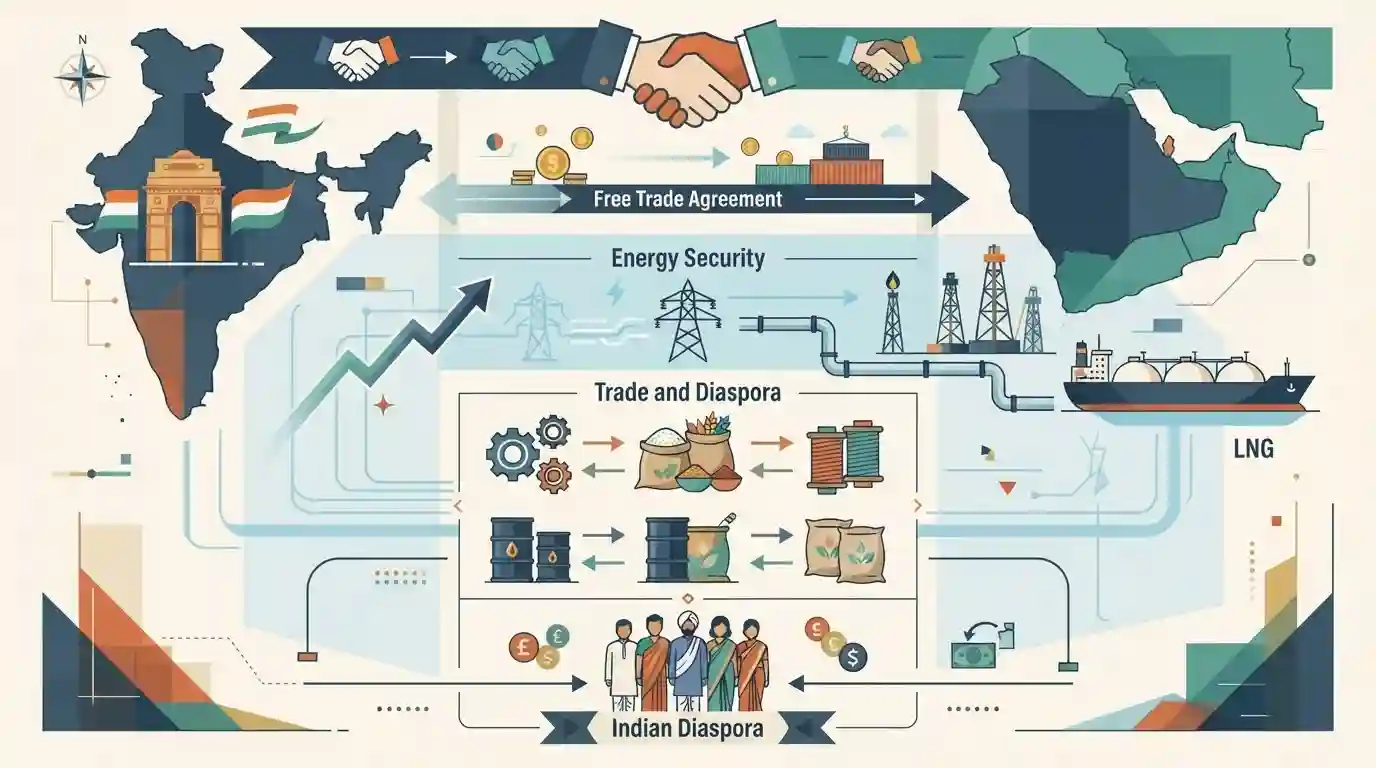
Talks between India and the Gulf Cooperation Council (GCC) regarding a Free Trade Agreement (FTA) are regaining momentum following a meeting between India's Ambassador to Saudi Arabia and the GCC Secretary General in Riyadh. The GCC, comprising six West Asian nations, is India's largest trading partner bloc, contributing significantly to India's energy security through crude oil and LNG exports. Despite previous delays caused by the West Asia crisis, both sides are keen to finalize the FTA to boost trade in engineering goods, agriculture, and textiles. The negotiations are also highly significant given the presence of nearly 10 million Indians in the region, a major driver of remittances.
मुख्य मुद्दे
- India and the Gulf Cooperation Council (GCC) are reviewing and advancing negotiations on a Free Trade Agreement (FTA).
- The GCC is India's largest regional trading partner bloc, accounting for $178.56 billion in bilateral trade during 2024-25.
- Major Indian exports include engineering goods, rice, and textiles, while imports are dominated by energy resources like crude oil, LNG, and petrochemicals.
- FTA talks had restarted in February but were stalled in June due to the ongoing West Asia crisis.
- The region is home to nearly 10 million Indians, making the GCC a critical source of diaspora remittances and strategic human capital.
- India already has individual Comprehensive Economic Partnership Agreements (CEPA) with the UAE and Oman.
महत्त्वाच्या संज्ञा
Free Trade Agreement (FTA)

An agreement between two or more countries to reduce or eliminate barriers, such as tariffs and quotas, on imports and exports of goods and services to encourage bilateral trade.
UPSC context
GS Paper 2 (Bilateral Agreements) & GS Paper 3 (Indian Economy); tests trade policy, economic integration, and international relations.
Comprehensive Economic Partnership Agreement (CEPA)
A broad-based trade agreement that goes beyond conventional FTAs to cover trade in goods, services, investment, intellectual property rights, customs cooperation, and regulatory transparency.
UPSC context
GS Paper 3 (Indian Economy) & GS Paper 2 (Bilateral Relations); tests deeper economic cooperation frameworks and trade diversification strategies.
Gulf Cooperation Council (GCC)
A political, economic, and security alliance of six West Asian nations—Saudi Arabia, UAE, Qatar, Kuwait, Oman, and Bahrain—established to promote regional cooperation and economic integration.
UPSC context
GS Paper 2 (Bilateral and Regional Groupings); tests India's foreign policy, energy security, and geopolitical interests in West Asia.
Indian Diaspora
The global community of people of Indian origin residing outside India, encompassing Non-Resident Indians (NRIs) and Persons of Indian Origin (PIOs) who maintain strong cultural and economic ties.
UPSC context
GS Paper 2 (Indian Diaspora); tests soft power, global influence, and foreign policy implications of overseas Indian communities.
Remittances
Funds transferred by migrant workers and Non-Resident Indians (NRIs) back to their home country, acting as a crucial, non-debt-creating source of foreign exchange and household income.
UPSC context
GS Paper 3 (Indian Economy/External Sector); tests balance of payments, macroeconomic stability, and the role of diaspora in national growth.
पूर्वपरीक्षा सापळा
India has signed a Comprehensive Economic Partnership Agreement (CEPA) with the Gulf Cooperation Council (GCC) bloc.
India is currently negotiating a bloc-wide FTA with the GCC. It only has concluded individual bilateral CEPAs with specific members (UAE and Oman).
संबंधित स्थिर संकल्पना
What is the Gulf Cooperation Council (GCC) and who are its members?
- Membership: Comprises six Arab states of the Persian Gulf: Saudi Arabia, UAE, Qatar, Kuwait, Oman, and Bahrain. Notably, Iran and Iraq are excluded.
- Establishment: Formed in 1981, its secretariat is headquartered in Riyadh, Saudi Arabia.
- Economic Integration: Aims to achieve a customs union, a common market, and eventually a unified currency and economic integration among member states.
How does a CEPA differ from a traditional Free Trade Agreement (FTA)?
- Broader Scope: CEPAs are more comprehensive, going beyond trade in goods to include services, cross-border investments, intellectual property rights, and government procurement.
- Deeper Integration: Usually features a comprehensive negative list, deeper tariff reductions, and focuses heavily on eliminating non-tariff barriers compared to a standard FTA.
- Regulatory Harmonization: CEPAs often include Mutual Recognition Agreements (MRAs) for professional qualifications and mechanisms for customs cooperation.
आंतर-विषय नमुने
Energy Security & Strategic Reserves
The GCC's dominance in India's crude and LNG imports ties directly to India's Strategic Petroleum Reserves (SPR) policy, such as the UAE's ADNOC storing crude in Mangaluru.
Diaspora Remittances & Balance of Payments
With nearly 10 million Indians in the GCC, inward remittances act as a crucial invisible receipt in the Balance of Payments, buffering India's Current Account Deficit against volatile oil prices.

Expect a multi-statement question mixing GCC membership (excluding Iran/Iraq) with India's specific CEPA status (UAE/Oman vs bloc FTA).
संबंधित PYQ · 3
संबंधित PYQ · 3
- 2017MainsGS2
The question of India's Energy Security constitutes the most important part of India's economic progress. Analyze India's energy policy cooperation with West Asian countries.
- 2016PrelimsGS1
Which of the following is not a member of 'Gulf Cooperation Council'?
- 2024MainsGS2
‘The West is fostering India as an alternative to reduce dependence on China's supply chain and as a strategic ally to counter China's political and economic dominance.’ Explain this statement with examples.
