State capacity expansion needed to secure India strategic autonomy
Source:Indian Express ↗
Why It Matters
Provides critical insights into the intersection of internal state capability and external foreign policy. It is highly relevant for GS-2 (Governance & IR) and GS-3 (Economy & Security) questions asking how India can leverage institutional reforms and economic growth to secure a stronger, more autonomous geopolitical standing.
Summary
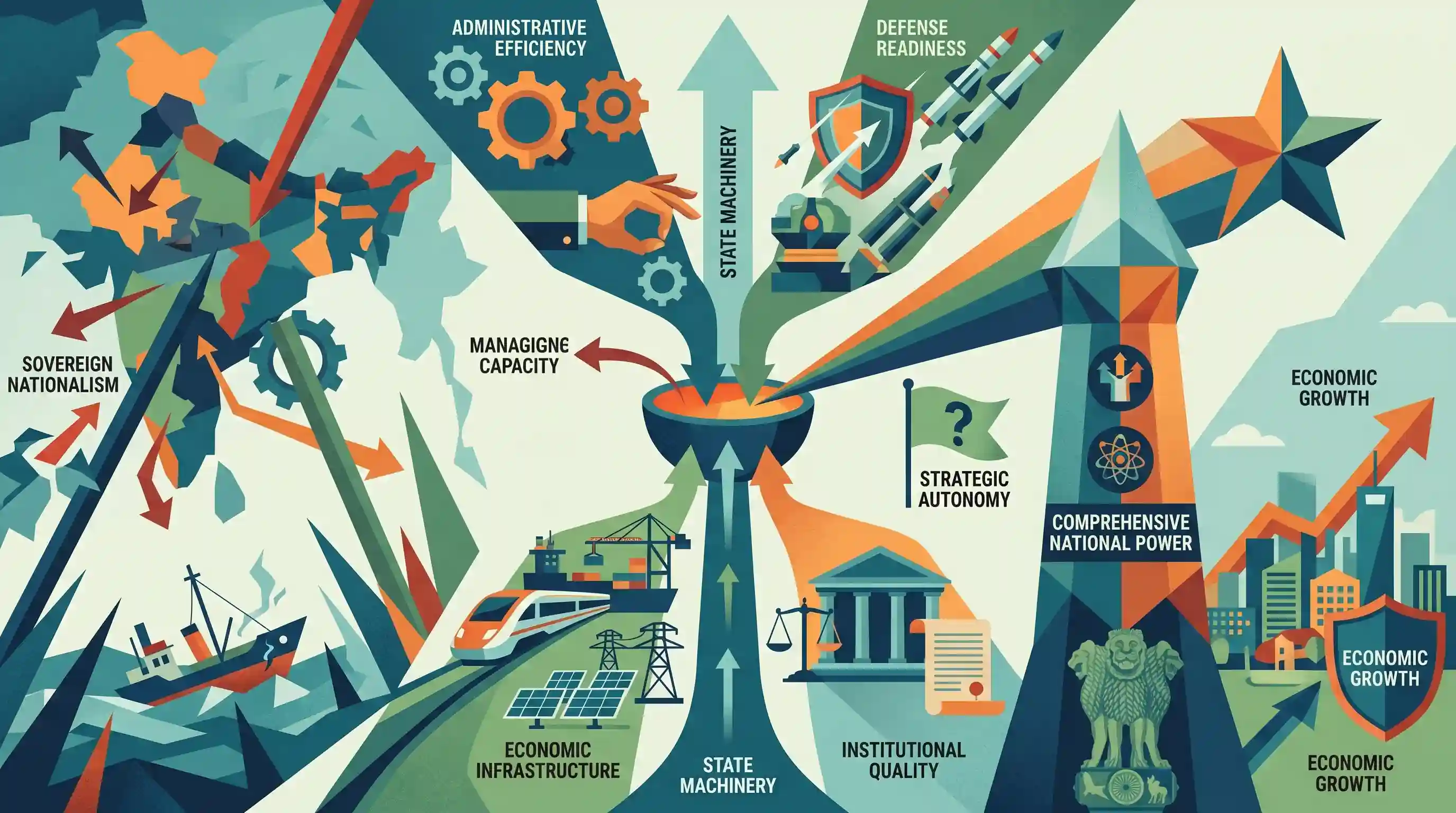
The article argues that in order to navigate an increasingly 'predatory' global order characterized by sovereign nationalism and multipolar friction, India must significantly enhance its comprehensive national power. This necessitates a massive expansion of 'capacity' across all fronts—state machinery, economic infrastructure, defense readiness, and institutional quality. The core thesis is that merely asserting strategic autonomy is insufficient without the underlying hard power and administrative efficiency needed to support economic growth and decisively defend national interests.
Key Points
- The contemporary global order is shifting from cooperative globalization towards a 'predatory' multipolar reality defined by intense sovereign nationalism and geopolitical friction.
- India's pursuit of strategic autonomy must be backed by a massive expansion in comprehensive national power, encompassing economic, military, and diplomatic dimensions.
- Enhancing state capacity and institutional quality is a fundamental prerequisite for sustaining high economic growth and executing national security objectives.
- Diplomatic agility alone is insufficient without the underlying administrative efficiency and hard power necessary to defend national interests in an uncertain world.
Prelims Trap
"Strategic autonomy implies India must adhere to traditional non-alignment and avoid bilateral security partnerships."
Aspirants confuse historical Non-Alignment with contemporary Strategic Autonomy, which actually allows for strategic, issue-based security alignments backed by hard internal capacity.
Static Concepts Connected
What are the core dimensions of State Capacity in governance?
- Extractive Capacity: The state's ability to raise revenue and collect taxes efficiently to fund public goods, welfare, and national defense.
- Administrative Capacity: The capability of the state machinery to deliver public services, execute policies effectively, and maintain law and order.
- Regulatory Capacity: The ability to enforce laws, resolve disputes, and maintain fair market competition without causing 'regulatory cholesterol'.
What constitutes Comprehensive National Power (CNP) in geopolitics?
- Hard Power: Quantitative metrics such as military strength, economic size (GDP), critical infrastructure, manufacturing base, and demographic dividends.
- Soft Power: Qualitative influence driven by cultural appeal, democratic values, diplomatic agility, diaspora networks, and overall institutional quality.
- Technological Sovereignty: Self-reliance in critical and emerging technologies (space, cyber, AI, critical minerals), increasingly vital for independent foreign policy.
Cross-Topic Patterns
Regulatory Cholesterol + State Capacity
Past Economic Surveys often cite poor contract enforcement and administrative delays as internal vulnerabilities that directly weaken India's comprehensive national power on the global stage.
Atmanirbharta + Strategic Autonomy
The push for defense indigenization (e.g., positive indigenization lists) is the practical internal bridge needed to achieve the external goal of strategic autonomy in a fragmented multipolar world.

Expect a GS-2 Mains question linking India's internal 'state capacity' bottlenecks directly to its external 'strategic autonomy' goals.
Linked PYQs · 2
Linked PYQs · 2
- 2025MainsGS2
"With the waning of globalization, post-Cold War world is becoming a site of sovereign nationalism.” Elucidate.
- 2020MainsGS2
Institutional quality is a crucial driver of economic performance". In this context suggest reforms in Civil Service for strengthening democracy.
