Grid Scale Energy Storage VGF Scheme Approved for Renewables
Source:Indian Express ↗
Why It Matters
Crucial for GS3 Infrastructure and Energy security, highlighting India's policy mechanisms like VGF to overcome technical and financial bottlenecks in integrating renewable energy into the national grid.
Summary
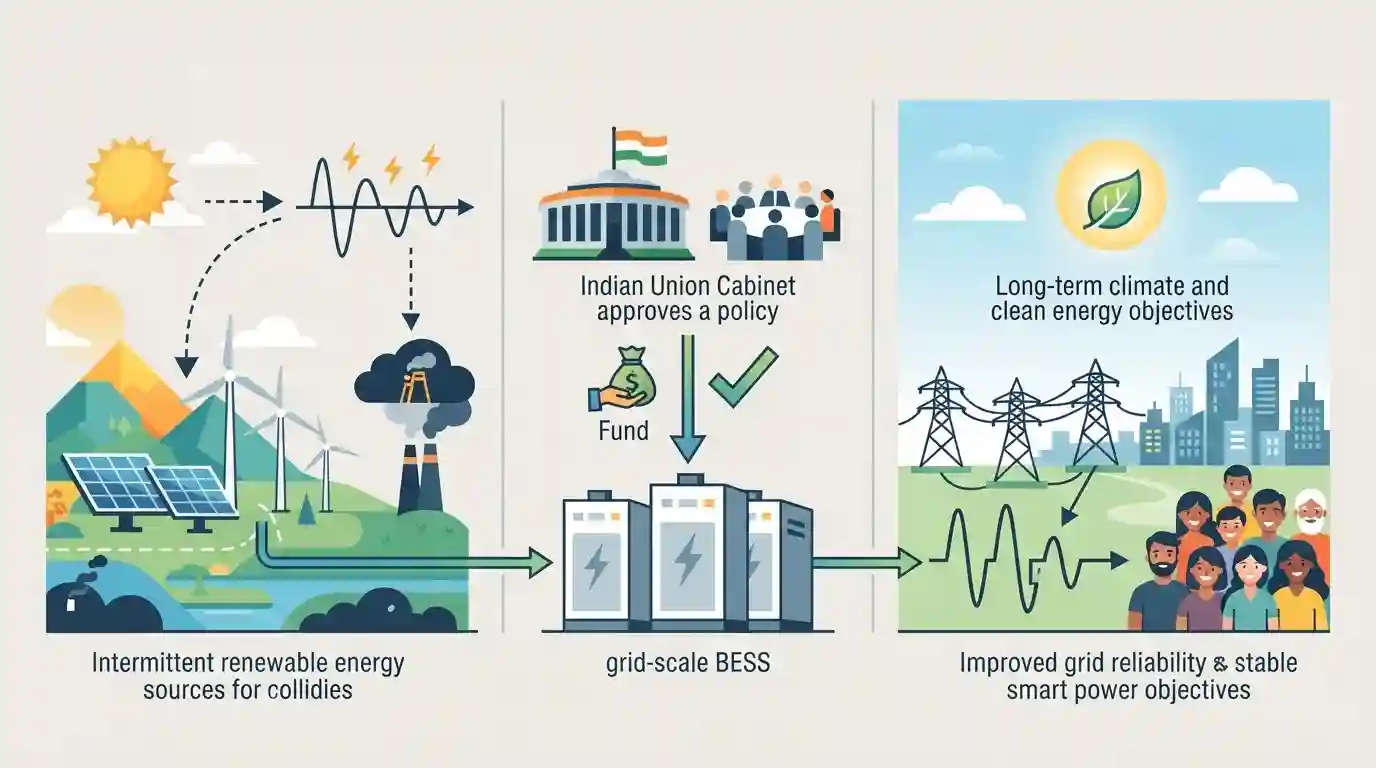
The Union Cabinet has approved a Viability Gap Funding (VGF) scheme aimed at promoting grid-scale battery energy storage systems (BESS) in India. This initiative is designed to tackle the intermittency problems of renewable energy sources like solar and wind, improve grid reliability, and help the country meet its long-term climate and clean energy objectives by providing financial backing to private infrastructure developers.
Key Points
- The Union Cabinet approved a Viability Gap Funding (VGF) scheme for grid-scale battery energy storage systems (BESS) to support India's ambitious renewable energy targets.
- Grid-scale storage addresses the intermittency and variability issues associated with wind and solar power generation, ensuring grid stability.
- VGF financial support reduces the capital cost barrier for private developers, making large-scale energy storage financially viable.
- This scheme supports India's broader climate commitments toward achieving net-zero emissions and increasing non-fossil fuel energy capacity.
Important Terms
Viability Gap Funding Scheme for Grid Scale Battery Energy Storage Systems

A financial grant mechanism provided by the government to bridge commercial viability shortfalls in infrastructure projects that are economically essential but lack immediate profitability, facilitating private sector participation.
UPSC context
UPSC GS Paper III (Infrastructure: Energy, Government Policies & Interventions). Tests understanding of financial models for promoting renewable energy integration.
Union Cabinet
The executive apex decision-making body of the Union government, headed by the Prime Minister, responsible for executive administration and major policy and budgetary approvals.
UPSC context
UPSC GS Paper II (Polity & Governance). Evaluates the structure, powers, and role of executive bodies in major national policy formulations.
Ministry of New and Renewable Energy
The Union government ministry responsible for formulating policies, programmes, and promoting research and deployment in the renewable energy sector, including solar, wind, and storage.
UPSC context
UPSC GS Paper III (Environmental Pollution & Degradation, Clean Energy). Tests institutional frameworks driving India's net-zero transition.
Prelims Trap
VGF is a government loan given to private developers to construct grid-scale battery storage.
Aspirants often confuse VGF as a direct loan from the government rather than a capital grant to make privately executed infrastructure projects financially viable.
Static Concepts Connected
What is Viability Gap Funding (VGF) and how does it support infrastructure projects?
- Capital Grant: Financial Grant: VGF is a one-time capital grant provided to infrastructure projects that are economically justified but financially unviable due to long gestation periods.
- PPP Model: PPP Framework: Typically utilized in Public-Private Partnership (PPP) projects where private sector efficiency is needed for public infrastructure.
- Funding Source: Central Sector: Usually administered by the Ministry of Finance or line ministries to bridge the revenue gap of commercially unviable assets.
Cross-Topic Patterns
Green VGF & Public-Private Infrastructure Financing
VGF schemes bridge market failures in green infrastructure, paralleling capital subsidies used in semiconductor manufacturing and green hydrogen missions.
Domestic Content Requirements & Global Trade Norms
Mandating domestic content requirements for BESS touches upon WTO trade compliance norms and localization pressures seen in solar PV manufacturing.

VGF mechanisms + Pumped Storage vs. BESS cost-benefit structures are prime candidates for Prelims statement-based MCQs.
Linked PYQs · 3
Linked PYQs · 3
- 2025MainsGS3
How can India achieve energy independence through clean technology by 2047? How can biotechnology can play a crucial role in this endeavour?
- 2022MainsGS3
Do you think India will meet 50 percent of its energy needs from renewable energy by 2030 ? Justify your answer. How will the shift of subsidies from fossil fuels to renewables help achieve the above objective ? Explain.
- 2021MainsGS3
Explain the purpose of the Green Grid Initiative launched at World Leaders Summit of the COP26 UN Climate Change Conference in Glasgow in November, 2021. When was this idea first floated in the International Solar Alliance (ISA)?
