India and Greece Sign Joint Declaration to Deepen Defence Ties
Source:Indian Express ↗
Why It Matters
This development highlights India's multi-aligned foreign policy and its proactive outreach to European nations beyond traditional powers. It is highly relevant for GS Paper 2 (Bilateral and Regional Groupings) and GS Paper 1 (Geography/Mapping of the Mediterranean region).
Summary
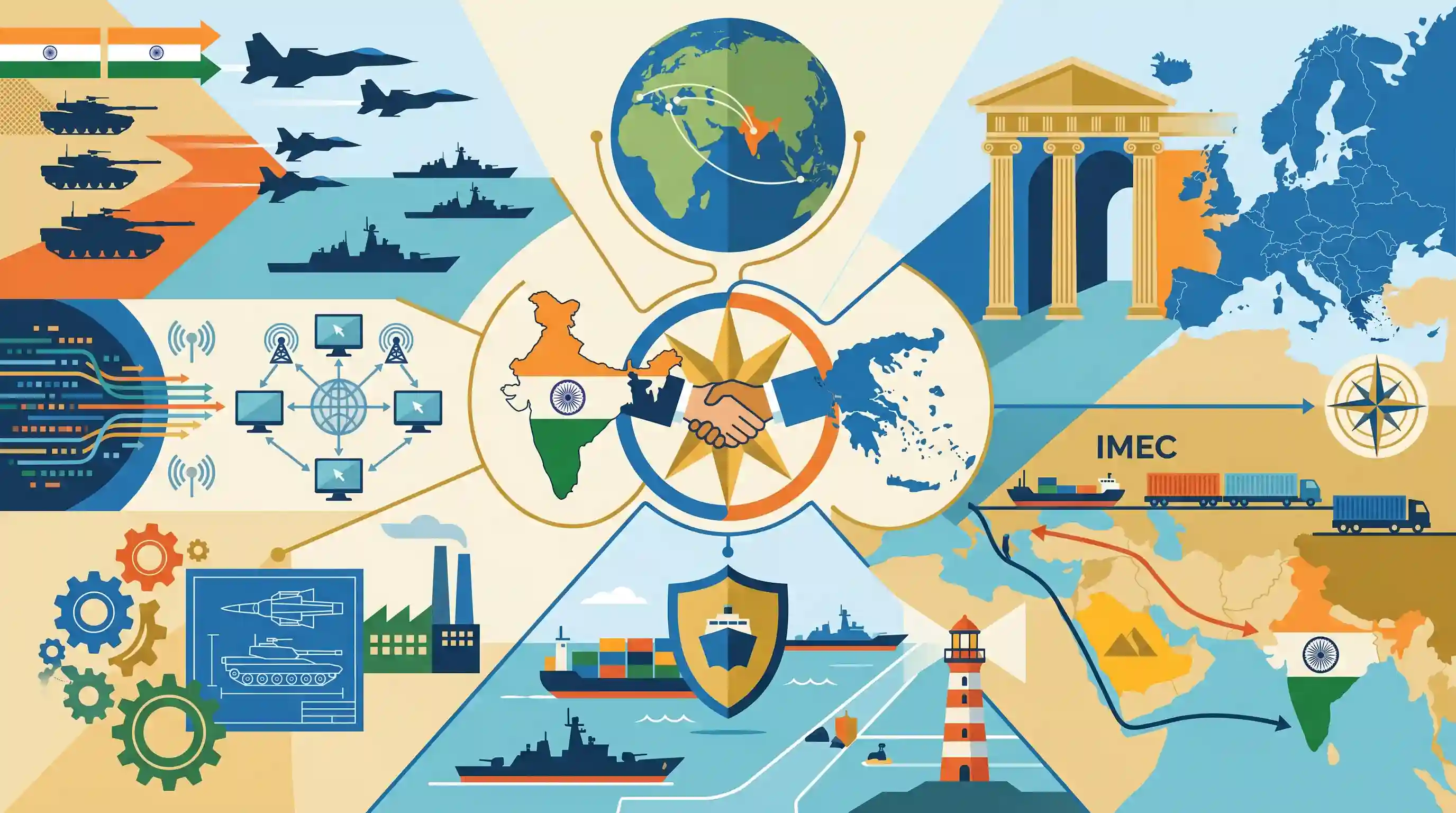
India and Greece have signed a Joint Declaration of Intent to deepen their bilateral defence cooperation, marking a significant milestone in their expanding strategic partnership. The agreement emphasizes enhanced joint military exercises, intelligence sharing, maritime security cooperation, and potential collaboration in defence manufacturing and co-production. Geopolitically, this move aligns with India's strategy to view Greece as a strategic 'gateway to Europe' and a critical node in the proposed India-Middle East-Europe Economic Corridor (IMEC). By intertwining the security architectures of the Mediterranean and the Indo-Pacific, both nations aim to safeguard supply chains and promote a rules-based international maritime order.
Key Points
- Strategic Partnership: The declaration builds upon the recent elevation of India-Greece bilateral relations to a 'Strategic Partnership', reflecting a shared vision for global stability.
- Defence Collaboration: The agreement focuses on enhancing military interoperability, intelligence sharing, joint exercises (such as INIOCHOS), and the co-development of defence equipment.
- Gateway to Europe: Greece is strategically viewed by New Delhi as India's gateway to Europe and a vital anchor for the proposed India-Middle East-Europe Economic Corridor (IMEC).
- Maritime Convergence: Both countries have aligned interests in ensuring maritime security, advocating for a 'free, open, and rules-based' Indo-Pacific and Mediterranean to protect vital sea lines of communication.
Important Terms
India-Middle East-Europe Economic Corridor (IMEC)

A multimodal transport corridor linking India, the Middle East, and Europe via ship-to-rail networks. It integrates energy, digital, and logistics infrastructure to boost trade and connectivity.
UPSC context
GS-II/GS-III: Global connectivity, trade diversification, and strategic alternative to China's Belt and Road Initiative (BRI).
Joint Declaration of Intent (JDoI)
A formal document outlining a mutual commitment to cooperate on specific objectives. In 2026, India and Greece signed one to establish a five-year defence industrial roadmap.
UPSC context
GS-II: International Relations; tests understanding of bilateral instruments and frameworks for defence cooperation.
Strategic Partnership
A high-level diplomatic framework for long-term bilateral cooperation across critical sectors. India and Greece elevated their relationship to this level in August 2023.
UPSC context
GS-II: Bilateral Relations; signifies the highest tier of diplomatic engagement and shared security interests.
Hellenic Armed Forces
The unified military forces of the Hellenic Republic (Greece). They are key partners for India in joint exercises, intelligence sharing, and Mediterranean security operations.
UPSC context
GS-II: Bilateral relations; highlights India's military diplomacy and interoperability with European partners.
Maritime Security
The protection of sea lanes and freedom of navigation under international law. It involves countering threats like piracy, terrorism, and illegal activities in maritime domains.
UPSC context
GS-II/GS-III: Security and IR; crucial for India's role as a net security provider in the Indo-Pacific.
NATO (North Atlantic Treaty Organization)
A 32-member intergovernmental military alliance. Greece’s membership bridges India’s strategic ties to the Euro-Atlantic security architecture and helps balance Eastern Mediterranean geopolitics.
UPSC context
GS-II: International Institutions; tests India's engagement with major global security alliances and their members.
Prelims Trap
"Greece serves as the primary European entry node for the International North-South Transport Corridor (INSTC)."
Greece is the intended European terminus for the newly proposed IMEC (India-Middle East-Europe Economic Corridor), not the older INSTC.
Static Concepts Connected
What are the geographical components of the IMEC?
- Eastern Corridor: Connects India to the Arabian Gulf via established maritime shipping lanes.
- Northern Corridor: Connects the Arabian Gulf to Europe via a multimodal rail and ship network, anchored in the Mediterranean.
- Overland Transit: Relies on cross-border railway networks through the UAE, Saudi Arabia, Jordan, and Israel to bypass traditional maritime chokepoints.
Which key straits and chokepoints control maritime access to the Mediterranean Sea?
- Strait of Gibraltar: Natural strait connecting the Mediterranean Sea to the Atlantic Ocean, separating Spain and Morocco.
- Dardanelles & Bosporus: The Turkish Straits connect the Mediterranean (via the Aegean) to the Black Sea.
- Suez Canal: Artificial waterway connecting the Mediterranean to the Red Sea, essential for Asia-Europe trade routes.
Cross-Topic Patterns
Red Sea disruptions fuel IMEC push
Houthi attacks in the Red Sea have exposed Suez Canal vulnerabilities, accelerating India's strategic push for IMEC and Mediterranean defence ties to secure alternative, resilient supply chains.
Air diplomacy via multinational exercises
India's participation in Greece's INIOCHOS, alongside Pitch Black (Australia) and Red Flag (US), reflects the IAF's broader shift towards deep interoperability with NATO-aligned air forces.

Map-based questions linking IMEC ports (Piraeus, Haifa) to Mediterranean and West Asian water bodies are highly probable in 2026.
Linked PYQs · 2
Linked PYQs · 2
- 2023MainsGS2
‘The expansion and strengthening of NATO and a stronger US-Europe strategic partnership works well for India.’ What is your opinion about this statement ? Give reasons and examples to support your answer.
- 2019PrelimsGS1
Consider the following pairs: Sea Bordering country 1. Adriatic Sea : Albania 2. Black Sea : Croatia 3. Caspian Sea : Kazakhstan 4. Mediterranean Sea : Morocco 5. Red Sea : Syria Which of the pairs given above are correctly matched?
