US reaffirms readiness to expand energy cooperation with India
Source:The Hindu ↗
Why It Matters
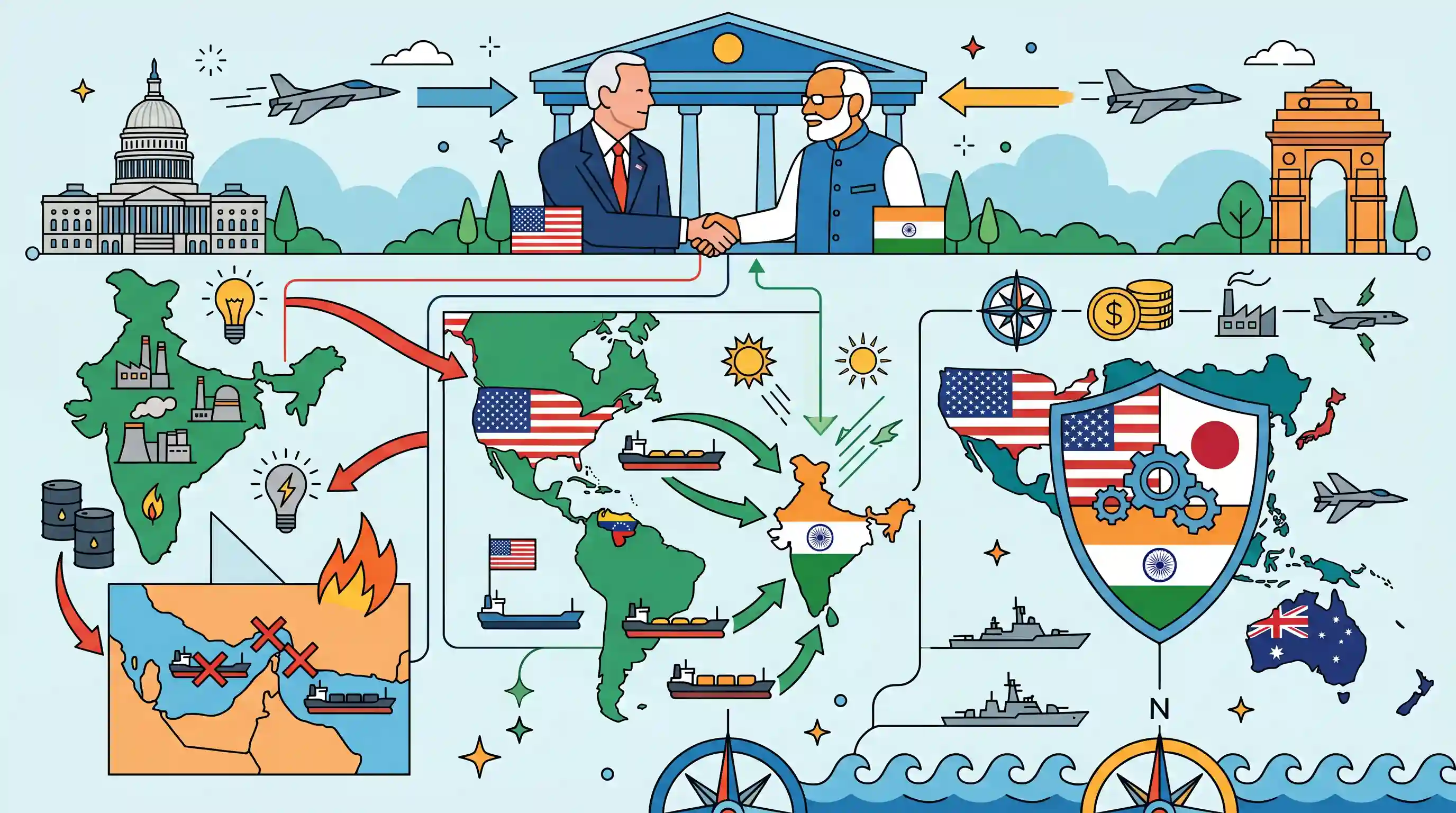
Highlights the intersection of India's energy security needs and its foreign policy. The closure of the Strait of Hormuz underlines the fragility of Middle Eastern oil dependency, making the U.S. and alternative sources like Venezuela critical for India. It also demonstrates how bilateral relations and multilateral forums like the Quad are evolving to encompass economic and energy resilience alongside traditional security.
Summary
Ahead of his visit to New Delhi, U.S. Secretary of State Marco Rubio emphasized the United States' commitment to expanding energy cooperation with India. Recognizing India's vulnerability to global energy price shocks—exacerbated by disruptions in the Middle East such as the closure of the Strait of Hormuz—Rubio highlighted opportunities for India to increase energy imports from the U.S. and Venezuela. He described India as a "great partner" and noted that the upcoming Quad Foreign Ministers' meeting would further deepen the strategic, economic, and security alignment between the two nations in the broader Indo-Pacific region.
Key Points
- The U.S. is prioritizing the expansion of energy cooperation with India, leveraging historic levels of U.S. energy production to meet India's growing demands.
- Geopolitical disruptions, such as the closure of the Strait of Hormuz, have driven up global energy prices, prompting India to seek reliable alternative energy sources.
- The U.S. supports India's move to diversify its energy imports, citing potential opportunities with Venezuela, whose interim President Delcy Rodriguez is also visiting India.
- U.S. Secretary of State Marco Rubio reaffirmed India's status as a "great partner," emphasizing strong bilateral ties.
- The upcoming Quad Foreign Ministers' meeting will serve as a platform to further solidify strategic and economic alignment among member nations in the Indo-Pacific.
Important Terms
Quad (Quadrilateral Security Dialogue)

An informal strategic forum comprising India, the United States, Japan, and Australia. It promotes a free, open, and inclusive Indo-Pacific and addresses maritime security, technology, and climate challenges.
UPSC context
GS Paper 2: International Relations. Tests understanding of plurilateral groupings, Indo-Pacific geopolitics, and India's strategic balancing.
Strait of Hormuz
A critical maritime chokepoint between the Persian Gulf and the Gulf of Oman. It facilitates nearly 20-25% of global seaborne oil trade, essential for India's energy imports.
UPSC context
GS Paper 1: Geography; GS Paper 2: International Relations. Vital for questions on global energy lifelines and West Asian stability.
Energy Security
The reliable availability of energy sources at an affordable price. For India, it involves diversifying suppliers (e.g., U.S., Venezuela) to mitigate risks from Middle East disruptions.
UPSC context
GS Paper 3: Infrastructure and Energy. Focuses on diversification, strategic reserves, and the economic impact of global price shocks.
Indo-Pacific Strategy
A geopolitical framework viewing the Indian and Pacific Oceans as a single strategic space. It emphasizes freedom of navigation, rules-based order, and maritime cooperation among like-minded democracies.
UPSC context
GS Paper 2: International Relations. Key for analyzing India's leadership role and security partnerships in the maritime domain.
Strategic Chokepoint
A narrow passage through which high volumes of global trade pass. Control or closure of such points (like Hormuz) can significantly impact global economics and security.
UPSC context
GS Paper 1: World Geography. Relevant for maritime trade routes and geopolitical vulnerability assessments.
2+2 Ministerial Dialogue
The highest-level institutional mechanism between India and the U.S., involving Foreign and Defense Ministers to discuss strategic, security, and defense cooperation issues.
UPSC context
GS Paper 2: Bilateral Relations. Tests knowledge of diplomatic structures and high-level engagement between major powers.
Prelims Trap
"The Strait of Hormuz connects the Persian Gulf to the Red Sea."
It connects the Persian Gulf to the Gulf of Oman/Arabian Sea. The Red Sea is connected to the Gulf of Aden via the Bab-el-Mandeb.
Static Concepts Connected
What are the key geographical features of the Strait of Hormuz?
- Water bodies: It serves as a critical maritime chokepoint connecting the oil-rich Persian Gulf to the Gulf of Oman and the Arabian Sea.
- Bordering nations: It is flanked by Iran to the north and Oman (via the Musandam Peninsula) and the United Arab Emirates to the south.
What is the U.S.-India Strategic Clean Energy Partnership (SCEP)?
- Origin: A bilateral framework launched under the U.S.-India Climate and Clean Energy Agenda 2030 Partnership.
- Key pillars: Focuses on five pillars: Power and Energy Efficiency, Responsible Oil and Gas, Renewable Energy, Sustainable Growth, and Emerging Fuels.
Cross-Topic Patterns
Quad's non-military evolution
The Quad is pivoting from traditional maritime security dialogues to broader economic cooperation, emphasizing clean energy partnerships, resilient supply chains, and critical technology standards.
Maritime chokepoints and India's CAD
Disruptions in Middle Eastern straits like Hormuz directly inflate India's oil import bill, widening the Current Account Deficit and triggering imported macroeconomic inflation.

Map-based multi-statements linking major straits (Hormuz, Bab-el-Mandeb) to global energy transit and bordering nations expected in 2026.
Linked PYQs · 4
Linked PYQs · 4
- 2025MainsGS2
"Energy security constitutes the dominant kingpin of India's foreign policy, and is linked with India's overarching influence in Middle Eastern countries.” How would you integrate energy security with India's foreign policy trajectories in the coming years?
- 2017MainsGS2
The question of India's Energy Security constitutes the most important part of India's economic progress. Analyze India's energy policy cooperation with West Asian countries.
- 2020MainsGS2
Quadrilateral Security Dialogue (Quad)' is transforming itself into a trade bloc from a military alliance, in present times - Discuss.
- 2020MainsGS2
What is the significance of Indo-US defence deals over Indo-Russian defence deals? Discuss with reference to stability in the Indo-Pacific region.
