India urges De-escalation and Security for Expatriates in Gulf
Source:Indian Express ↗
Why It Matters
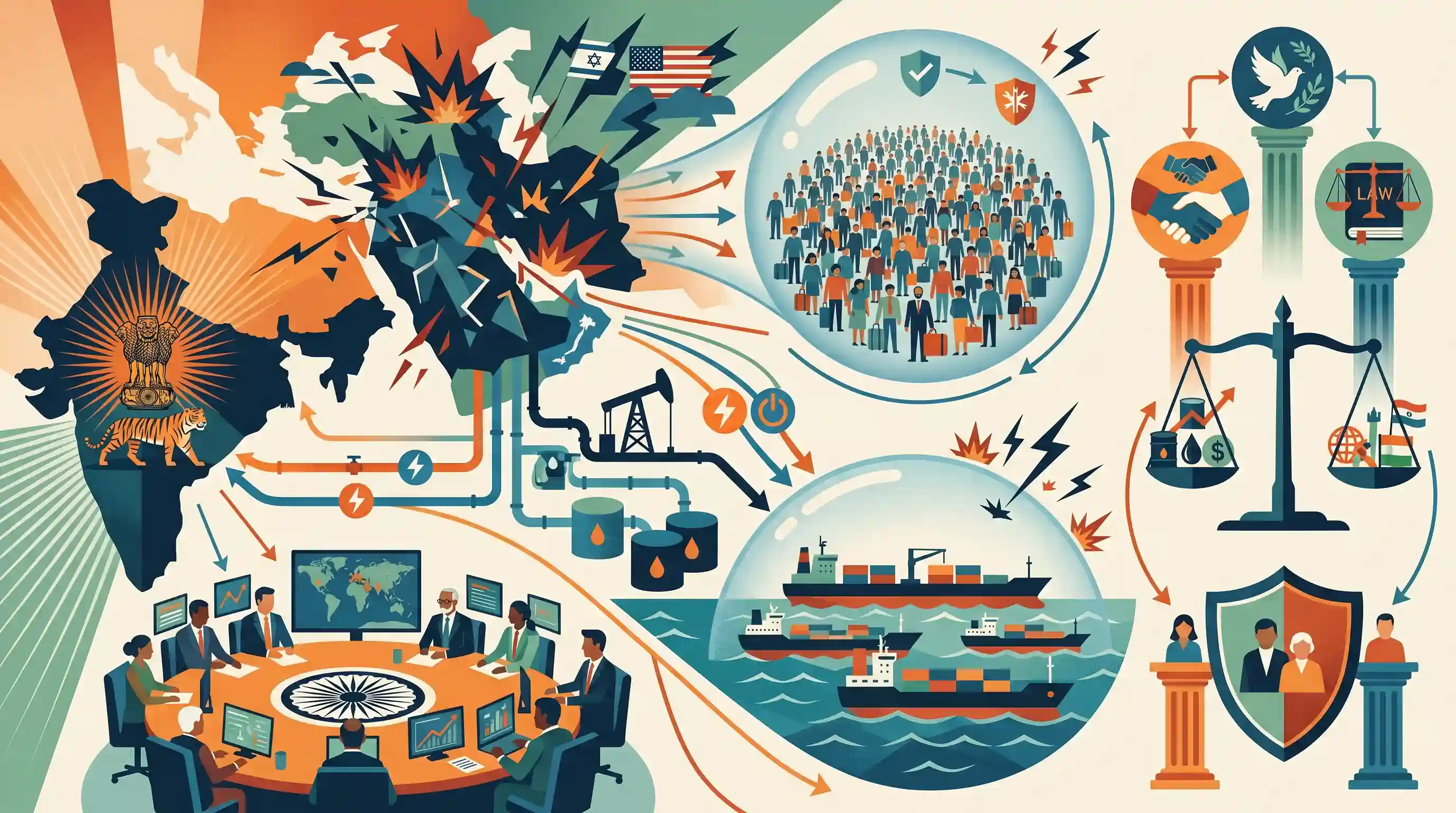
West Asia is central to India's energy security and diaspora remittances. The escalating conflict challenges India's strategic autonomy, requiring proactive diplomatic balancing to safeguard national interests without alienating key partners in the region.
Summary
India has officially voiced deep concern regarding the widening conflict in the West Asia and Gulf region involving Iran, Israel, and the United States. Emphasizing diplomacy, de-escalation, and international law, the government highlighted the grave implications of regional instability for India's strategic interests. These include the safety of approximately 10 million Indian expatriates, securing vital energy supply chains, and protecting merchant shipping from attacks. The Cabinet Committee on Security (CCS) held discussions to monitor the situation, as India balances its strategic ties across the region while advocating for the protection of civilians and sovereign territorial integrity.
Key Points
- India urged immediate de-escalation and a return to diplomacy to prevent a broader regional war in West Asia.
- The protection of nearly 1 crore Indian citizens working and living in the Gulf is a primary concern, prompting top-level monitoring by the Cabinet Committee on Security.
- India highlighted the conflict's threat to global trade routes, condemning attacks on merchant shipping and emphasizing the necessity of securing vital energy supply chains.
- The government reiterated its commitment to international law, stressing that the sovereignty and territorial integrity of all states must be respected in resolving the crisis.
Important Terms
Cabinet Committee on Security (CCS)

India's apex executive body for national security, defense, and strategic affairs. Chaired by the PM, it includes the Ministers of Defense, Home, External Affairs, and Finance.
UPSC context
GS Paper 2/3: Tests knowledge of national security architecture and top-level executive decision-making during regional crises.
Indian Diaspora (West Asia)
Over 9 million Indian nationals living in West Asia, serving as a vital source of remittances (~$120 billion annually) and a key foreign policy priority.
UPSC context
GS Paper 2: International Relations. Tests understanding of diaspora’s economic role and safety as a pillar of Indian diplomacy.
Strategic Autonomy
India's pursuit of an independent foreign policy, balancing ties with competing powers (e.g., Israel and Iran) to safeguard national interests without formal military alliances.
UPSC context
GS Paper 2: International Relations. Evaluates the candidate's grasp of India's realist approach in a multipolar world.
Energy Security
Ensuring reliable and affordable energy access; critical as West Asia provides over 50% of India's crude oil and 70% of its natural gas imports.
UPSC context
GS Paper 3: Economy/Security. Focuses on the impact of geopolitical shocks on India's energy supply chains and fiscal stability.
Extended Neighbourhood
A diplomatic framework viewing West Asia and Central Asia as integral to India's security and economic interests despite being beyond immediate borders.
UPSC context
GS Paper 2: International Relations. Tests knowledge of India's regional influence and the "Look West" policy.
Maritime Security (SLOCs)
The protection of commercial maritime routes; crucial for West Asia due to chokepoints like the Strait of Hormuz where Indian trade flows.
UPSC context
GS Paper 3: Internal/External Security. Tests awareness of trade vulnerabilities and the role of the Indian Navy in securing sea lanes.
Prelims Trap
"India’s ‘de-hyphenation’ policy requires it to maintain strict neutrality and equal distance from adversarial nations."
De-hyphenation means pursuing independent, parallel bilateral relationships based on specific national interests, not maintaining passive neutrality or strict equidistance.
Static Concepts Connected
What is the composition and mandate of the Cabinet Committee on Security (CCS)?
- Chairperson: It is headed by the Prime Minister of India.
- Key Members: Includes the Ministers of Defence, Home Affairs, Finance, and External Affairs.
- Mandate: It is the highest executive decision-making body for India's national security, foreign policy, and defence expenditure.
How does the 'De-hyphenation' policy shape India's relations in West Asia?
- Core Definition: Evaluating and engaging with two adversarial nations independently, rather than viewing one through the lens of the other.
- West Asia Context: India maintains strong, simultaneous strategic ties with both Israel and Arab states/Iran without letting one relationship dictate the other.
- Strategic Autonomy: It allows India to maximize its national interests (diaspora safety, energy security, technology) while avoiding entanglement in regional bloc politics.
Cross-Topic Patterns
Chabahar, INSTC and Central Asian Access
Iran's destabilization directly threatens India's operational control of Chabahar Port and the INSTC, which are crucial for bypassing Pakistan and countering China's Belt and Road Initiative in Eurasia.
Maritime Security and Operation Sankalp
Attacks on Red Sea and Gulf of Aden shipping link West Asian geopolitics to the Indian Navy's expanding operational footprint (Operation Sankalp) as a net security provider for energy chains.

Mapping of West Asian chokepoints (Hormuz, Bab-el-Mandeb) combined with India's de-hyphenation policy is highly probable for Prelims 2026.
Linked PYQs · 2
Linked PYQs · 2
- 2025MainsGS2
"Energy security constitutes the dominant kingpin of India's foreign policy, and is linked with India's overarching influence in Middle Eastern countries.” How would you integrate energy security with India's foreign policy trajectories in the coming years?
- 2023MainsGS2
Indian diaspora has scaled new heights in the West. Describe its economic and political benefits for India.
