India Gifts Electric Vehicles to Nepal for Climate Dialogue
Source:The Hindu ↗
Why It Matters
This event is a classic example of soft power diplomacy under India\'s Neighbourhood First policy, combined with climate advocacy. It demonstrates how bilateral aid can align with global environmental goals like emission reduction and sustainable development, which are critical themes in both GS2 (IR) and GS3 (Environment/Tech).
Summary
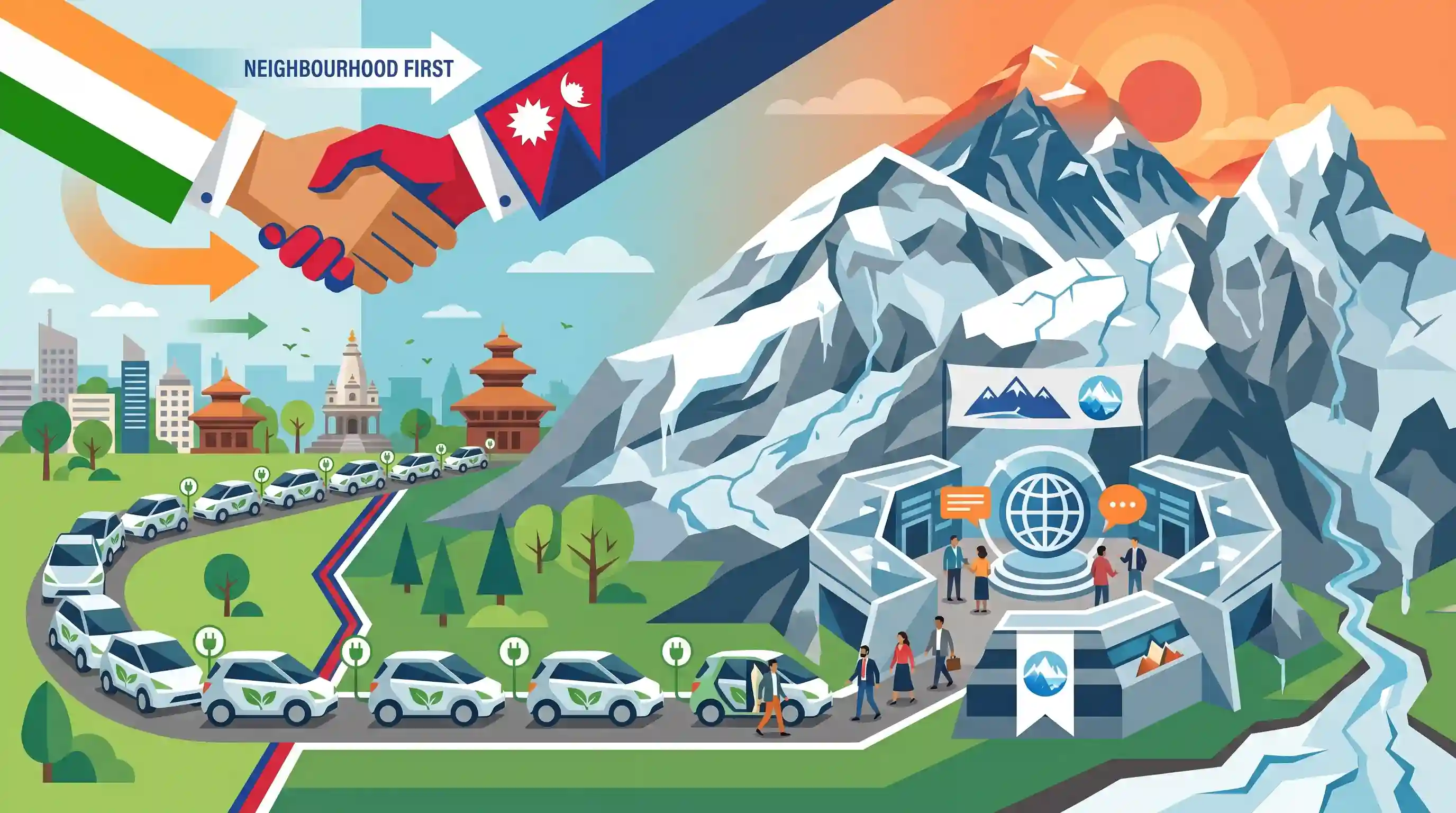
India gifted 15 electric vehicles to Nepal to facilitate the organization of the \'Sagarmatha Sambad\' mountain dialogue in Kathmandu. Themed \'Climate Change, Mountains and the Future of Humanity\', the summit aims to address the severe impact of climate change on the Himalayan ecosystem. The diplomatic gesture highlights India\'s ongoing support for Nepal\'s development initiatives and underscores a shared regional commitment to environmental sustainability and green mobility.
Key Points
- India gifted 15 electric vehicles to Nepal to assist in organizing the \'Sagarmatha Sambad\' (mountain dialogue).
- The international summit, hosted in Kathmandu, focuses on the theme \'Climate Change, Mountains and the Future of Humanity\'.
- The event aims to highlight the vulnerabilities of mountain regions to climate change, attracting around 300 global participants.
- The gesture reinforces India\'s Neighborhood First policy, reflecting a commitment to Nepal\'s progress while promoting sustainable green mobility.
Important Terms
Sagarmatha Sambad

A biennial global dialogue forum initiated by Nepal to address pressing global issues; its inaugural session focuses on climate change and mountain resilience.
UPSC context
GS Paper II (International Relations). Relevant for regional environmental diplomacy and India's role in Himalayan climate initiatives.
Neighbourhood First Policy
India's foreign policy priority to build friendly, consultative, and mutually beneficial relations with its immediate neighbors to ensure regional stability and prosperity.
UPSC context
GS Paper II (India and its Neighborhood). Fundamental for analyzing India’s strategic engagement and connectivity in South Asia.
Green Diplomacy
The integration of environmental protection and sustainable technology (like EVs) into foreign policy to strengthen diplomatic ties and address global ecological challenges.
UPSC context
GS Paper II/III (International Relations/Environment). Tests knowledge of India's soft power and leadership in climate action.
Mountain Ecosystems
Fragile high-altitude environments providing vital water and biodiversity, currently facing severe threats from global warming and glacial melting.
UPSC context
GS Paper III (Environment). Critical for understanding Himalayan ecology, disaster management (GLOFs), and water security.
SAGAR Vision
A strategic vision for the Indian Ocean Region focusing on "Security and Growth for All in the Region," often integrated with neighborhood policies.
UPSC context
GS Paper II (International Relations). Key for discussing maritime security and regional cooperation in India's extended neighborhood.
Prelims Trap
"Sagarmatha Sambad is an initiative under India's SAGAR vision for the Indian Ocean."
"Sagarmatha" is the Nepali name for Mount Everest. This is a Nepal-led global dialogue on mountains, entirely distinct from India’s SAGAR (Security and Growth for All in the Region) policy.
Static Concepts Connected
What is the "carrying capacity" of a Himalayan ecosystem?
- Definition: The maximum population size and degree of human activity an environment can sustain indefinitely without facing severe ecological degradation.
- Himalayan vulnerability: High seismic activity, steep gradients, and extreme weather make its carrying capacity significantly lower than plain terrains.
- UPSC relevance: Unplanned urbanization and unchecked tourism breach this capacity, leading to severe land subsidence (e.g., Joshimath) and amplified flash floods.
What are the core pillars of India's 'Neighbourhood First' policy?
- Connectivity: Improving physical, energy, and digital linkages across borders, such as cross-border petroleum pipelines and transnational grid connections.
- Capacity Building: Providing technical assistance, developmental grants, and training programs to neighbors without imposing restrictive conditionalities.
- Non-reciprocity: Adopting principles from the Gujral Doctrine, focusing on unilateral accommodation and non-reciprocal benefits for smaller neighbors.
Cross-Topic Patterns
Green diplomacy vs. traditional infrastructure
India is increasingly using "green diplomacy" (gifting EVs, solar grid linkages) as a soft-power tool in its neighborhood to differentiate its assistance from China\'s heavy-infrastructure Belt and Road Initiative (BRI).
Third Pole cryosphere and disaster management
The \'Sagarmatha Sambad\' discourse ties directly into GS-1/GS-3 themes on the Third Pole, specifically glacial lake outburst floods (GLOFs), cryosphere melting, and cross-border river basin management.

Sagarmatha Sambad is prime for Prelims match-the-pair, while Mains may test 'green diplomacy' in Neighbourhood First policy.
Linked PYQs · 4
Linked PYQs · 4
- 2022MainsGS2
India is an age-old friend of Sri Lanka.’ Discuss India's role in the recent crisis in Sri Lanka in the light of the preceding statement.
- 2015MainsGS2
Terrorist activities and mutual distrust have clouded India-Pakistan relations. To what extent the use of soft power like sports and cultural exchanges could help generate goodwill between the two countries? Discuss with suitable examples.
- 2017MainsGS3
'Climate change' is a global problem. How India will be affected by climate change? How Himalayan and coastal states of India will be affected by climate change?
- 2023MainsGS3
The adoption of electric vehicles is rapidly growing worldwide. How do electric vehicles contribute to reducing carbon emissions and what are the key benefits they offer compared to traditional combustion engine vehicles?
