India secures ISA licence for deep-sea mining in Indian Ocean
Source:The Hindu ↗
Why It Matters
The exploration of seabed minerals overlaps Geography, Economy, and International Relations. Understanding deep-sea topography, UNCLOS provisions on continental shelves, and the strategic importance of critical minerals to counter regional rivals is essential for both Prelims and Mains.
Summary
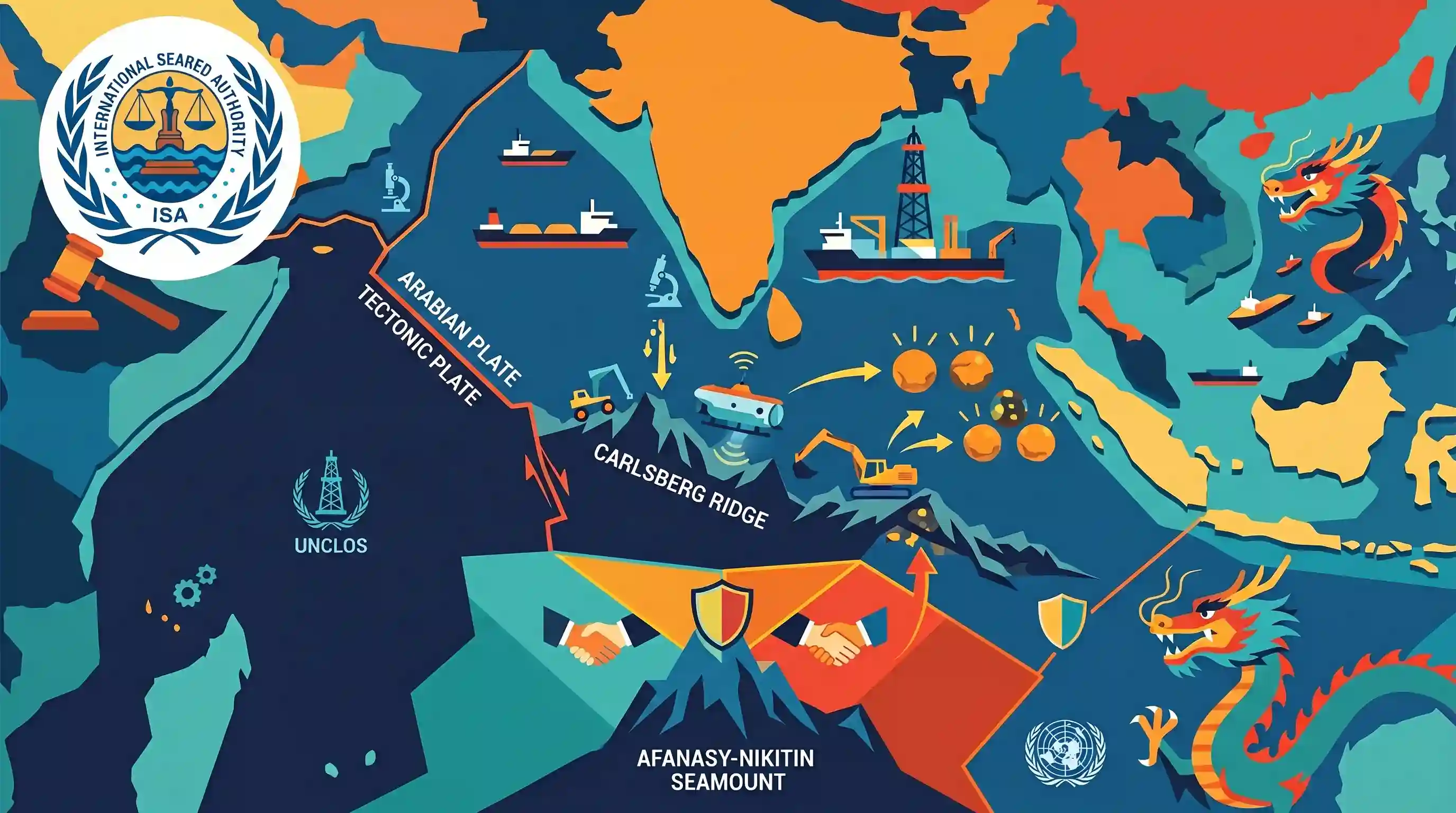
India has received a licence from the International Seabed Authority (ISA) to explore the Carlsberg Ridge in the Indian Ocean for polymetallic sulphides rich in manganese, cobalt, nickel, and copper. This region spans the boundary between the Indian and Arabian tectonic plates. Alongside this, India is also asserting its rights over the Afanasy-Nikitin Seamount, which faces overlapping continental shelf claims by Sri Lanka under UNCLOS rules. Gaining these exclusive exploration contracts is both an economic necessity for acquiring critical minerals and a strategic maneuver to prevent China from monopolizing deep-sea assets in the Indian Ocean Region.
Key Points
- India secured an exploration contract from the International Seabed Authority (ISA) to scout for polymetallic sulphides in the Carlsberg Ridge.
- The Carlsberg Ridge spans 3,00,000 sq km and lies on the tectonic boundary between the Indian and Arabian plates.
- India has also applied for exploration rights at the Afanasy-Nikitin Seamount in the Central Indian Ocean, which is contested by Sri Lanka under UNCLOS continental shelf provisions.
- UNCLOS generally allows states to claim up to 350 nautical miles as their continental shelf, but special provisions apply to Bay of Bengal countries.
- Beyond acquiring critical minerals (manganese, cobalt, nickel, copper), these exploration rights are strategically pursued by India to preempt Chinese dominance in the Indian Ocean's deep-sea mineral zones.
Important Terms
United Nations Convention on the Law of the Sea (UNCLOS)

A 1982 international treaty establishing a comprehensive legal framework for marine and maritime activities, defining maritime zones like Territorial Waters and Exclusive Economic Zones (EEZ) globally.
UPSC context
GS Paper 2 (International Relations); tests knowledge of maritime zones and international legal frameworks for sea-based disputes.
International Seabed Authority (ISA)
An autonomous intergovernmental organization established under UNCLOS to regulate and control mineral-related activities in the international seabed area beyond the limits of national jurisdiction.
UPSC context
GS Paper 2 (International Institutions); crucial for understanding the governance of deep-sea mining and resource allocation.
Ministry of Earth Sciences (MoES)
The Indian ministry responsible for policies on meteorology, oceanography, and seismology, spearheading the Deep Ocean Mission to explore minerals like polymetallic nodules and sulphides.
UPSC context
GS Paper 3 (Science & Tech); relevant for institutional roles in India's Blue Economy and critical mineral security.
Polymetallic Sulphides (PMS)
Mineral deposits rich in copper, zinc, gold, and silver, formed near deep-sea hydrothermal vents where hot, mineral-rich fluids precipitate upon contact with cold ocean water.
UPSC context
GS Paper 3 (Resources); identifies critical minerals needed for India’s energy transition and high-tech manufacturing.
Afanasy-Nikitin Seamount
A cobalt-rich undersea mountain in the Central Indian Basin, approximately 3,000 km from India, currently subject to overlapping maritime claims between India and Sri Lanka.
UPSC context
GS Paper 2 (International Relations); tests knowledge of maritime disputes and strategic maneuvers in the Indian Ocean.
Carlsberg Ridge
A mid-ocean ridge in the northwestern Indian Ocean marking a divergent boundary between the Indian and Somalian plates, hosting hydrothermal vents with significant mineral potential.
UPSC context
GS Paper 1 (Geographical phenomena); tests understanding of plate tectonics and oceanic topography in the Indian Ocean.
Prelims Trap
"Polymetallic sulphides are primarily extracted from the abyssal plains of the ocean floor."
Polymetallic sulphides form at hydrothermal vents along mid-ocean ridges (like Carlsberg), whereas polymetallic nodules are scattered across abyssal plains (like the Central Indian Ocean Basin).
Static Concepts Connected
What is the mandate and jurisdiction of the International Seabed Authority (ISA)?
- Mandate: Established under UNCLOS to organize, regulate, and control all mineral-related activities in the international seabed.
- Jurisdiction limits: Strictly restricted to 'The Area'—the seabed and ocean floor extending beyond the limits of national jurisdiction (i.e., beyond a nation's EEZ and continental shelf).
- Headquarters: Headquartered in Kingston, Jamaica, it functions as an autonomous international organization distinct from the UN Secretariat.
How do UNCLOS Continental Shelf limits uniquely apply to the Bay of Bengal?
- Standard Limit: Under standard UNCLOS provisions, states can claim an extended continental shelf up to a maximum of 350 nautical miles from their baseline.
- The Bengal Rule: A special provision ('Statement of Understanding') allows Bay of Bengal states like India and Sri Lanka to claim territory beyond 350 nm due to exceptional sedimentary thickness.
- Overlapping Claims: This rule leads to overlapping maritime claims, as seen with the Afanasy-Nikitin Seamount being contested by both India and Sri Lanka.
Cross-Topic Patterns
Samudrayaan & Critical Mineral Security
The Deep Ocean Mission (via Matsya 6000) directly operationalizes these ISA exploration blocks, bridging India's underwater scientific capabilities with the geopolitical push for non-Chinese critical mineral supply chains.
Seamounts & Strategic Chokepoints
Securing exploration rights at the Afanasy-Nikitin Seamount prevents China from establishing a dual-use deep-sea presence near crucial equatorial shipping lanes and overlapping Sri Lankan maritime claims.

Expect a paired-matching Prelims question mapping ocean relief features (mid-ocean ridges vs abyssal plains) to their mineral deposits.
Linked PYQs · 3
Linked PYQs · 3
- 2021PrelimsGS1
Consider the following statements : 1. The Global Ocean Commission grants licences for seabed exploration and mining in international waters. 2. India has received licences for seabed mineral exploration in international waters. 3. 'Rare earth minerals' are present on seafloor in international waters. Which of the statements given above are correct?
- 2014MainsGS1
Critically evaluate the various resources of the oceans which can be harnessed to meet the resource crisis in the world.
- 2025MainsGS1
Discuss how the changes in shape and sizes of continents and ocean basins of the planet take place due to tectonic movements of the crustal masses.
