India Germany Sign Defence Industrial Cooperation Agreement
Source:The Hindu ↗
Why It Matters
The India-Germany relationship is evolving from primarily economic ties to encompass strategic defense cooperation, joint technological development (like green hydrogen), and shared geopolitical interests in the Indo-Pacific and Global South. This aligns closely with India's foreign policy objectives of strategic autonomy, defense self-reliance, and emerging as a leader of the Global South.
Summary
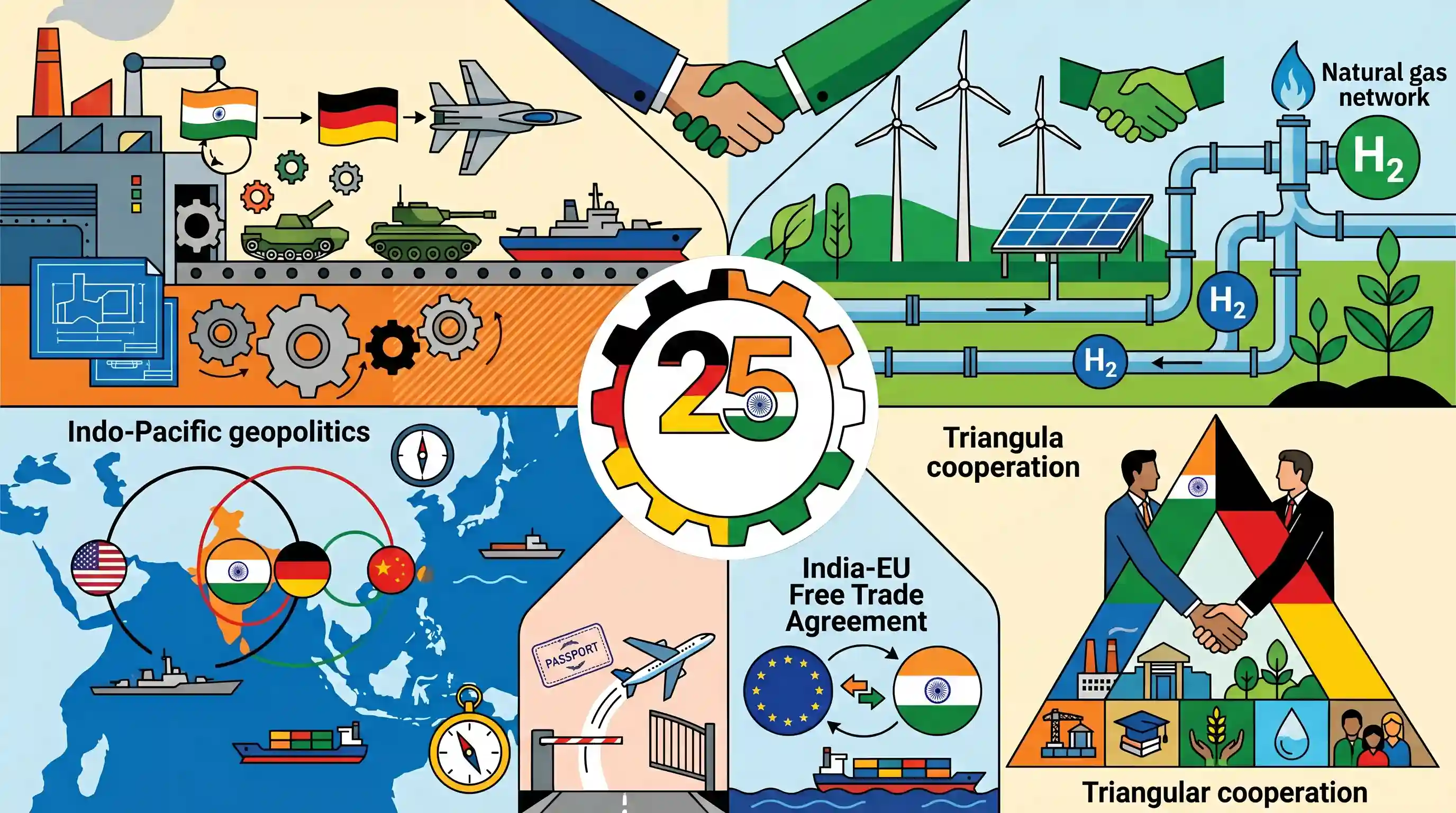
During German Chancellor Friedrich Merz's visit to India, the two countries deepened their bilateral ties by focusing on defense co-production, green energy, and geopolitical cooperation. Marking 25 years of their strategic partnership, the leaders signed a bilateral defense industrial cooperation agreement and launched an Indo-Pacific consultation mechanism. Additionally, they established a Triangular Development Cooperation to assist Global South countries, signed an MoU for integrating green hydrogen into natural gas infrastructure, and advocated for the early conclusion of the India-EU Free Trade Agreement. Germany also eased transit rules for specific Indian passport holders.
Key Points
- India and Germany signed an agreement on 'Strengthening the Bilateral Defence Industrial Cooperation' to emphasize defence co-production and co-development.
- The two nations launched a new consultation mechanism for enhanced collaboration in the Indo-Pacific region.
- Both leaders called for an early conclusion of the India-EU Free Trade Agreement amidst a global rise in protectionism.
- A Triangular Development Cooperation was established to jointly execute projects in Global South countries, beginning with Ghana, Cameroon, and Malawi.
- India's PNGRB and Germany's DVGW signed an MoU to promote the integration of green hydrogen into existing natural gas infrastructure.
- Germany announced visa-free transit through German airports for Indian passport holders holding valid US or UK visas.
- The meeting commemorated 25 years of the India-Germany Strategic Partnership and 75 years of diplomatic ties.
Important Terms
Bilateral Defence Industrial Cooperation

A strategic roadmap between India and Germany focused on the co-development, co-production, and technology transfer of advanced military systems.
UPSC context
GS Paper 2 & 3: International Relations and Defence Indigenization. Tests understanding of 'Make in India' in the defense sector.
Migration and Mobility Partnership Agreement (MMPA)
An agreement facilitating legal migration and exchange of students, researchers, and professionals through simplified visa procedures and structured mobility pathways.
UPSC context
GS Paper 2: International Relations and Indian Diaspora. Relevant for topics on human capital and bilateral workforce mobility.
India-EU Free Trade Agreement
A comprehensive trade pact aimed at reducing tariffs, eliminating trade barriers, and protecting investments between India and the 27-member European bloc.
UPSC context
GS Paper 2 & 3: Bilateral Trade and Economy. Tests knowledge of trade negotiations, BTIA, and economic diplomacy.
Triangular Development Cooperation
A development model where India and Germany jointly provide expertise and resources to implement sustainable projects in third countries across the Global South.
UPSC context
GS Paper 2: International Relations. Focuses on South-South and North-South cooperation and India's role in the Global South.
Petroleum and Natural Gas Regulatory Board (PNGRB)
India's statutory regulator for the midstream and downstream oil, gas, and green hydrogen sectors, ensuring fair competition and safety standards.
UPSC context
GS Paper 3: Energy and Infrastructure. Important for understanding the regulatory framework of India's green energy transition.
DVGW (German Technical and Scientific Association for Gas and Water)
Germany's leading technical body that sets safety and hygiene standards for gas and water infrastructure, now assisting India with hydrogen blending.
UPSC context
GS Paper 2: International Relations. Illustrates technical diplomacy and international collaboration in clean energy standard-setting.
Prelims Trap
Triangular Development Cooperation is a trilateral defense or trade pact between India, Germany, and the EU.
It is not a trilateral defense pact. It is a development framework where India and Germany jointly execute capacity-building projects in third countries of the Global South (like Ghana).
Static Concepts Connected
What is the statutory mandate of the Petroleum and Natural Gas Regulatory Board (PNGRB)?
- Statutory Origin: Established under the Petroleum and Natural Gas Regulatory Board Act, 2006.
- Core Mandate: Regulates the refining, processing, storage, transportation, distribution, and marketing of crude oil and natural gas.
- Upstream Exclusion: Crucially, it does not regulate the upstream exploration and production of crude oil and natural gas (handled by the Directorate General of Hydrocarbons).
What are the technical dynamics of blending Green Hydrogen with natural gas?
- Emission Reduction: Lowers the overall carbon intensity of the fuel and significantly reduces carbon monoxide and unburned hydrocarbon emissions.
- Infrastructure Re-use: Allows the transition to a hydrogen economy utilizing existing natural gas pipeline networks, circumventing immediate and massive capital costs.
- Blending Limits: Blending beyond roughly 10-20% by volume typically requires retrofitting pipelines and appliances to prevent hydrogen embrittlement (weakening of steel pipes).
Cross-Topic Patterns
G20 Legacy + Africa Outreach
Germany partnering with India for projects in Ghana, Cameroon, and Malawi leverages India's G20 achievement of integrating the African Union, cementing India as the bridge between the West and the Global South.
Green Hydrogen + CBAM Friction
Pushing the India-EU FTA while signing green hydrogen pacts highlights a dual strategy: aligning on clean energy tech while negotiating around the EU's controversial Carbon Border Adjustment Mechanism (CBAM) tax.

"Triangular Development Cooperation" frameworks (India + West + Africa) are highly likely to appear as a GS-2 Global South mains question.
Linked PYQs · 5
Linked PYQs · 5
- 2023MainsGS2
‘The expansion and strengthening of NATO and a stronger US-Europe strategic partnership works well for India.’ What is your opinion about this statement ? Give reasons and examples to support your answer.
- 2020MainsGS2
What is the significance of Indo-US defence deals over Indo-Russian defence deals? Discuss with reference to stability in the Indo-Pacific region.
- 2021MainsGS2
The newly tri-nation partnership AUKUS is aimed at countering China's ambitions in the Indo-Pacific region. Is it going to supersede the existing partnerships in the region? Discuss the strength and impact of AUKUS in the present scenario.
- 2021MainsGS3
Explain the purpose of the Green Grid Initiative launched at World Leaders Summit of the COP26 UN Climate Change Conference in Glasgow in November, 2021. When was this idea first floated in the International Solar Alliance (ISA)?
- 2013MainsGS3
Write a note on India's green energy corridor to alleviate the problem of conventional energy.
