India and Germany sign defence cooperation and technology pacts
Source:Indian Express ↗
Why It Matters
Understanding India's strategic outreach to European partners is critical for GS2 (International Relations). The focus on technology transfer, Make in India in defence, and the Project-75(I) submarine program directly ties into GS3 (Security and Indigenisation of Technology). Furthermore, military exercises like Ex-TARANG SHAKTI and UN Peacekeeping collaborations are standard Prelims targets.
Summary
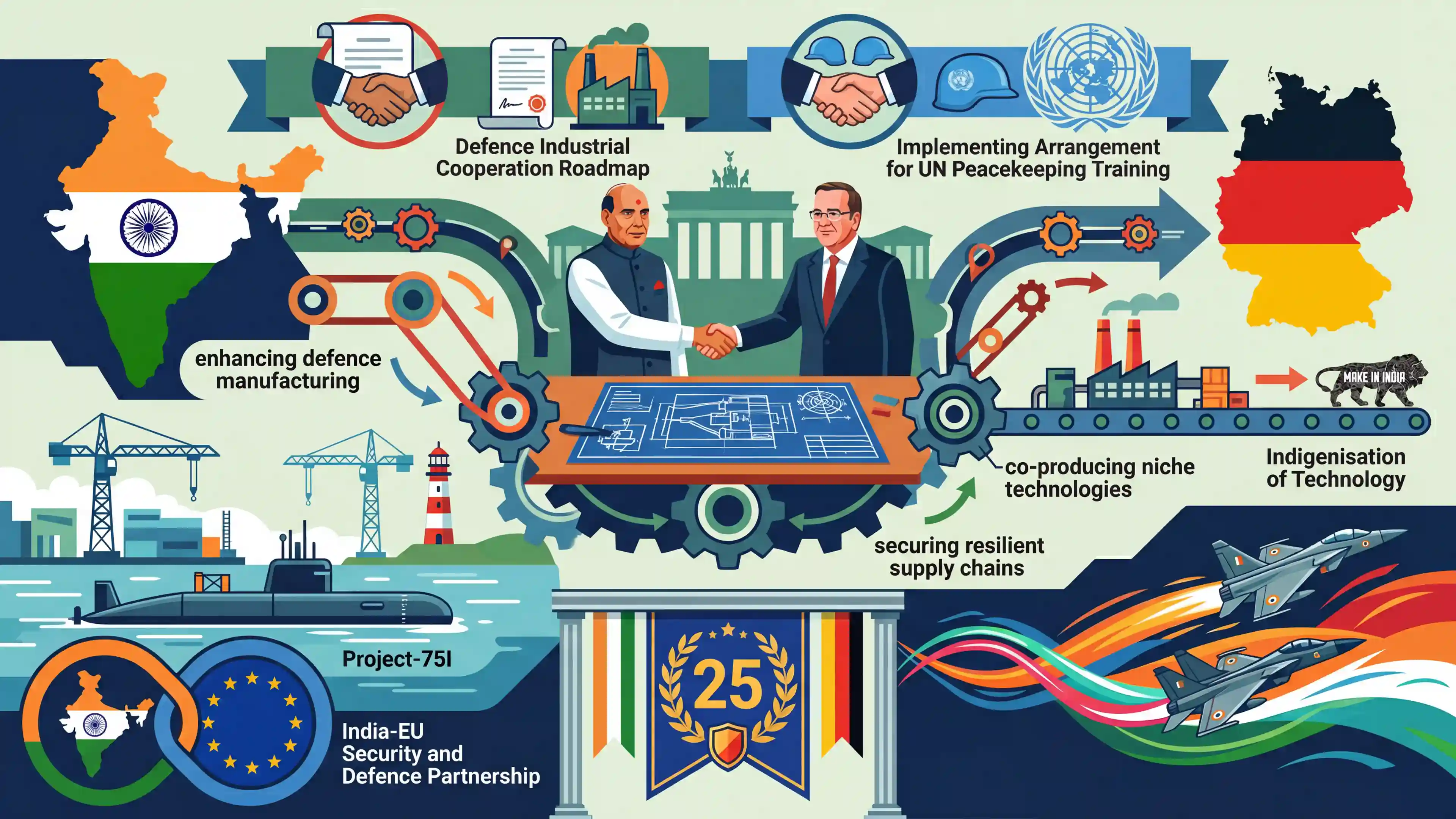
India and Germany have bolstered their bilateral ties by signing two significant agreements: the Defence Industrial Cooperation Roadmap and an Implementing Arrangement for Cooperation in UN Peacekeeping Training. During Defence Minister Rajnath Singh's visit to Berlin, talks with his German counterpart Boris Pistorius centered on enhancing defence manufacturing, co-producing niche technologies, and securing resilient supply chains. A major focal point was advancing the Project-75(I) submarine-building deal, underlined by Singh's visit to the TKMS facility in Kiel. The strengthening of these defence ties aligns with the broader India-EU Security and Defence Partnership, ahead of the 25th anniversary of the India-Germany Strategic Partnership in 2026. Military interoperability will also see a boost with the German Air Force joining India's Ex-TARANG SHAKTI.
Key Points
- India and Germany signed the Defence Industrial Cooperation Roadmap and an Implementing Arrangement for Cooperation in UN Peacekeeping Training.
- Discussions emphasized co-development, co-production, and the transfer of niche technologies to bolster supply chain resilience and Make in India initiatives.
- Progress was made toward the Project-75(I) deal, under which TKMS aims to build advanced submarines for the Indian Navy, as highlighted by Singh's visit to the Kiel shipyard.
- The pacts build upon the recent India-EU Security & Defence Partnership and look ahead to the 25th anniversary of the India-Germany Strategic Partnership in 2026.
- The German Air Force will participate in India's upcoming multilateral air exercise, Ex-TARANG SHAKTI, marking deeper military interoperability.
Important Terms
Defence Industrial Cooperation Roadmap

A strategic framework signed to guide bilateral collaboration in defense manufacturing, technology co-development, and resilient supply chains, focusing on niche areas like AI and cybersecurity.
UPSC context
GS Paper II: Bilateral Relations; GS Paper III: Indigenization of technology and defense manufacturing. Tests knowledge of strategic frameworks.
Project-75(I)
An Indian Navy project to build six advanced conventional submarines with Air Independent Propulsion (AIP) technology under the Strategic Partnership model to enhance underwater endurance.
UPSC context
GS Paper III: Science and Technology/Defense. Tests understanding of naval modernization and the Strategic Partnership model for indigenization.
Implementing Arrangement for Cooperation in UN Peacekeeping Training
A bilateral agreement to enhance joint training, capacity building, and expertise sharing for personnel deployed in United Nations peacekeeping missions.
UPSC context
GS Paper II: International Relations/UN. Tests awareness of India's role in global security and peacekeeping cooperation.
Ex-TARANG SHAKTI
India's largest multinational air exercise, hosted by the IAF, aimed at enhancing interoperability among friendly air forces and showcasing indigenous defense capabilities.
UPSC context
GS Paper III: Security/Military Exercises. Tests knowledge of India's defense diplomacy and multilateral military engagements.
India-EU Security & Defence Partnership
A comprehensive framework between India and the EU to deepen engagement in maritime security, counter-terrorism, and cybersecurity in the Indo-Pacific.
UPSC context
GS Paper II: Regional Groupings. Tests understanding of India's strategic alignment with the European Union and regional security.
Prelims Trap
Project-75(I) aims to indigenously construct six nuclear-powered attack submarines for the Indian Navy.
Project-75(I) is exclusively for conventional diesel-electric submarines equipped with Air-Independent Propulsion (AIP). India's nuclear submarines (SSBNs/SSNs) are built under a separate, classified program.
Static Concepts Connected
What is Air-Independent Propulsion (AIP) technology in submarines?
- Core Function: Allows non-nuclear submarines to operate without surfacing to access atmospheric oxygen, vastly improving their submerged endurance.
- Stealth Advantage: AIP-equipped conventional submarines are significantly quieter than nuclear submarines, making them much harder for enemy sonar to detect.
- Fuel Cell Tech: Modern AIP systems often use fuel cell technology (hydrogen and oxygen) to generate electricity and charge the submarine's batteries underwater.
What is the Strategic Partnership (SP) Model in Defence?
- Objective: A procurement model enabling private Indian firms to partner with foreign Original Equipment Manufacturers (OEMs) for domestic manufacturing.
- Key Sectors: Focuses on big-ticket platforms like submarines, fighter aircraft, helicopters, and armored fighting vehicles to boost 'Make in India'.
- Technology Transfer: Ensures long-term transfer of niche technology, creating a self-reliant domestic defence supply chain and reducing import dependency.
Cross-Topic Patterns
European pivot for defence indigenisation
India is strategically using European OEMs (Germany, France, Spain) under the SP model to diversify from Russian dependency and build a robust domestic military-industrial base.
Indo-Pacific footprint via Ex-TARANG SHAKTI
German deployments to India for Ex-TARANG SHAKTI highlight Europe's increasing hard-security commitments in the Indo-Pacific, moving beyond traditional economic-only engagements.

Project-75(I) AIP technology and the Strategic Partnership Model are highly probable as a combined multi-statement Prelims question in 2026.
Linked PYQs · 4
Linked PYQs · 4
- 2023MainsGS2
‘The expansion and strengthening of NATO and a stronger US-Europe strategic partnership works well for India.’ What is your opinion about this statement ? Give reasons and examples to support your answer.
- 2022MainsGS3
What are the maritime security challenges in India ? Discuss the organisational, technical and procedural initiatives taken to improve the maritime security.
- 2014MainsGS3
Foreign Direct Investment (FDI) in the defence sector is now set to be liberalized. What influence this is expected to have on Indian defence and economy in the short and long run?
- 2024PrelimsGS1
Which of the following statements about 'Exercise Mitra Shakti-2023' are correct? 1. This was a joint military exercise between India and Bangladesh. 2. It commenced in Aundh (Pune). 3. Joint response during counter-terrorism operations was a goal of this operation. 4. Indian Air Force was a part of this exercise. Select the answer using the code given below :
