India Generic Drug Exports Resilience Against US Tariffs
Source:Indian Express ↗
Why It Matters
Understanding the resilience of India's pharma sector in international markets is crucial for answering questions on India's export competitiveness, bilateral trade negotiations, and the impact of developed nations' protectionist policies on Indian industries.
Summary
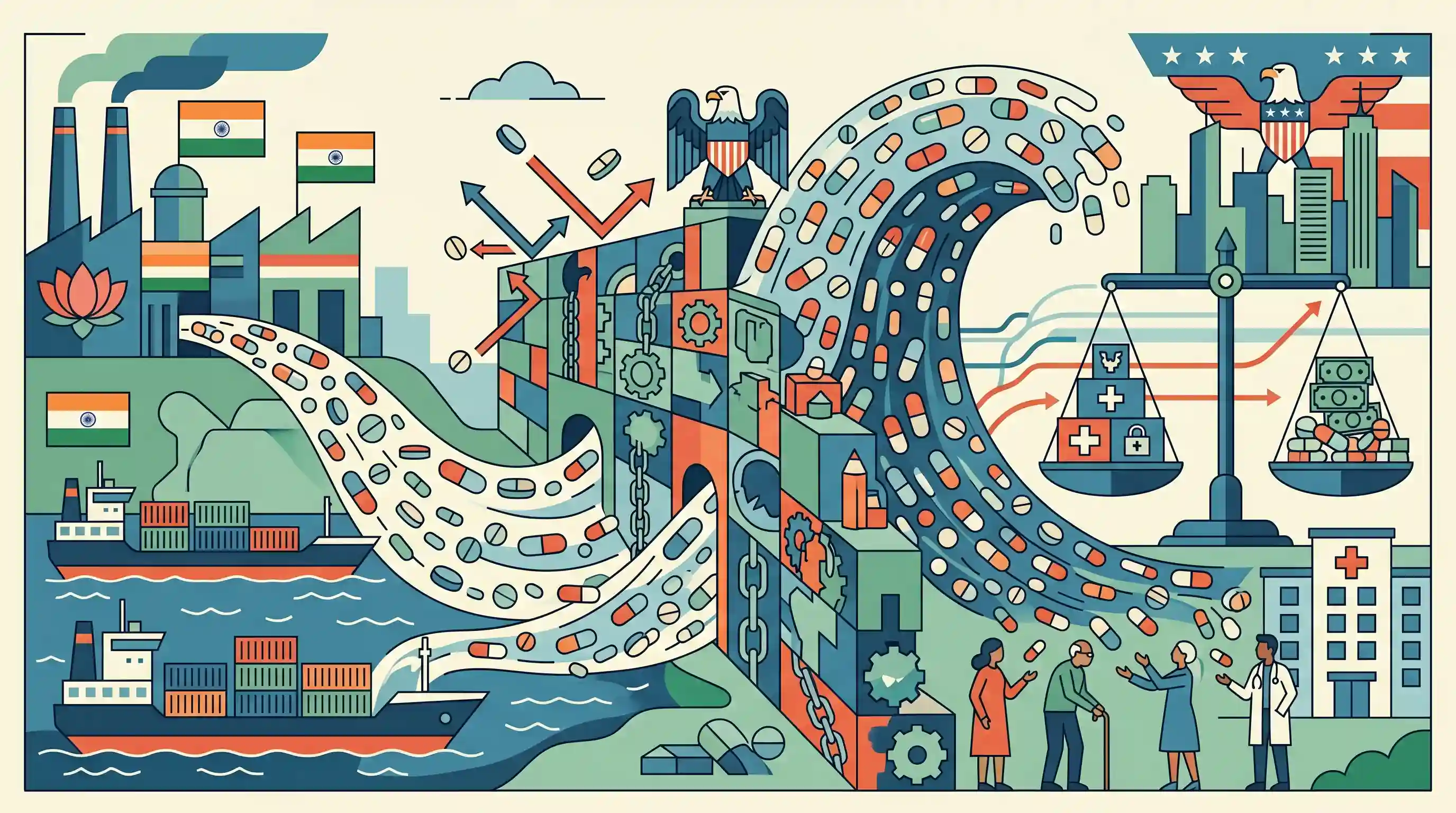
The article examines the resilience of India's generic pharmaceutical exports to the United States in the face of potential US tariffs and protectionist policies. Despite changing trade dynamics, the Indian pharma industry maintains its dominance due to the critical US need for affordable medicines to manage its ballooning healthcare costs. Consequently, upcoming trade deals are unlikely to significantly diminish the Indian generic drug juggernaut, highlighting a vital interdependence in the India-US bilateral trade relationship.
Key Points
- India continues to be a dominant supplier of generic drugs to the United States, earning the moniker 'pharmacy of the world'.
- US reliance on affordable Indian generics is primarily driven by the need to control rising domestic healthcare and prescription drug costs.
- Protectionist tariffs and trade barriers typically struggle to curb Indian pharmaceutical exports, as limiting them would lead to significantly higher healthcare costs for US consumers.
- A prospective new trade deal between India and the US is unlikely to severely disrupt the entrenched competitiveness of India's generic drug industry.
Important Terms
Generic Drugs

Medicines chemically identical to branded versions, sold at lower prices after patent expiry. India provides ~20% of global volume and ~40% of US demand, vital for global healthcare affordability.
UPSC context
GS Paper III (Economy/Health). Tests understanding of India's export strengths, healthcare equity, and the 'Pharmacy of the World' status.
Pharmacy of the World
A term highlighting India's role as the largest global provider of affordable generic medicines and a leading vaccine manufacturer (fulfilling over 60% of world demand).
UPSC context
GS Paper II/III (International Relations/Economy). Tests knowledge of India’s soft power and strategic economic significance in global health.
US Food and Drug Administration (USFDA)
The US federal agency responsible for regulating drug safety. Its stringent inspections and 'Form 483' observations are critical for Indian exporters, as the US is India’s largest pharmaceutical market.
UPSC context
GS Paper III (Science & Technology/Economy). Tests awareness of global regulatory standards and non-tariff barriers impacting Indian exports.
Intellectual Property Rights (IPR)
Legal rights protecting inventions (e.g., patents). In pharma, India’s regime (Patents Act Section 3d) prevents 'evergreening,' balancing innovator incentives with public access, often causing trade friction with the US.
UPSC context
GS Paper III (Economy/IPR). A high-frequency topic testing the balance between innovation and public health (TRIPS/Compulsory Licensing).
Protectionism
Policy of shielding domestic industries from foreign competition via tariffs or quotas. Recent US 'sector-specific duties' represent a shift toward economic nationalism that challenges India’s export-driven pharma sector.
UPSC context
GS Paper II/III (International Relations/Economy). Tests understanding of global trade shifts, 'de-globalization,' and their impact on India’s interests.
World Trade Organization (WTO)
The only global body overseeing trade rules between nations. It facilitates negotiations, settles disputes, and manages the TRIPS agreement, which governs international pharmaceutical patents and trade standards.
UPSC context
GS Paper II (International Institutions). Tests knowledge of multilateral trade frameworks, dispute settlement, and global economic governance.
Prelims Trap
India leads global generic drug exports because it is entirely self-sufficient in producing Active Pharmaceutical Ingredients (APIs).
False. While India leads globally in downstream generic formulations, it is extremely vulnerable upstream, importing 65-70% of its Active Pharmaceutical Ingredients (APIs) from China.
Static Concepts Connected
What is Patent Evergreening and how does the Indian Patents Act prevent it?
- Definition: The practice where corporations extend a patent's life by making minor modifications to an existing drug without offering significant therapeutic improvements.
- Section 3(d): Section 3(d) of the Indian Patents Act, 1970, disallows patents on new forms of known substances unless they result in significantly enhanced therapeutic efficacy.
- Novartis Case: The Supreme Court upheld Section 3(d) by rejecting the patent for the cancer drug Glivec, legally protecting India's generic drug manufacturing ecosystem.
What are Active Pharmaceutical Ingredients (APIs) and how is India reducing import dependency?
- API Defined: The biologically active component of a medication that produces the intended therapeutic effects.
- China Dependency: Despite being the 'Pharmacy of the World' for formulations, India imports 65-70% of its APIs and Key Starting Materials from China, exposing massive supply chain risks.
- Policy Push: The government launched the Production Linked Incentive (PLI) scheme for bulk drugs and is establishing Bulk Drug Parks to catalyze domestic API manufacturing.
Cross-Topic Patterns
US Protectionism vs Domestic Inflation
US tariffs on Indian generics directly fuel US healthcare inflation. This paradox explains why protectionist measures often exempt essential Indian pharma despite broader trade friction.
Geopolitics of the API Supply Chain
India exports finished doses to the US, but relies heavily on Chinese APIs. This indirectly links US healthcare security to Chinese supply chains, highlighting a complex geopolitical vulnerability.

Expect a multi-statement question linking India's generic export dominance (Section 3d of Patents Act) with its upstream API dependency.
Linked PYQs · 3
Linked PYQs · 3
- 2012MainsGS2
Discuss the likely negative impact of the protectionist measures proposed by the US on India's software industry.
- 2014MainsGS3
In a globalized world, Intellectual Property Rights assume significance and are a source of litigation. Broadly distinguish between the terms-Copyrights, Patents and Trade Secrets.
- 2019MainsGS3
How is the Government of India protecting traditional knowledge of medicine from patenting by pharmaceutical companies?
