Government Updates GDP Base Year to Compute Economic Growth Metrics
Source:The Hindu ↗
Why It Matters
Base year revisions for GDP computation fundamentally alter baseline economic statistics, directly impacting critical vulnerability metrics like the fiscal deficit and debt-to-GDP ratios. This is highly relevant for UPSC GS3 as aspirants must understand the distinction between real and nominal GDP, the mechanics of national income accounting, and how technical data changes interact with fiscal management goals outlined under the FRBM framework.
Summary
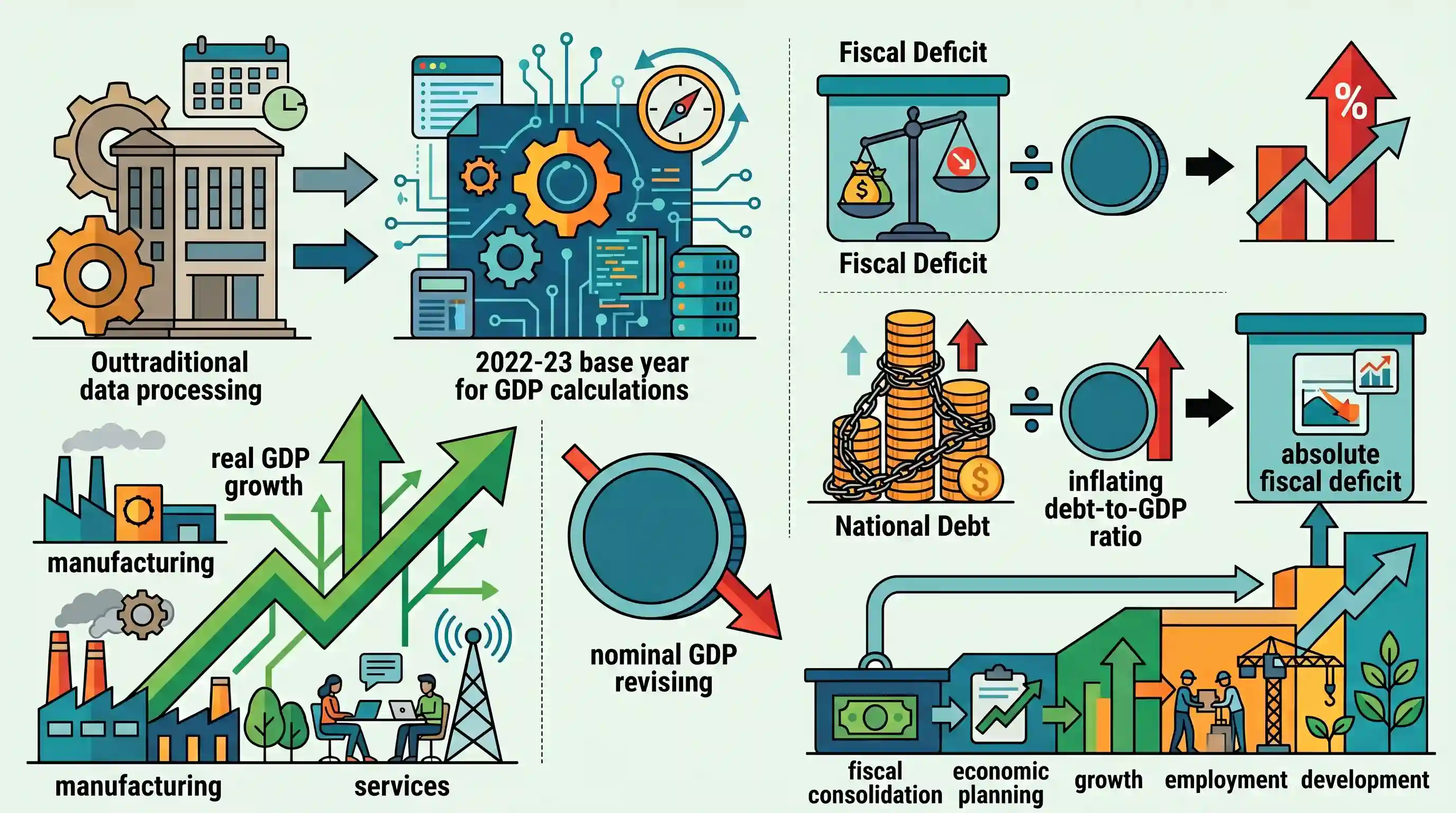
The Indian government has introduced an updated data series for calculating the Gross Domestic Product (GDP), shifting the base year to 2022-23 to incorporate more current economic realities. While real GDP growth expectations remain strong—upgraded to 7.6% for FY26 on the back of resilient manufacturing and services sectors—the absolute size of nominal GDP has been revised downwards. This mathematical adjustment naturally inflates critical macroeconomic ratios, pushing up the fiscal deficit percentage and the debt-to-GDP ratio. However, officials clarify that the absolute fiscal deficit remains unchanged, indicating no real deterioration in the government's fiscal consolidation path.
Key Points
- The government updated the base year for computing India's GDP from 2011-12 to 2022-23, integrating broader, granular datasets.
- This recalibration resulted in a smaller absolute nominal GDP size across the 2023-26 period, meaning fiscal indicators mapped as a percentage of GDP will optically worsen.
- Despite a lower nominal base, real GDP growth estimates for 2025-26 were upgraded to 7.6% (from 7.4%), supported by a robust 9.5% growth in the secondary sector (12.5% in manufacturing).
- Agriculture and the broader primary sector showed sluggishness, with growth decelerating to 2.5% and 2.8% respectively.
- Due to the smaller nominal GDP denominator, the fiscal deficit for FY26 is now pegged at 4.51% (up from 4.36%) even though the absolute borrowing amount remains identical.
- The debt-to-GDP ratio will mechanically increase by 1.9 percentage points to 57.5% for FY27, though the target to bring it down to 50% by 2031 remains intact.
Important Terms
FRBM Act

A 2003 law setting legally binding targets for the Union government to reduce deficits, aiming for long-term macroeconomic stability and fiscal discipline via sustainable borrowing.
UPSC context
GS-III (Budgeting); tests knowledge of fiscal consolidation, deficit targets, and the move toward debt-to-GDP anchors.
GDP Base Year
A benchmark year (now 2022-23) used as a reference point for calculating 'real' economic growth, updated periodically to reflect current economic structures and consumption patterns.
UPSC context
GS-III (Growth); tests understanding of National Income accounting, inflation adjustment, and structural economic shifts.
Fiscal Deficit
The gap between the government's total expenditure and its non-debt receipts, indicating the total borrowing required by the government to fund its expenses.
UPSC context
GS-III (Budgeting); critical for analyzing fiscal health, inflation, and the 'crowding-out' effect on private investment.
Debt-to-GDP Ratio
A ratio comparing a nation's total public debt to its Gross Domestic Product; it serves as a primary indicator of a country's debt sustainability.
UPSC context
GS-III (Budgeting); relevant for debt sustainability and the government's strategy to use debt as a fiscal anchor.
Double Deflation
A statistical method where output and intermediate inputs are deflated separately by their respective price indices to derive a more accurate real Gross Value Added.
UPSC context
GS-III (Economy); tests advanced understanding of GDP calculation methodology and improvements in capturing manufacturing/service sector value.
Nominal GDP
The total market value of all goods and services produced in a year, calculated using current prices without adjusting for inflation.
UPSC context
GS-III (Growth); essential for calculating critical fiscal ratios (deficit, debt) expressed as a percentage of economic size.
EY India
A leading global professional services firm whose Chief Policy Advisor provides influential macroeconomic forecasts and policy reports often cited in Indian economic discourse.
UPSC context
GS-III (Policy); represents private-sector analytical perspectives that provide third-party validation or contrast to government economic data.
Central Government
The Union Government of India, responsible for national economic policy, budgeting, and statutory oversight via the Finance and Statistics (MoSPI) ministries.
UPSC context
GS-II (Executive) & GS-III (Budgeting); tests knowledge of the Union's role in fiscal management and resource mobilization.
Prelims Trap
A rising fiscal deficit as a percentage of GDP definitively indicates an increase in absolute government borrowing.
The ratio can rise mechanically due to a downward revision of the nominal GDP (the denominator effect), even if the absolute borrowing (the numerator) remains completely unchanged.
Static Concepts Connected
What is the 'Denominator Effect' in macroeconomic ratios?
- Ratio Mechanics: Metrics like fiscal deficit and debt-to-GDP are ratios where nominal GDP serves as the denominator.
- Optical Inflation: If the nominal GDP base is revised downwards, the resulting percentage optically increases, even if actual debt or deficit values remain constant.
Why does the government periodically change the GDP base year?
- Structural Reflection: To integrate new economic activities, updated products, and modern granular datasets that were missing in older series (e.g., shifting from 2011-12 to 2022-23).
- Accurate Deflation: Updating the base year resets the constant prices used to strip out inflation, ensuring Real GDP accurately reflects genuine volume growth.
Cross-Topic Patterns
GDP rebasing + FRBM Act targets
Revising the GDP base mathematically shifts the debt-to-GDP trajectory. Aspirants must link statistical rebasing directly to fiscal consolidation challenges and debt targets under the FRBM Act.
Sectoral divergence + Disguised unemployment
Contrasting robust manufacturing growth with sluggish agriculture highlights the ongoing structural transition challenge, echoing core GS3 debates on job creation, manufacturing policy, and rural distress.

Expect a prelims statement on how downward nominal GDP revision inflates fiscal deficit percentages without raising absolute borrowing.
Linked PYQs · 5
Linked PYQs · 5
- 2021MainsGS3
Explain the difference between computing methodology of India's Gross Domestic Product (GDP) before the year 2015 and after the year 2015.
- 2018PrelimsGS1
Consider the following statements: 1. The Fiscal Responsibility and Budget Management (FRBM) Review Committee Report has recommended a debt to GDP ratio of 60% for the general (combined) government by 2023, comprising 40% for the Central Government and 20% for the State Governments. 2. The Central Government has domestic liabilities of 21% of GDP as compared to that of 49% of GDP of the State Governments. 3. As per the Constitution of India, it is mandatory for a State to take the Central Government's consent for raising any loan if the former owes any outstanding liabilities to the latter. Which of the statements given above is/are correct?
- 2020PrelimsGS1
Along with the Budget, the Finance Minister also places other documents before the Parliament which include 'The Macro Economic Framework Statement'. The aforesaid document is presented because this is mandated by
- 2013MainsGS3
What were the reasons for the introduction of Fiscal Responsibility and Budget Management (FRBM) Act, 2003 ? Discuss critically its salient features and their effectiveness.
- 2023MainsGS3
Faster economic growth requires increased share of the manufacturing sector in GDP, particularly of MSMEs. Comment on the present policies of the Government in this regard.
