India GDP Growth Forecasts and Actual Estimates Divergence
Source:Indian Express ↗
Why It Matters
Understanding how GDP is forecasted versus measured helps UPSC aspirants analyze macroeconomic health, policy formulation by the central bank and government, and the credibility of economic indicators.
Summary
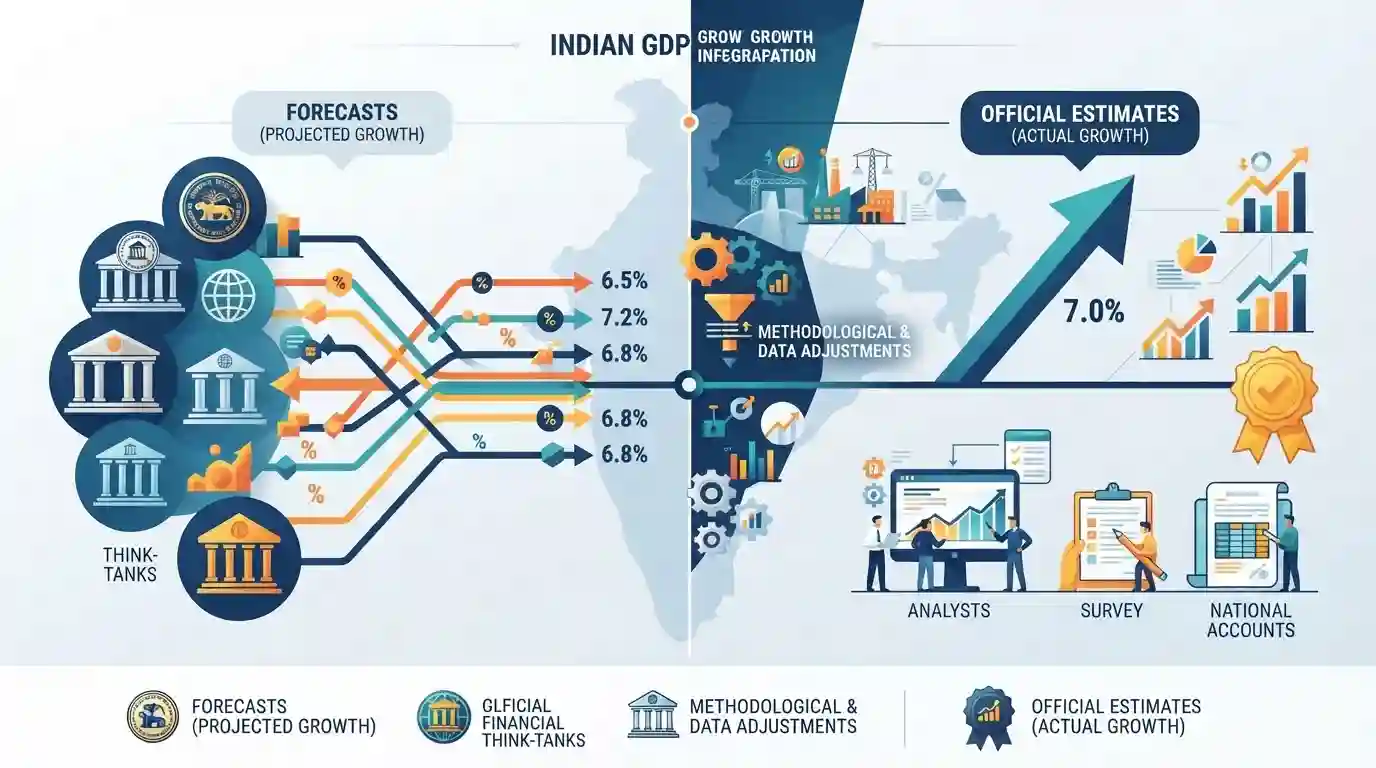
The article examines the differences and discrepancies between India's GDP growth forecasts made by various domestic and international bodies versus the actual growth estimates released by official statistical agencies, explaining the methodological and data-driven reasons behind these variations.
Key Points
- GDP growth forecasts by institutions like the RBI, IMF, and World Bank often diverge from actual National Statistical Office (NSO) estimates due to varying data models, assumptions, and information lags.
- Forecasting involves predicting future economic performance based on high-frequency indicators, whereas actual estimates rely on comprehensive sectoral data collection over time.
- Discrepancies highlight the inherent difficulties of capturing macroeconomic trends in dynamic developing economies like India.
Important Terms
Reserve Bank of India

India's central banking institution that regulates the monetary policy, issues currency, and regularly releases forward-looking GDP growth forecasts and macroeconomic projections using models like the Quarterly Projection Model (QPM).
UPSC context
UPSC GS Paper III (Indian Economy - Monetary Policy, Inflation, Growth). Essential for understanding macroeconomic forecasting and central bank interventions.
National Statistical Office
The statistical wing under MoSPI responsible for the collection, compilation, and official release of national accounts data, including quarterly GDP estimates and advance growth figures.
UPSC context
UPSC GS Paper III (Inclusive Growth and Planning). Crucial for questions on economic data credibility, base year revisions, and official growth statistics.
Ministry of Statistics and Programme Implementation
The nodal central ministry in India responsible for formulating policies, coordinating statistical standards, and overseeing national income accounting through agencies like the NSO.
UPSC context
UPSC GS Paper III (Indian Economy - Planning and Resource Mobilization). Important for understanding administrative mechanisms behind macroeconomic data releases.
Prelims Trap
High-frequency economic indicators such as GST collections and e-way bills constitute the final official GDP estimates released by the NSO.
Aspirants often confuse high-frequency indicators used for nowcasting with official NSO national accounts data based on comprehensive annual surveys.
Static Concepts Connected
What are the key differences between the provisional estimates, advance estimates, and final revisions of India's GDP?
- First Advance Estimates: Calculated using limited data and corporate filings; released soon after the financial year ends as a preliminary benchmark.
- Subsequent Revisions: Incorporate more comprehensive sectoral data sets and industrial surveys to refine the initial macroeconomic growth trajectory.
- Final Revisions: Involve exhaustive census and annual survey data from MCA-21 and administrative databases, often taking several years to finalise.
Cross-Topic Patterns
Macro Forecasting + Digital Fiscal Governance
High-frequency indicators like GST collections and e-way bills are increasingly used by both the RBI for growth forecasting and fiscal planners for tax buoyancy estimates.

Expect statement-based questions on the difference between forecasting models and actual NSO national accounts estimation methodologies.
Linked PYQs · 1
Linked PYQs · 1
- 2021MainsGS3
Explain the difference between computing methodology of India's Gross Domestic Product (GDP) before the year 2015 and after the year 2015.
