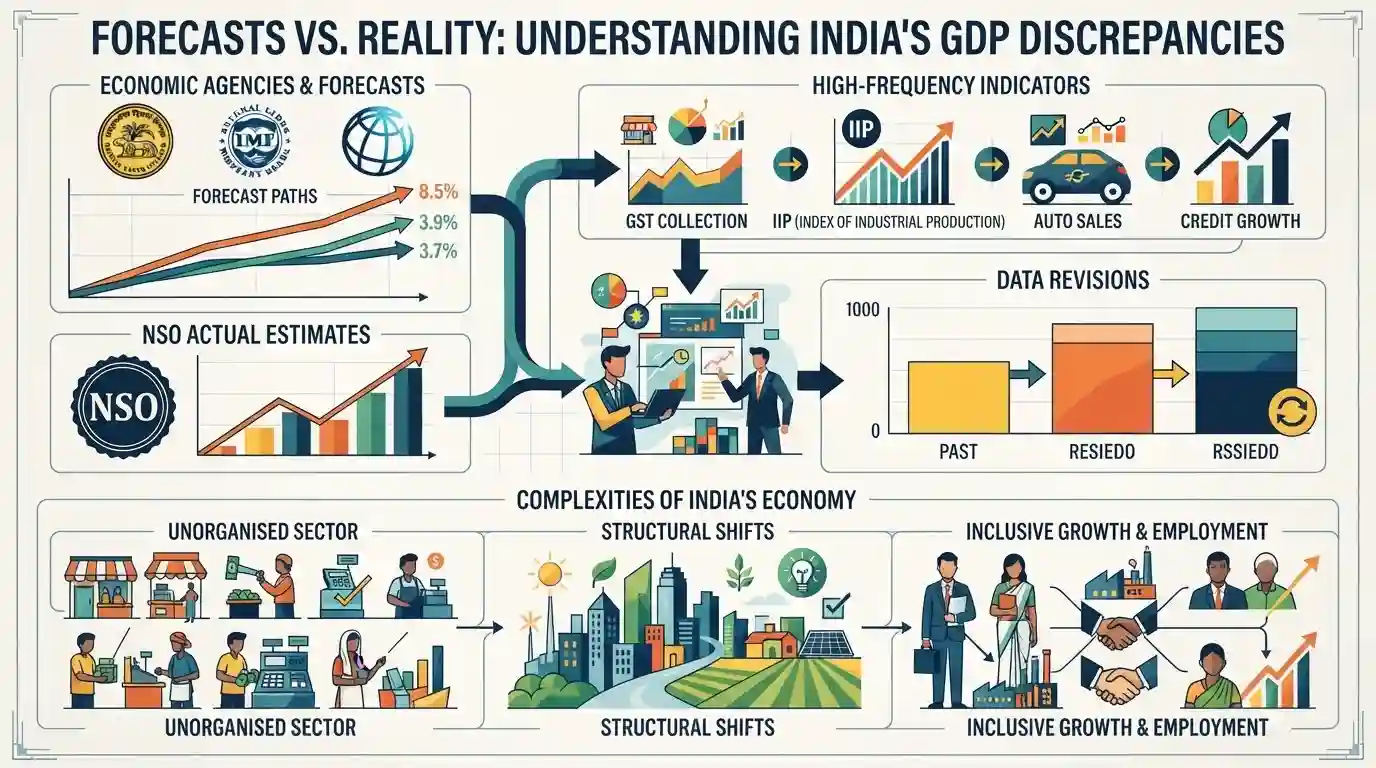
Analyzing divergence between GDP growth forecasts and actual estimates
Source:Indian Express ↗
কেন এটি গুরুত্বপূর্ণ
Understanding the mechanics of GDP forecasting and actual growth data is critical for civil services aspirants as it underpins fiscal policy formulation, monetary policy decisions by the RBI, and evaluations of India's macroeconomic performance.
সারসংক্ষেপ
The article explains why GDP growth forecasts made by premier economic agencies (such as the RBI, IMF, and World Bank) frequently diverge from actual growth estimates released by the National Statistical Office (NSO). It dives into the methodologies of economic forecasting, the reliance on high-frequency indicators, data revisions, and the limitations of predicting growth in complex developing economies like India.
মূল বিষয়
- GDP growth forecasts by institutions like the RBI, IMF, and World Bank often differ from actual macroeconomic outcomes due to structural shifts, unpredictable global shocks, and revisions in statistical data.
- The National Statistical Office (NSO) releases advance estimates, provisional estimates, and actual data, which undergo revision as more comprehensive sector-wise data becomes available.
- Forecasting methodologies rely on high-frequency indicators (PMI, tax collections, credit growth), which can sometimes misalign with informal sector realities or sudden supply-side disruptions.
- Discrepancies between forecasted and actual numbers highlight the inherent challenges of predicting economic momentum in a complex, transitioning economy like India.
গুরুত্বপূর্ণ শব্দ
National Statistical Office (NSO)

The premier statistical agency under the Ministry of Statistics and Programme Implementation (MoSPI) responsible for collecting data, conducting large-scale sample surveys, and releasing official macroeconomic aggregates like national income and GDP estimates in India.
UPSC context
UPSC Prelims/Mains (GS Paper III): Important statutory/institutional bodies in Indian economy, data collection methodologies, and national income accounting.
Reserve Bank of India (RBI)
India's central banking institution which regulates the monetary policy framework, issues currency, and formulates macroeconomic projections including quarterly and annual GDP growth forecasts to anchor inflation and growth.
UPSC context
UPSC Prelims/Mains (GS Paper III): Central banking, monetary policy committee (MPC), inflation targeting, and economic growth management.
International Monetary Fund (IMF)
An international organization of 190 member countries working to foster global monetary cooperation, secure financial stability, and provide macroeconomic policy advice and growth projections for member nations.
UPSC context
UPSC Prelims/Mains (GS Paper III): International financial institutions, global economic outlook, and balance of payments.
World Bank
A global financial institution comprising the IBRD and IDA that provides financial and technical assistance to developing countries, frequently publishing independent economic forecasts and development reports for India.
UPSC context
UPSC Prelims/Mains (GS Paper III): International economic organizations, poverty alleviation, infrastructure financing, and developmental planning.
সংযুক্ত স্থির ধারণা
What are the stages of National Income estimation and release by the NSO in India?
- First Advance Estimates (FAE):: Released in January, prior to the close of the financial year, using pre-actual data for baseline extrapolation.
- Second Advance Estimates (SAE):: Released in February with slightly more comprehensive sectoral data updates.
- Provisional Estimates (PE):: Released at the end of May following the financial year, incorporating full-year departmental data.
- Revised Estimates:: Subject to multiple subsequent revisions (First, Second, and Third Revised Estimates) as comprehensive annual structural data flows in.
আন্তঃবিষয় প্যাটার্ন
GDP Forecasting & MoSPI Data Reliability
The heavy reliance of official forecasting models on high-frequency tax and PMI data links macro-governance with data science governance under the Ministry of Statistics and Programme Implementation (MoSPI).

Expect a statement-based prelims question on the sequence of NSO GDP releases (FAE to FRE) and institutional forecasting methods.
সংযুক্ত PYQ · 2
সংযুক্ত PYQ · 2
- 2021MainsGS3
Explain the difference between computing methodology of India's Gross Domestic Product (GDP) before the year 2015 and after the year 2015.
- 2020MainsGS3
Define potential GDP and explain its determinants. What are the factors that have been inhibiting India from realizing its potential GDP?
