India Economic Growth Trends Inflation and Export Challenges
Source:Indian Express ↗
Why It Matters
Crucial for understanding macroeconomic stability, growth determinants, and structural bottlenecks in India's path to higher potential GDP.
Summary
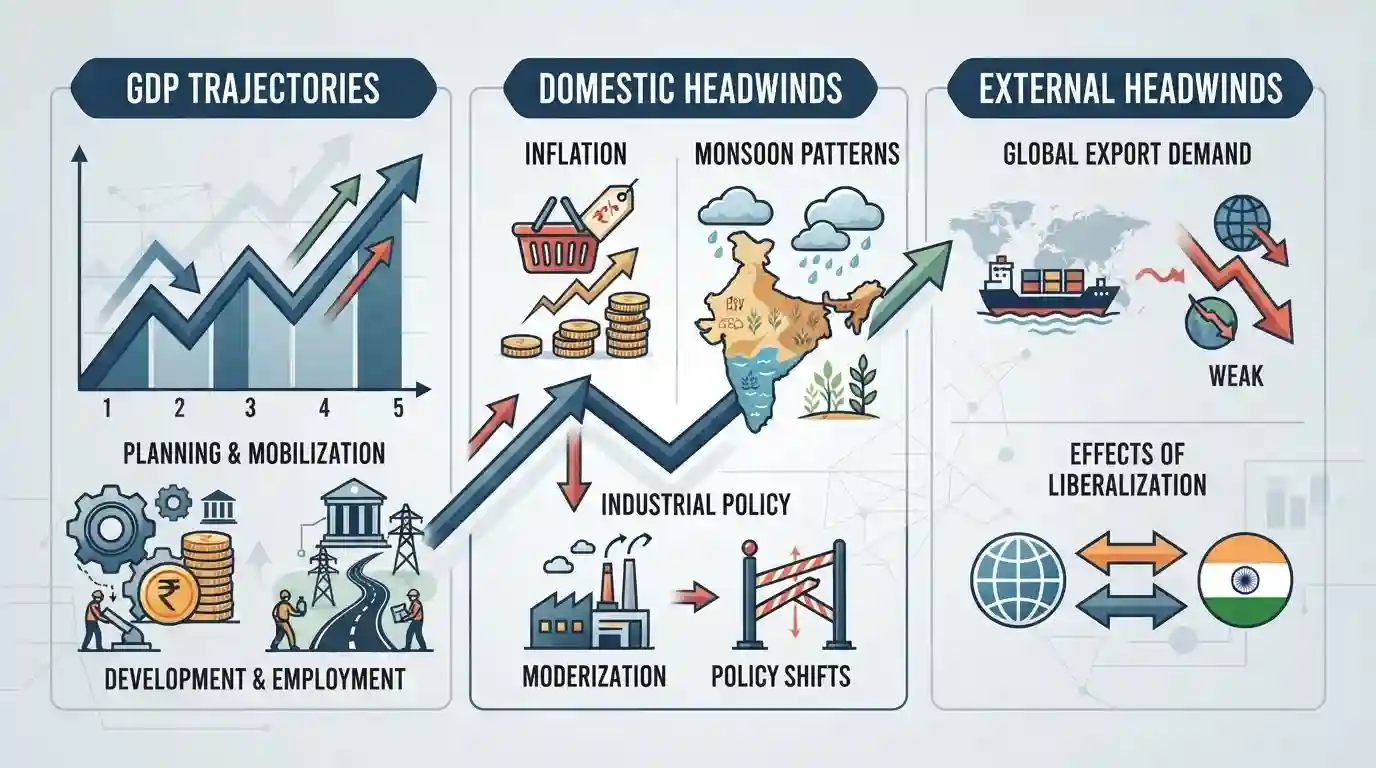
An analysis of India's GDP growth trajectories, examining key domestic and external headwinds such as inflation, monsoon patterns, and global export demand as outlined by economic assessments.
Key Points
- India's GDP growth is witnessing structural shifts, balancing domestic consumption against external global headwinds.
- Monsoon patterns and agricultural output continue to play a foundational role in rural demand and overall inflation management.
- Export performance is increasingly tied to global trade dynamics, geopolitical fragmentation, and competitiveness in manufacturing.
- Inflationary pressures pose a challenge to monetary policy formulation and purchasing power parity across income groups.
Important Terms
CRISIL

A leading Indian analytical company providing ratings, research, and risk and policy advisory services, frequently cited for macroeconomic forecasts and industry performance analysis in India.
UPSC context
UPSC CSE General Studies Paper III (Economy): Useful for understanding economic indicators, growth projections, and private sector macroeconomic analysis in India.
Prelims Trap
CRISIL's economic assessments directly determine the statutory liquidity ratio and repo rate adjustments by the RBI.
Aspirants often assume credit rating agencies like CRISIL set monetary policy rates or statutory liquidity ratios, whereas their role is strictly analytical and projective.
Static Concepts Connected
What are the primary components and limitations of measuring GDP via the Expenditure Method in India?
- Core Components: Formula components include Private Final Consumption Expenditure (PFCE), Government Final Consumption Expenditure (GFCE), Gross Capital Formation (GCF), and Net Exports (X-M).
- Expenditure Role: Measures the total final expenditure incurred by all entities within the domestic territory, serving as a vital counterpart to Gross Value Added (GVA).
- Measurement Limits: Informal sector cash flows and unorganized manufacturing output create estimation lags and revision discrepancies in quarterly data releases.
Cross-Topic Patterns
Monsoon Deficits and Monetary Policy Transmission
How agricultural shocks transmitted through erratic monsoons directly feed headline inflation, forcing RBI's monetary policy committee to balance growth with price stability.
Global Value Chains vs Domestic Consumption Buffer
Examining how domestic structural demand buffers the Indian economy against global trade fragmentation and declining western export demand.

Expect statement-based questions pairing CRISIL/RBI growth projections with structural drivers like rural demand elasticity and export fragmentation.
Linked PYQs · 3
Linked PYQs · 3
- 2019MainsGS3
Do you agree with the view that steady GDP growth and low inflation have left the Indian economy in good shape? Give reasons in support of your arguments.
- 2023MainsGS3
Faster economic growth requires increased share of the manufacturing sector in GDP, particularly of MSMEs. Comment on the present policies of the Government in this regard.
- 2020MainsGS3
Define potential GDP and explain its determinants. What are the factors that have been inhibiting India from realizing its potential GDP?
