India First Quarter GDP Growth and Capital Formation Performance
Source:Indian Express ↗
Why It Matters
This article provides vital empirical insights into India's post-pandemic macroeconomic momentum, trends in capital formation and private investments, and the delicate balance central banks must navigate between fostering growth and containing imported inflation amid geopolitical headwinds.
Summary
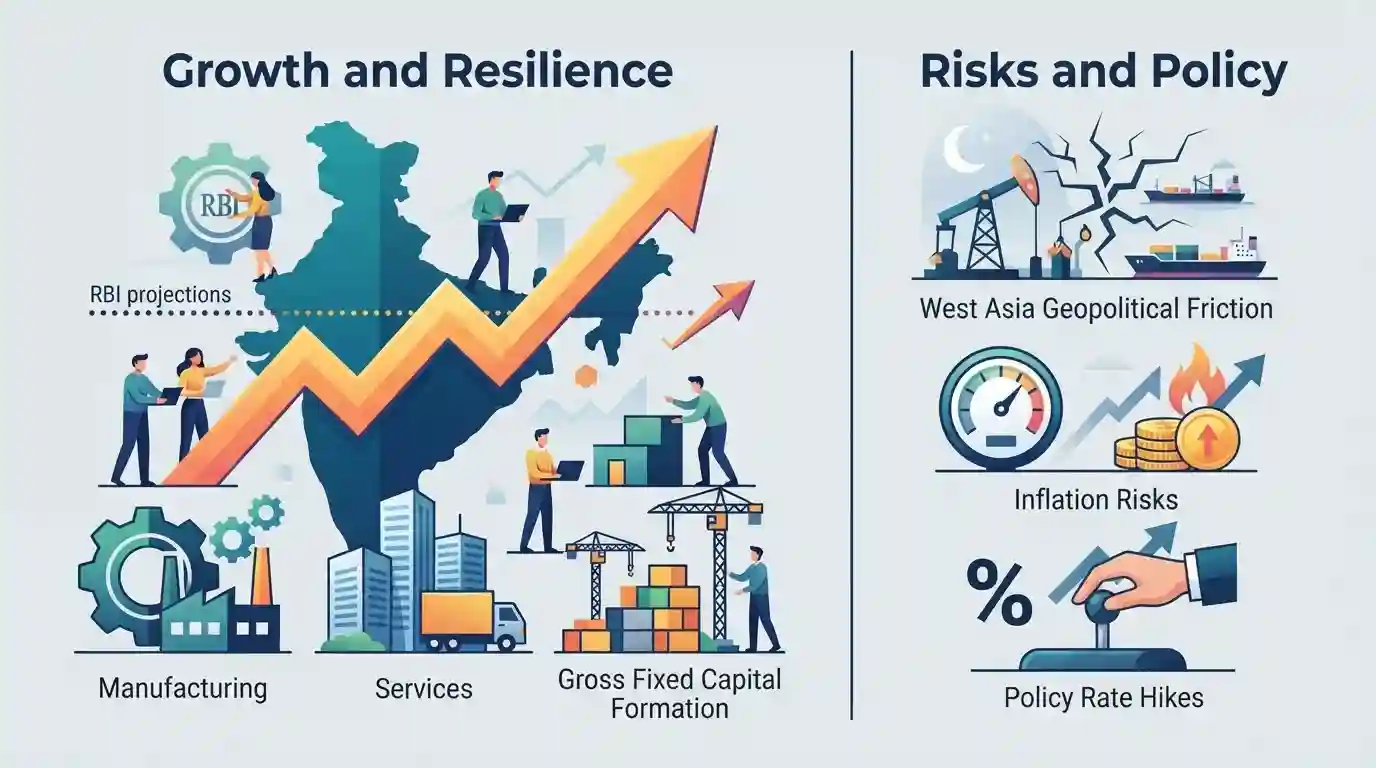
India's real GDP grew by 7.8% in the April-June quarter of FY 2026-27, outperforming the Reserve Bank of India's projection of 7%. The resilient performance was underpinned by robust manufacturing and services activity alongside a sharp surge in Gross Fixed Capital Formation (GFCF). However, analysts caution that persistent West Asia geopolitical friction and crude oil supply risks could elevate inflation, potentially tilting the central bank toward policy rate hikes.
Key Points
- India's GDP grew by a robust 7.8% year-on-year in the April-June quarter of FY 2026-27, beating the RBI's forecast of 7%.
- Growth was heavily driven by near double-digit expansions in manufacturing (9.2%) and services (10%).
- Gross Fixed Capital Formation (GFCF), a vital proxy for investments, grew by a sharp 11.9% (20.4% in nominal terms), increasing its share in GDP to 34.3%.
- Geopolitical tensions and conflicts in West Asia pose lingering risks of high crude oil prices and supply chain disruptions, which could stoke inflation and provoke RBI rate hikes.
Important Terms
Reserve Bank of India

India's central banking institution that regulates the monetary policy, issues currency, supervises the financial system, and sets policy rates to maintain price stability alongside growth.
UPSC context
UPSC GS Paper III (Indian Economy): Tests understanding of monetary policy, central banking functions, inflation targeting, and financial sector regulation.
Ministry of Statistics and Programme Implementation
The nodal central government ministry responsible for independent collection, compilation, and dissemination of official statistical data, including national income accounts and macroeconomic indicators like GDP.
UPSC context
UPSC GS Paper III (Indian Economy): Tests knowledge of official macroeconomic data sources, statistical measurement, and growth estimation in India.
Static Concepts Connected
What are the components of Gross Domestic Product (GDP) calculated via the Expenditure Method?
- Expenditure Identity: Formula represents GDP as Consumption plus Investment plus Government spending plus Net Exports (C + I + G + NX).
- Domestic Spending: Measures the total final expenditures made by households, businesses, government, and the external sector within domestic territory.
- Capital Formation: Gross Fixed Capital Formation (GFCF) forms the core investment component (I) reflecting physical capital creation.
Cross-Topic Patterns
Macroeconomic stability + External geopolitical shocks
How West Asian energy shocks transmit through imported inflation to pressure the RBI's flexible inflation-targeting mandate, complicating fiscal-monetary coordination during high growth phases.

GFCF surge paired with manufacturing growth in quarterly GDP data makes an ideal multi-statement prelims question on capital formation.
Linked PYQs · 3
Linked PYQs · 3
- 2024MainsGS3
What are the causes of persistent high food inflation in India? Comment on the effectiveness of the monetary policy of the RBI to control this type of inflation.
- 2020MainsGS3
Explain the meaning of investment in an economy in terms of capital formation. Discuss the factors to be considered while designing a concession agreement between a public entity and a private entity.
- 2023MainsGS3
Faster economic growth requires increased share of the manufacturing sector in GDP, particularly of MSMEs. Comment on the present policies of the Government in this regard.
