India Quarterly GDP Growth Performance and RBI Projections
Source:Indian Express ↗
ఇది ఎందుకు ముఖ్యం
Understanding quarterly GDP data and economic growth trends is vital for aspirants to analyze macroeconomic stability, fiscal policy formulation, and India's path toward achieving its potential growth rate.
సారాంశం
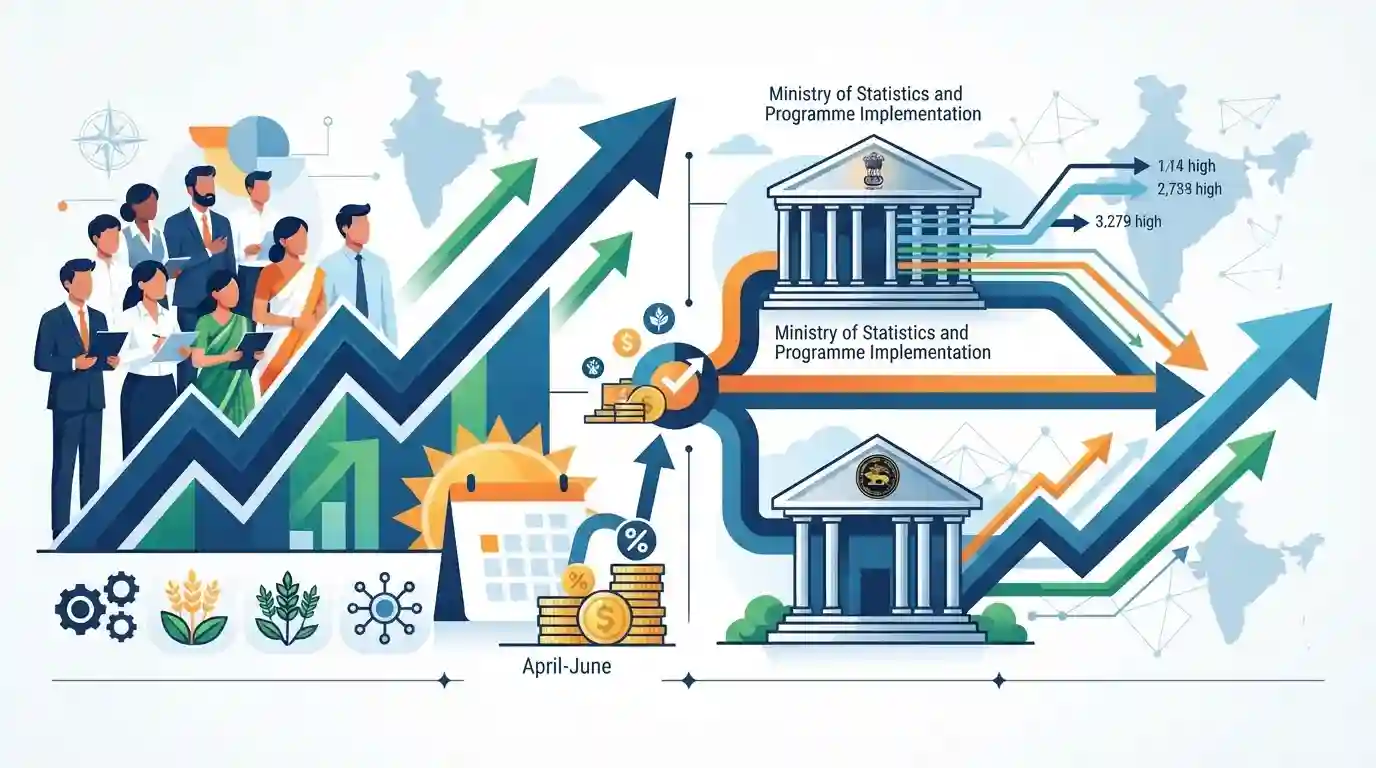
The article discusses India's GDP growth performance for the April-June quarter, analyzing official statistics released by the Ministry of Statistics and Programme Implementation alongside projections made by the Reserve Bank of India (RBI).
ముఖ్య అంశాలు
- India's GDP growth data for the April-June quarter as released by the statistics ministry.
- Comparison of actual growth figures against Reserve Bank of India (RBI) forecasts and macroeconomic indicators.
- Evaluation of key growth drivers such as consumption, investment, and sectoral performance (agriculture, industry, services).
ముఖ్యమైన పదాలు
Reserve Bank of India

India's central bank and apex monetary authority responsible for regulating the issue of bank notes, maintaining price stability, controlling inflation, and managing the country's credit and foreign exchange systems.
UPSC context
UPSC GS Paper III (Indian Economy): Tests understanding of monetary policy, central banking functions, and economic regulation.
Ministry of Statistics and Programme Implementation
The central government ministry responsible for formulating and publishing official statistics—including GDP estimates and IIP data—and monitoring major infrastructure programs and developmental projects across India.
UPSC context
UPSC GS Paper III (Indian Economy): Tests knowledge of official data systems, national income accounting, and economic planning.
ప్రిలిమ్స్ ఉచ్చు
Quarterly Gross Value Added (GVA) growth is identical to GDP growth because both measure the total national output at market prices without exception.
Aspirants often confuse Gross Value Added (GVA) at basic prices with GDP at market prices; GVA excludes net indirect taxes, whereas GDP includes them.
అనుసంధానమైన స్థిర భావనలు
What is the difference between Gross Value Added (GVA) and Gross Domestic Product (GDP)?
- Supply-Side Metric: GVA measures output from the supply side by looking at value added across different economic sectors (agriculture, industry, services).
- Demand-Side Metric: GDP measures output from the demand side, calculated by summing consumption, investment, government spending, and net exports.
- The Formula Link: GDP is mathematically derived from GVA by adding product taxes and subtracting product subsidies.
అంతర-అంశ నమూనాలు
Infrastructure CAPEX + Fiscal Deficit Targets
High-frequency capital expenditure by the state directly crowds in private corporate investment, boosting GFCF and impacting the central fiscal deficit trajectory under the FRBM Act.
GVA vs GDP Growth Divergence
Discrepancies between Gross Value Added (supply side) and Gross Domestic Product (demand side) frequently appear in Mains questions on national income accounting.

Expect a statement-based prelims question distinguishing between GVA (sectoral supply) and GDP (expenditure) along with RBI's forecasting role.
అనుసంధాన PYQలు · 2
అనుసంధాన PYQలు · 2
- 2020MainsGS3
Define potential GDP and explain its determinants. What are the factors that have been inhibiting India from realizing its potential GDP?
- 2021MainsGS3
“Investment in infrastructure is essential for more rapid and inclusive economic growth.” Discuss in the light of India's experience.
