India Quarterly GDP Growth and RBI Macroeconomic Forecast Trends
Source:Indian Express ↗
हे का महत्त्वाचे आहे
Tracking quarterly GDP growth and comparing it with central bank forecasts is vital for understanding macroeconomic stability, policy responses, and the trajectory of India's economic development.
सारांश
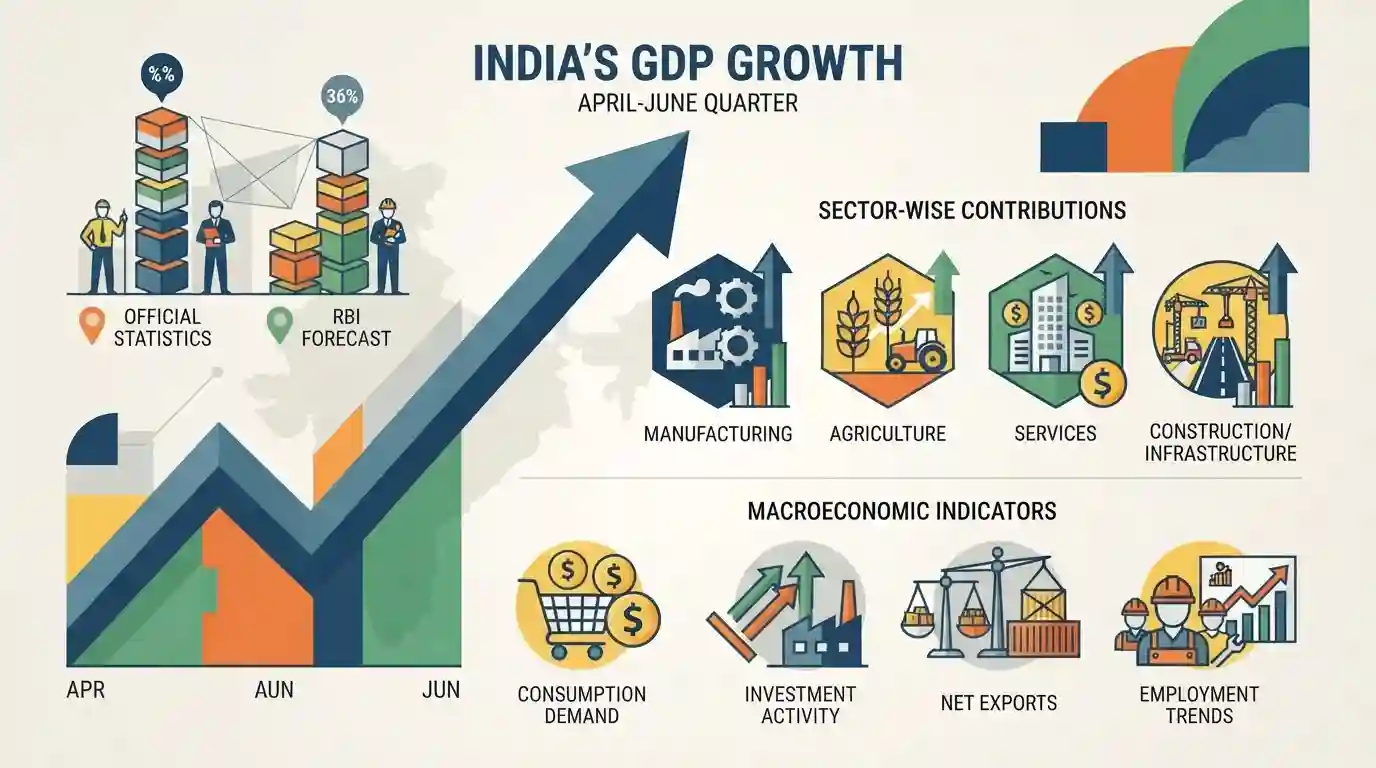
An analysis of India's GDP growth performance for the April-June quarter, evaluating official statistics against RBI forecasts and examining underlying macroeconomic indicators such as sector-wise contributions and growth drivers.
मुख्य मुद्दे
- India's GDP growth rate data for the April-June quarter reflects macro-economic trends and momentum in key sectors.
- Comparisons between Reserve Bank of India (RBI) forecasts and actual statistics released by the Ministry provide insight into forecasting accuracy and economic health.
- Analysing quarterly growth trends helps evaluate consumption demand, manufacturing performance, and investment cycles in the Indian economy.
महत्त्वाच्या संज्ञा
Reserve Bank of India

India's central bank and apex monetary authority, established in 1935 under the RBI Act, 1934, responsible for regulating currency, issuing monetary policy, and maintaining financial stability.
UPSC context
Important for UPSC GS Paper III under Indian Economy and issues relating to monetary policy, banking, and financial sector regulation.
Ministry of Statistics and Programme Implementation
The central statistical agency of India under the Ministry of Statistics and Programme Implementation responsible for collecting national accounts data, including GDP and GVA estimates.
UPSC context
Crucial for UPSC GS Paper III (Indian Economy), focusing on official data systems, economic planning, growth measurement, and national income accounting.
संबंधित स्थिर संकल्पना
How are quarterly GDP estimates compiled in India, and which agency is responsible?
- Compiled by NSO: NSO Role: Compiled by the National Statistics Office (NSO) under the Ministry of Statistics and Programme Implementation (MoSPI).
- Methodology Used: Benchmark-Indicator: Uses the benchmark-indicator methodology, extrapolating past annual benchmark figures using high-frequency indicators like IIP, corporate results, and GST collections.
आंतर-विषय नमुने
GDP Estimates vs. RBI Monetary Policy Framework
Quarterly GDP growth and inflation trends dictate the Monetary Policy Committee's rate-cut cycles, directly testing the statutory 4 (+/-2)% inflation-targeting framework under the RBI Act.
Quarterly Growth Trends vs. FRBM Fiscal Targets
Disaggregated quarterly data reveals private consumption and gross capital formation trends, linking immediate macroeconomic performance with structural capex cycles in the Union Budget.

Expect statement-based prelims questions pairing MoSPI's benchmark-indicator methodology with NSO's high-frequency extrapolation techniques.
संबंधित PYQ · 2
संबंधित PYQ · 2
- 2019MainsGS3
Do you agree with the view that steady GDP growth and low inflation have left the Indian economy in good shape? Give reasons in support of your arguments.
- 2023MainsGS3
Faster economic growth requires increased share of the manufacturing sector in GDP, particularly of MSMEs. Comment on the present policies of the Government in this regard.
