Quarterly GDP Growth and RBI Macroeconomic Projections
Source:Indian Express ↗
ఇది ఎందుకు ముఖ్యం
Understanding quarterly GDP growth data and RBI projections is crucial for analyzing India's macroeconomic trajectory, domestic demand, investment activity, and the monetary policy framework, which directly aligns with GS3 syllabus requirements on economic development and growth.
సారాంశం
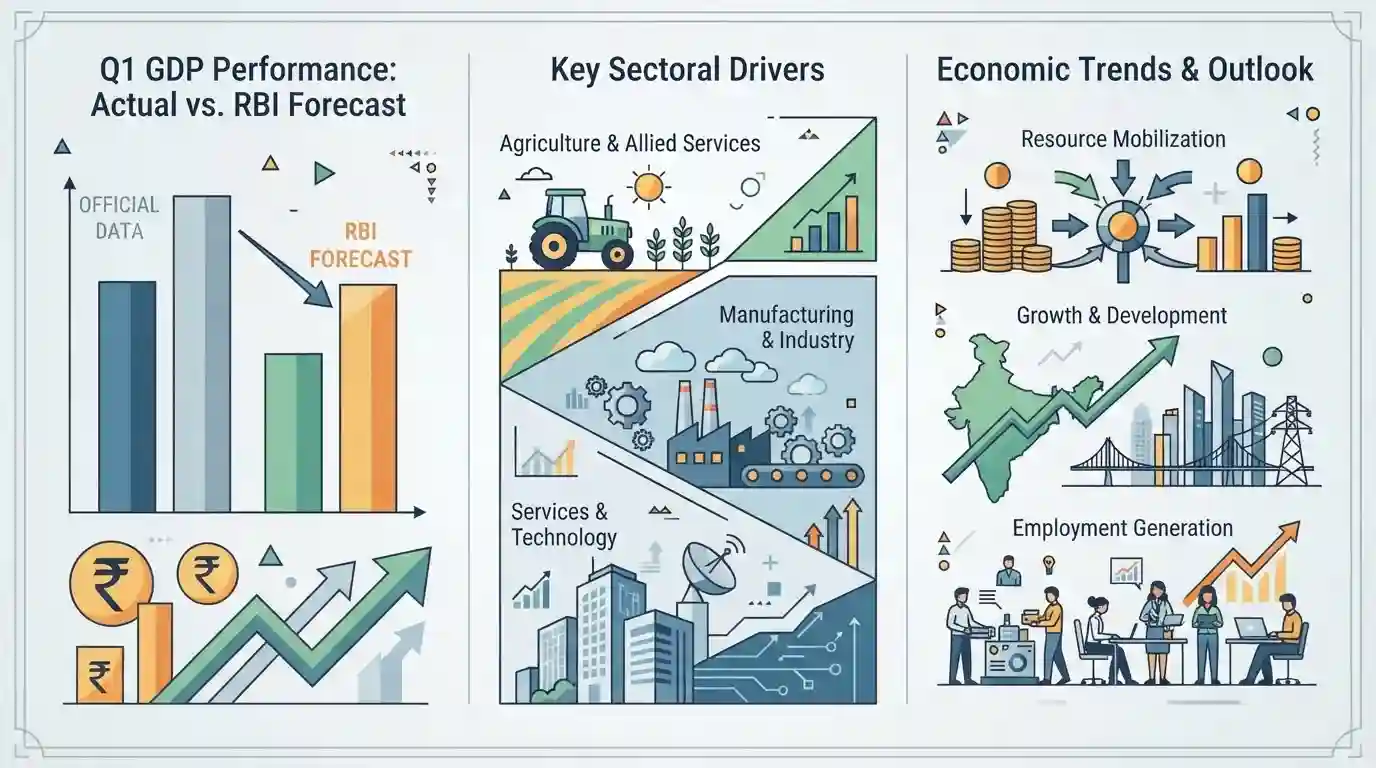
This article discusses India's GDP growth performance for the April-June quarter, evaluating official statistics released by the government against forecasts previously made by the Reserve Bank of India (RBI), highlighting key sectoral drivers and economic trends.
ముఖ్య అంశాలు
- India's quarterly GDP growth metrics for the April-June period reflect macroeconomic performance, comparing official statistics with projections made by the Reserve Bank of India (RBI).
- Analysis of key growth drivers like manufacturing, services, capital formation, and private final consumption expenditure provides insights into domestic economic health.
- Discrepancies or alignments between central bank forecasts and national statistical releases guide monetary policy stance and liquidity management.
ముఖ్యమైన పదాలు
Reserve Bank of India

India's central bank and apex monetary authority responsible for regulating the monetary and financial system, issuing currency, managing foreign exchange, and maintaining price stability alongside economic growth.
UPSC context
UPSC Prelims & Mains (GS Paper III): Core institution for monetary policy, inflation management, banking regulation, and liquidity operations in the Indian economy.
Ministry of Statistics and Programme Implementation
The central ministry responsible for formulation of national statistical policies, collection, compilation, and release of macroeconomic aggregates like Gross Domestic Product (GDP) and Gross Value Added (GVA) in India.
UPSC context
UPSC Prelims & Mains (GS Paper III): Essential for questions on national income accounting, economic data releases, and statistical methodologies like base-year revisions.
ప్రిలిమ్స్ ఉచ్చు
Real GVA growth and real GDP growth are identical because both measure aggregate economic output at constant prices.
Aspirants often confuse Gross Value Added (GVA) at basic prices with Gross Domestic Product (GDP) at market prices; GVA excludes net product taxes, whereas GDP includes them.
అనుసంధానమైన స్థిర భావనలు
What is the difference between Gross Domestic Product (GDP) and Gross Value Added (GVA)?
- GVA Definition: Measures output from the supply side, tracking value added across primary, secondary, and tertiary sectors before adding net taxes.
- GDP Definition: Measures output from the demand side, calculated as GVA plus product taxes minus product subsidies.
- Policy Utility: GDP is the preferred measure for international comparisons and overall economic size, while GVA reflects sectoral performance.
అంతర-అంశ నమూనాలు
GDP Growth + Monetary Policy Transmission
Quarterly GDP releases directly inform the RBI's Monetary Policy Committee (MPC) rate-setting decisions and liquidity absorption/injection operations.
National Accounts Base Year Revision + Fiscal Math
Shifting base years in national accounts (now 2022-23) alter GVA weightings, directly impacting fiscal deficit ratios and debt-to-GDP computations.

Expect statements comparing real GDP vs GVA growth divergence and RBI projection accuracy in prelims macroeconomics MCQs.
అనుసంధాన PYQలు · 2
అనుసంధాన PYQలు · 2
- 2023MainsGS3
Faster economic growth requires increased share of the manufacturing sector in GDP, particularly of MSMEs. Comment on the present policies of the Government in this regard.
- 2022MainsGS3
Is inclusive growth possible under market economy ? State the significance of financial inclusion in achieving economic growth in India.
