April June Quarter GDP Growth and Macroeconomic Indicators
Source:Indian Express ↗
কেন এটি গুরুত্বপূর্ণ
Understanding quarterly GDP trends, drivers of growth like GFCF and manufacturing, and macroeconomic challenges such as inflation and global supply shocks is crucial for aspirants studying India's macroeconomic framework and growth recovery.
সারসংক্ষেপ
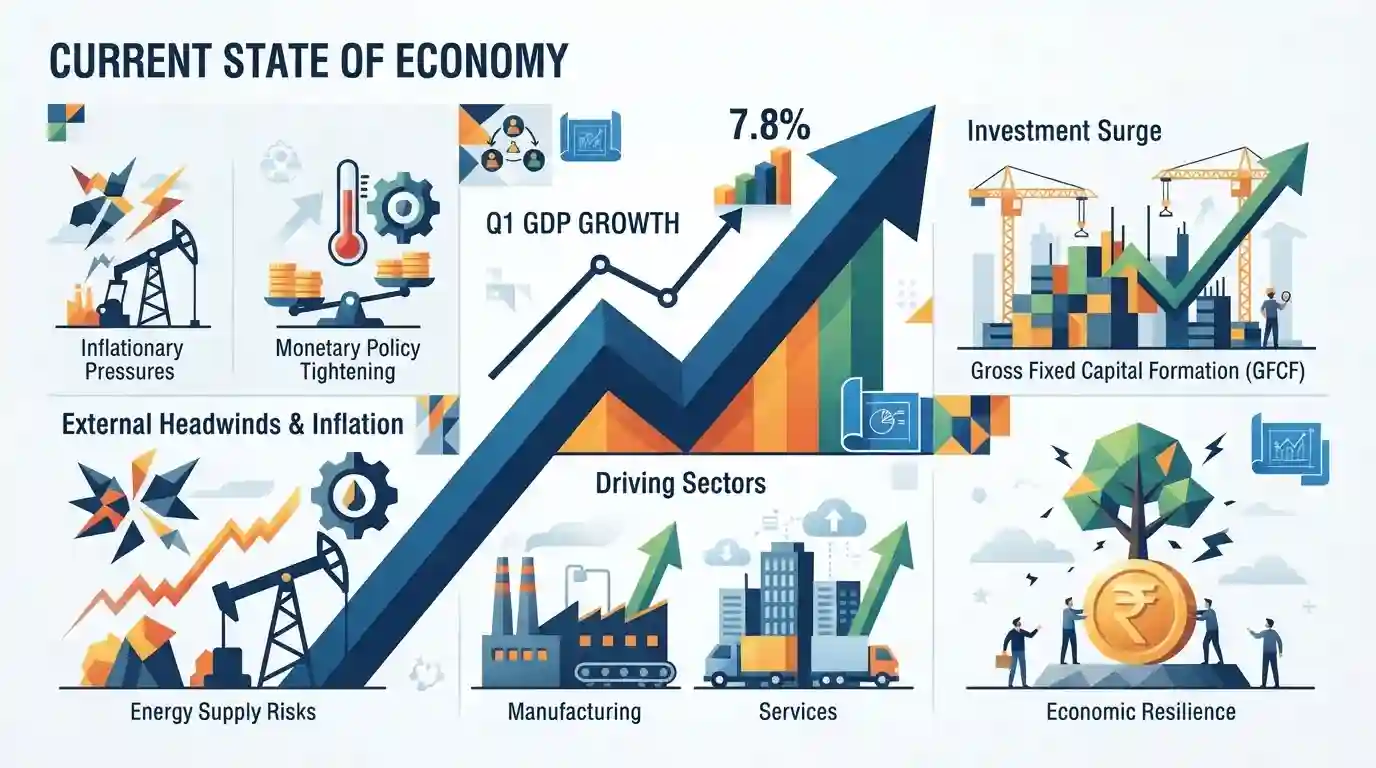
India's economy registered a robust 7.8% growth rate in the April-June quarter, driven by strong performances in manufacturing and services, as well as a significant surge in Gross Fixed Capital Formation (GFCF). Despite external headwinds from the West Asia conflict and energy supply risks, the data highlights strong economic resilience, though analysts caution that inflationary pressures could prompt future monetary policy tightening by the RBI.
মূল বিষয়
- India's GDP grew by a robust 7.8% year-on-year in the April-June quarter, outperforming the Reserve Bank of India's forecast of 7%.
- The manufacturing sector grew by 9.2%, while the tertiary (services) sector expanded by 10%.
- Gross Fixed Capital Formation (GFCF), a key proxy for investments, surged by 11.9% in real terms and 20.4% in nominal terms, pushing its share in GDP to 34.3%.
- Despite strong resilience, analysts and officials warn that persistent West Asia conflicts, high energy prices, and crude supply disruptions pose upside risks to inflation and could potentially trigger interest rate hikes.
গুরুত্বপূর্ণ শব্দ
Reserve Bank of India

India's central bank and apex monetary authority, established under the RBI Act of 1934, responsible for regulating monetary policy, issuing currency, and maintaining financial stability.
UPSC context
UPSC Prelims/Mains GS-3: Central banking functions, monetary policy framework, inflation targeting, and regulation of the Indian financial system.
Ministry of Statistics and Programme Implementation
The nodal central ministry responsible for collecting, compiling, and disseminating official statistical data, national accounts (GDP), and monitoring major government infrastructure programs in India.
UPSC context
UPSC Prelims/Mains GS-3: Official data systems, socio-economic indicators, national income accounting, and program monitoring in economic planning.
Gross Fixed Capital Formation
A macroeconomic component of the expenditure-based GDP that measures net acquisitions of fixed assets (like machinery, buildings, and infrastructure) used to expand an economy's productive capacity.
UPSC context
UPSC Prelims/Mains GS-3: Investment trends, capital formation, components of GDP, and drivers of economic growth.
প্রিলিমস ফাঁদ
Gross Fixed Capital Formation includes inventory accumulation and valuables alongside fixed asset creation.
Aspirants often confuse Gross Fixed Capital Formation (GFCF) with total Gross Capital Formation (GCF). GFCF excludes changes in inventories and valuables, focusing strictly on fixed asset creation.
সংযুক্ত স্থির ধারণা
What are the key components and methods of estimating Gross Domestic Product (GDP) in India?
- Expenditure Approach: Expenditure method measures GDP as the sum of private consumption, government consumption, gross capital formation, and net exports (C + I + G + (X - M)).
- Investment Proxy: Gross Fixed Capital Formation (GFCF) measures net additions to fixed assets like machinery, buildings, and infrastructure, serving as a key proxy for investment demand.
- Data Agency: The National Statistical Office (NSO) under the Ministry of Statistics and Programme Implementation (MoSPI) is responsible for releasing national accounts data in India.
আন্তঃবিষয় প্যাটার্ন
GFCF surge + Union Budget capital expenditure
Robust capital formation data directly reflects the impact of capital expenditure (capex) push by the Union Budget, connecting national income accounts to fiscal policy.
Global energy shocks + RBI monetary policy
Crude supply shocks and energy price risks from West Asia directly influence domestic retail inflation trajectories and RBI repo rate decisions.

Expect a statement-based question combining GFCF share in GDP, manufacturing growth rates, and components of national income accounts.
সংযুক্ত PYQ · 1
সংযুক্ত PYQ · 1
- 2023MainsGS3
Faster economic growth requires increased share of the manufacturing sector in GDP, particularly of MSMEs. Comment on the present policies of the Government in this regard.
