GDP Growth Metrics and Structural Inequality Challenges in India
Source:Indian Express ↗
हे का महत्त्वाचे आहे
Crucial for understanding macroeconomic governance, policy trade-offs between headline GDP targets and inclusive development, and addressing structural bottlenecks in India's growth story.
सारांश
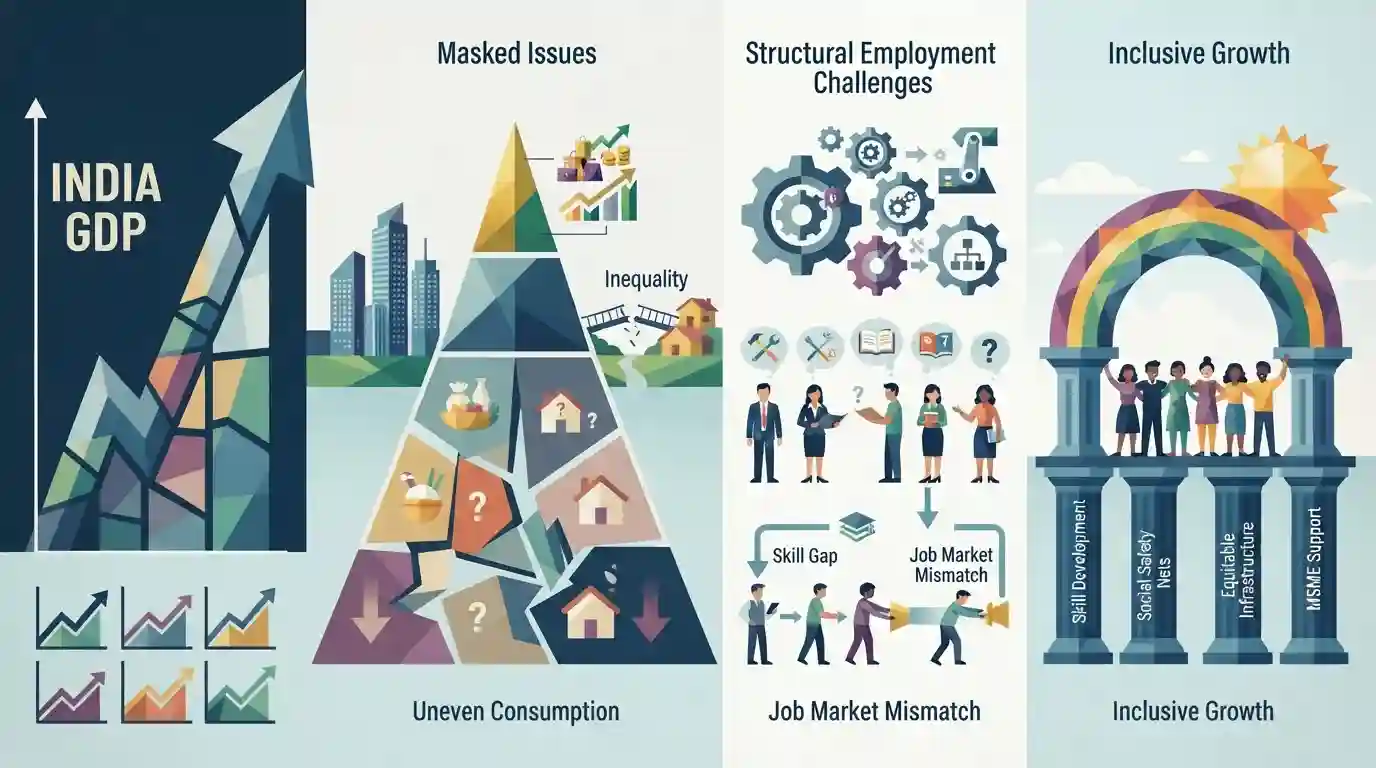
The article analyzes India's GDP growth beyond headline numbers, highlighting how aggregate economic expansion can mask deeper issues like uneven consumption, rising inequality, and structural employment challenges, emphasizing the need for inclusive growth metrics.
मुख्य मुद्दे
- Headline GDP numbers often mask underlying structural realities, such as consumption disparities, joblessness, and K-shaped recovery patterns in India's economy.
- Growth driven primarily by government capital expenditure and high-end consumption may fail to trickle down adequately to the broader workforce and rural sectors.
- There is an urgent need to shift policy focus from mere macroeconomic aggregate growth targets to quality of employment, wage growth, and inclusive distribution.
महत्त्वाच्या संज्ञा
Reserve Bank of India

India's central banking institution, responsible for regulating monetary policy, issuing currency, supervising banking systems, and maintaining financial stability to support sustainable economic growth.
UPSC context
GS Paper III (Economy - Monetary Policy, Banking, Growth); tests understanding of central bank interventions and economic stability.
Central Statistics Office
The former nodal government agency responsible for coordinating statistical activities and compiling national accounts statistics, now merged into the National Statistical Office (NSO) under MoSPI.
UPSC context
GS Paper III (Economy - Growth, Development, Data & Statistics); crucial for evaluating macro-data reliability and GDP measurement.
पूर्वपरीक्षा सापळा
High headline GDP growth ensures broad-based employment generation and uniform consumption across all income deciles.
Aspirants often assume high aggregate GDP growth automatically resolves rural distress and structural unemployment, ignoring K-shaped recovery realities.
संबंधित स्थिर संकल्पना
What is a K-shaped recovery and how does it differ from other economic recovery models?
- Divergent Trajectories: Divergent sectors or income groups recover at vastly different speeds or trajectories following a recession.
- Unequal Impact: High-income earners and formal sectors thrive, while low-income groups and informal sectors experience continued distress.
- Policy Challenge: It highlights structural inequalities where headline macroeconomic growth masks microeconomic distress.
आंतर-विषय नमुने
GDP Growth vs. Multidimensional Inequality Linkages
Economic growth statistics are increasingly linked with social security allocations and multidimensional poverty indices in Mains evaluations.
Jobless Growth and Demographic Dividend Challenges
Jobless growth patterns directly feed into agrarian distress and youth demographic dividend challenges, merging fiscal policy discussions with labor economics.

Examinees must look beyond aggregate GDP growth; expect statements evaluating structural drivers like K-shaped recovery and wage stagnation.
संबंधित PYQ · 2
संबंधित PYQ · 2
- 2025MainsGS3
Distinguish between the Human Development Index (HDI) and the Inequality-adjusted Human Development Index (IHDI) with special reference to India. Why is the IHDI considered a better indicator of inclusive growth?
- 2022MainsGS3
Is inclusive growth possible under market economy ? State the significance of financial inclusion in achieving economic growth in India.
