Structural Analysis of India GDP Growth Beyond Headline Numbers
Source:Indian Express ↗
Why It Matters
Crucial for civil services aspirants to understand the nuances of economic growth, moving past aggregate numbers to evaluate actual welfare, inequality, and structural bottlenecks in the Indian economy.
Summary
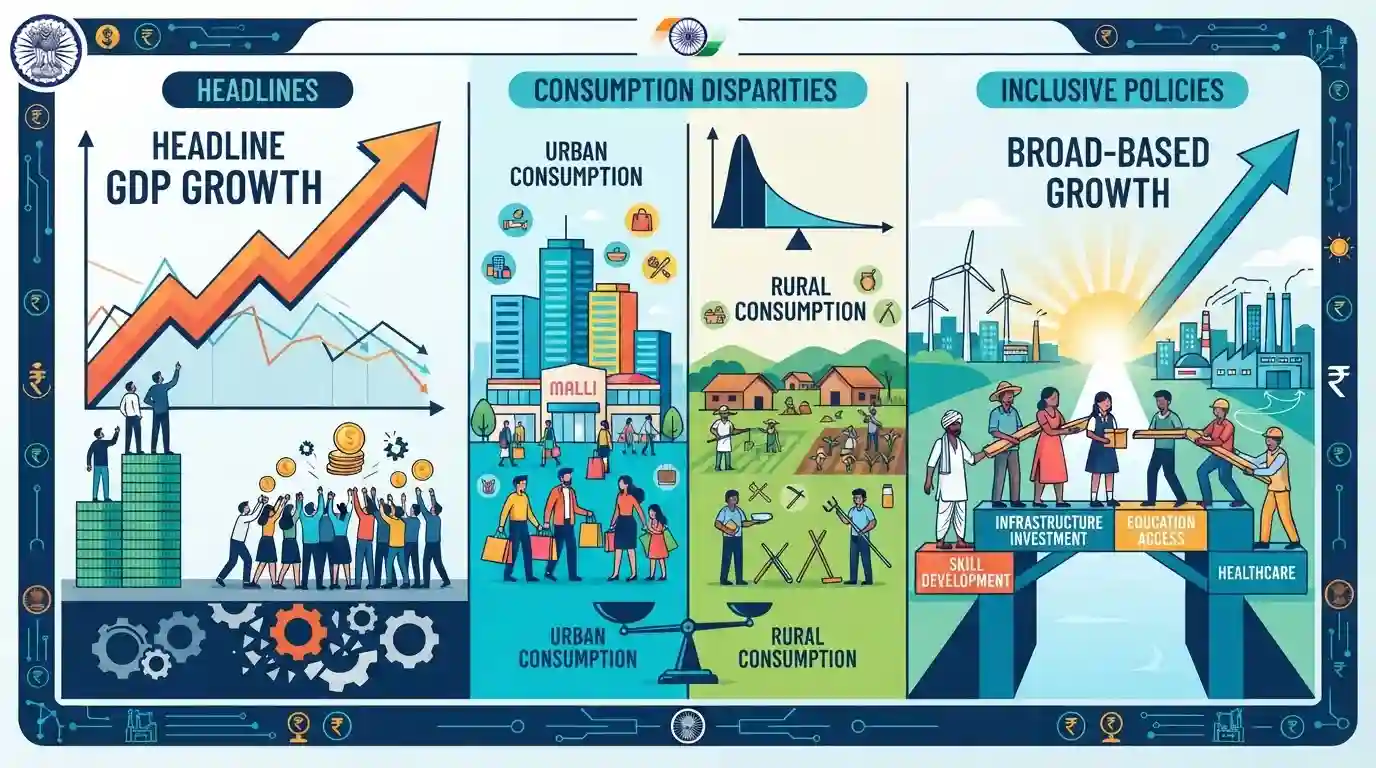
The article analyses India's GDP growth beyond headline numbers, highlighting the hidden structural vulnerabilities, consumption disparities, and the need for inclusive economic policies that foster broad-based growth rather than relying solely on aggregate macroeconomic figures.
Key Points
- Headline GDP growth numbers often conceal underlying structural fragilities, uneven sectoral recoveries, and disparities in consumption demand.
- K-shaped recovery or uneven income distribution impacts broad-based economic welfare, affecting the lower-income segments more severely.
- Policy formulation must move beyond macroeconomic stabilization to address microeconomic stress, job creation, and sustainable inclusive growth.
Important Terms
Reserve Bank of India

India's central banking institution that controls monetary policy, regulates the banking system, and manages currency reserves and inflation targets.
UPSC context
UPSC GS Paper III (Indian Economy): crucial for questions on monetary policy, inflation control, and banking sector regulation.
Inclusive growth
Economic growth that distributes its benefits equitably across all sections of society, ensuring job creation, poverty reduction, and regional balance rather than mere aggregate output expansion.
UPSC context
UPSC GS Paper III (Inclusive Growth and issues arising from it): tests developmental challenges, inequality, and social sector policies.
Gross Domestic Product
The total monetary value of all finished goods and services produced within a country's geographic borders over a specific period.
UPSC context
UPSC GS Paper III (Indian Economy): foundational concept for understanding national income accounting, growth trends, and macroeconomic stability.
Static Concepts Connected
What are the primary structural components and limitations of measuring GDP via the expenditure approach in India?
- Core Components: Formula representation: GDP is computed as C (Private Consumption) + I (Investment) + G (Government Expenditure) + (X - M) (Net Exports).
- Consumption Weight: Consumption skew: Private consumption constitutes over 55-60% of India's GDP, meaning bifurcation in consumer demand directly impacts headline trajectories.
- Informal Sector Limit: Informal sector blind spots: High reliance on proxy indicators for unorganized manufacturing and services can distort real-time quarterly output assessments.
Cross-Topic Patterns
GDP Growth vs. Consumption Inequality Linkage
Economic growth studies frequently pair GDP metrics with National Sample Survey Office (NSSO) consumption data to evaluate actual poverty reduction and inequality trends.
Monetary Policy Transmission and MSME Stress
Monetary policy tightening by central banks often disproportionately impacts unorganized micro-enterprises compared to large corporations with access to diversified capital markets.

Examine statements distinguishing between aggregate GDP growth and broad-based inclusive welfare indicators like K-shaped recoveries.
Linked PYQs · 3
Linked PYQs · 3
- 2015MainsGS3
The nature of economic growth in India in recent times is often described as jobless growth. Do you agree with this view ? Give arguments in favour of your answer.
- 2022MainsGS3
Is inclusive growth possible under market economy ? State the significance of financial inclusion in achieving economic growth in India.
- 2023MainsGS3
Most of the unemployment in India is structural in nature. Examine the methodology adopted to compute unemployment in the country and suggest improvements.
