India and Gulf Cooperation Council Free Trade Agreement Talks
Source:Indian Express ↗
Why It Matters
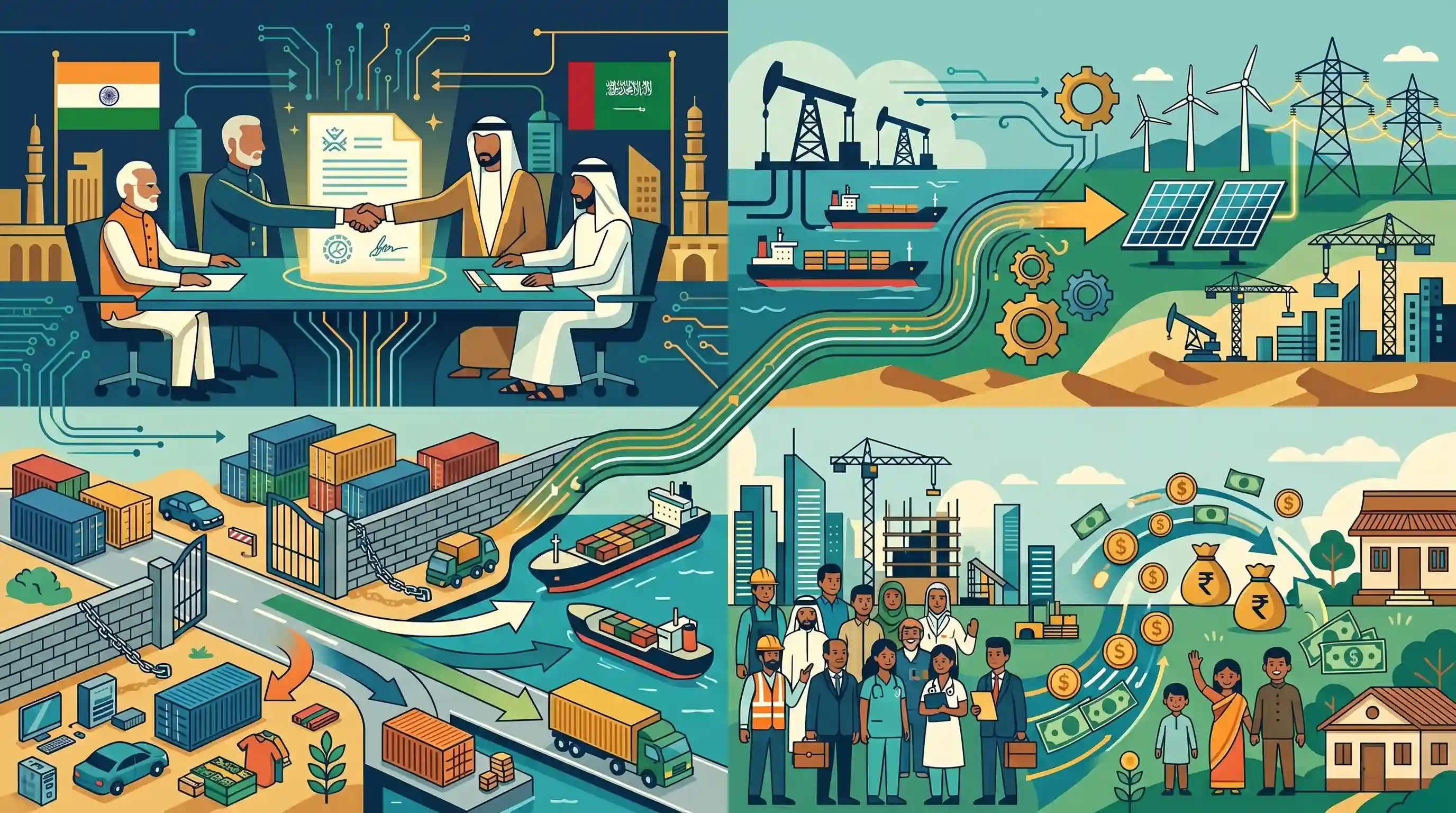
The GCC is critical to India's energy security and serves as a major hub for the Indian diaspora. Formalizing a Free Trade Agreement with this bloc enhances India's strategic and economic footprint in West Asia, offering a vast market for Indian exports and ensuring a stable flow of investments and energy.
Summary
India and the Gulf Cooperation Council (GCC) have taken a significant step toward deeper economic integration by signing the Terms of Reference (ToR) to formally launch negotiations for a Free Trade Agreement (FTA). The GCC is one of India's most significant regional trading partners, essential for meeting the country's energy security needs and hosting a massive Indian diaspora that sends back substantial remittances. The successful negotiation of an FTA would aim to reduce trade barriers, diversify commerce in goods and services, and attract investments, transforming the traditional buyer-seller energy relationship into a strategic and comprehensive economic partnership.
Key Points
- India and the Gulf Cooperation Council (GCC) have signed the Terms of Reference (ToR) to officially commence negotiations for a Free Trade Agreement (FTA).
- The GCC, comprising Saudi Arabia, the UAE, Qatar, Kuwait, Oman, and Bahrain, is a vital trading bloc and a major source of India's oil and natural gas imports.
- The region also hosts millions of Indian expatriates, making it a crucial source of inward remittances and a cornerstone of India's diaspora diplomacy.
- The planned FTA aims to broaden economic engagement beyond traditional energy ties by lowering tariffs and boosting trade in goods, services, and cross-border investments.
Important Terms
Gulf Cooperation Council (GCC)

A political and economic alliance of six Middle Eastern monarchies (Saudi Arabia, UAE, Qatar, Kuwait, Oman, Bahrain) established in 1981 to promote regional integration and security.
UPSC context
GS-II: International Relations. Tests India's 'Think West' policy, regional stability, and strategic engagement with a key 'extended neighborhood' partner.
Free Trade Agreement (FTA)
A treaty between two or more countries to reduce or eliminate tariffs and trade barriers on goods and services, aimed at increasing market access.
UPSC context
GS-III: Economy. Tests understanding of trade liberalization, its impact on domestic industries, and India's shift toward interest-based economic partnerships.
Comprehensive Economic Partnership Agreement (CEPA)
A comprehensive trade pact covering goods, services, investment, intellectual property, and regulatory cooperation, representing a deeper level of economic integration than a standard FTA.
UPSC context
GS-III: Economy. Essential for differentiating types of trade agreements (CEPA vs. CECA vs. FTA) and their role in global value chain integration.
Terms of Reference (ToR)
A formal document defining the objectives, scope, structure, and administrative framework for a negotiation process or project to ensure mutual understanding.
UPSC context
GS-II/III: Bilateral Agreements. Tests knowledge of procedural diplomacy and the technical stages of launching formal international trade negotiations.
Remittances
Transfers of money by migrants to their home countries; for India, these are critical for the Current Account and stabilizing the Balance of Payments.
UPSC context
GS-II/III: Indian Diaspora/Economy. Tests understanding of external sector stability and the socio-economic impact of the 9 million-strong Indian diaspora in the Gulf.
Energy Security
The reliable and affordable supply of energy; for India, it involves securing long-term crude oil and natural gas supplies from the energy-rich GCC region.
UPSC context
GS-III: Energy/Infrastructure. Tests strategies for national resource security and the transformation of buyer-seller relations into strategic energy partnerships.
Prelims Trap
"Yemen and Iran are members of the Gulf Cooperation Council (GCC)."
The GCC comprises only six Arab states: Saudi Arabia, UAE, Qatar, Kuwait, Oman, and Bahrain. Iran and Iraq (despite sharing the Gulf coastline) and Yemen are NOT members.
Static Concepts Connected
What is the difference between an FTA, CECA, and CEPA?
- Free Trade Agreement: Focuses primarily on the reduction or elimination of customs duties on a positive/negative list of traded goods.
- CECA: A broader agreement that covers goods, but also includes limited commitments on services and investments.
- CEPA: The most comprehensive pact; covers goods, services, investments, intellectual property rights, government procurement, and digital trade.
How do inward remittances impact India's Balance of Payments?
- Current Account Buffer: Recorded under 'invisible transfers' in the current account, they directly offset a significant portion of the merchandise trade deficit.
- Forex Stability: Consistent dollar inflows bolster forex reserves, helping the RBI manage rupee volatility against global currency shocks.
Cross-Topic Patterns
IMEC and Regional Connectivity
The FTA talks reinforce India's geoeconomic footprint in the Middle East, acting as the commercial bedrock for the strategic India-Middle East-Europe Economic Corridor (IMEC).
Diaspora Remittances & Current Account
With nearly 10 million Indians in the GCC, remittances serve as a crucial invisible receipt, buffering India's Current Account Deficit against structural oil-import shocks.
Oil to Green Energy Transition
Beyond traditional hydrocarbons, India and the GCC are actively integrating their green energy grids, aligning with initiatives like OSOWOG and mutual green hydrogen investments.

Expect a multi-statement Prelims question combining GCC membership, India's trade deficit status with the bloc, and IMEC connectivity.
Linked PYQs · 2
Linked PYQs · 2
- 2016PrelimsGS1
Which of the following is not a member of 'Gulf Cooperation Council'?
- 2017MainsGS2
The question of India's Energy Security constitutes the most important part of India's economic progress. Analyze India's energy policy cooperation with West Asian countries.
