India Secures EU Steel Market Access Despite Carbon Levy
Source:The Hindu ↗
ఇది ఎందుకు ముఖ్యం
It addresses critical issues concerning India's international trade, export competitiveness, and the impact of climate-related trade barriers (such as the EU's CBAM) on developing economies moving away from open multilateralism towards protectionist environmental regulations.
సారాంశం
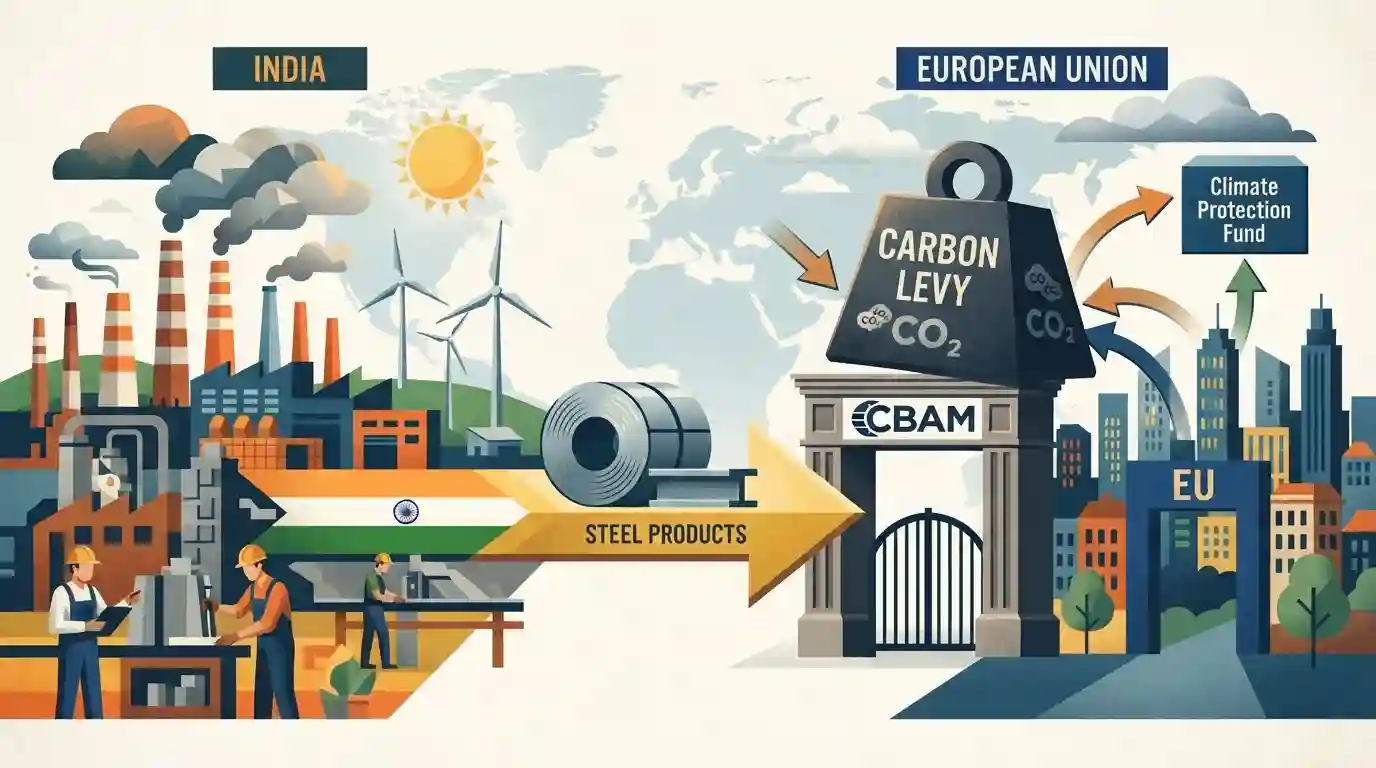
India has gained expanded access to the European Union steel market, but the continuation of the EU's Carbon Border Adjustment Mechanism (CBAM) carbon levy poses a persistent challenge for Indian manufacturing and export competitiveness, illustrating the intersection of trade policy and climate protectionism.
ముఖ్య అంశాలు
- India has secured wider market access for its steel exports to the European Union following trade adjustments.
- However, the European Union's Carbon Border Adjustment Mechanism (CBAM) carbon levy remains a significant challenge for Indian steel exporters.
- The ongoing trade dynamics highlight the tension between global free trade, market access, and emerging environmental protectionism measures like carbon taxes.
ముఖ్యమైన పదాలు
Carbon Border Adjustment Mechanism

A climate policy tool used by the European Union to place a carbon price on imports of carbon-intensive goods, ensuring equivalent carbon costs between domestic and foreign producers to prevent carbon leakage.
UPSC context
UPSC GS Paper III (Environment, Economy): Tests knowledge of climate protectionism, trade barriers, carbon taxation, and India-EU bilateral trade dynamics.
CBAM
The acronym for the European Union's Carbon Border Adjustment Mechanism, a levy on carbon-intensive imports like steel, aluminum, and cement.
UPSC context
UPSC GS Paper III: Relevant for current affairs on international trade negotiations, carbon pricing, and industrial competitiveness in developing nations like India.
European Union
A political and economic union of 27 European member states operating a single internal market and common trade policies, increasingly integrating climate measures into external trade.
UPSC context
UPSC GS Paper II (International Relations): Essential for understanding India-EU strategic partnerships, plurilateral trade pacts, and regulatory compliance issues.
EU
The common abbreviation for the European Union, a major trade partner and regulatory standard-setter impacting Indian exports through environmental and technical barriers.
UPSC context
UPSC GS Paper III: Frequently tested in the context of export competitiveness, carbon border measures, and global environmental governance frameworks.
ప్రిలిమ్స్ ఉచ్చు
The Carbon Border Adjustment Mechanism (CBAM) functions as a standard import tariff imposed directly by EU customs.
Aspirants often assume CBAM is a standard tariff collected by customs authorities; however, it is structurally designed around the purchase of CBAM certificates reflecting the carbon price paid in the country of production.
అనుసంధానమైన స్థిర భావనలు
What are the core design features and compliance mechanisms of the EU's Carbon Border Adjustment Mechanism (CBAM)?
- Covered Sectors: Targets carbon-intensive sectors including iron and steel, cement, aluminium, fertilisers, electricity, and hydrogen.
- Certificate System: Importers must purchase CBAM certificates corresponding to the carbon price that would have been paid had the goods been produced under EU carbon pricing rules.
- Timeline: Transition phase began in October 2023 focusing on reporting emissions, with full financial levy implementation slated progressively through 2026.
- Objective: Aims to prevent carbon leakage, where EU companies relocate production to countries with laxer emission standards.
అంతర-అంశ నమూనాలు
CBAM vs WTO Rules and Climate Protectionism
The EU's CBAM bridges international trade law (WTO rules, GATT Article XX exemptions) and domestic climate commitments (NDCs under the Paris Agreement), making it a frequent multi-subject exam theme.
Domestic Carbon Markets vs External Green Levies
India's push for domestic carbon markets (CCTS) to offset external tariffs mirrors historical responses to non-tariff barriers and sanitary/phytosanitary measures in global trade.

Expect a multi-statement prelims question pairing CBAM features (scope, calculation) with India's domestic CCTS counter-frameworks.
అనుసంధాన PYQలు · 1
అనుసంధాన PYQలు · 1
- 2025MainsGS3
What are the challenges before the Indian economy when the world is moving away from free trade and multilateralism to protectionism and bilateralism? How can these challenges be met?
