High Crude Oil Prices Create Credit Strain for Indian Fuel Retailers
Source:The Hindu ↗
Why It Matters
Understanding the financial dynamics of OMCs is crucial for UPSC aspirants, as it connects global geopolitics (crude prices) with domestic macroeconomic stability, inflation management, and the fiscal health of critical Public Sector Undertakings. It highlights the trade-off the government faces between deregulating fuel prices and controlling domestic inflation.
Summary
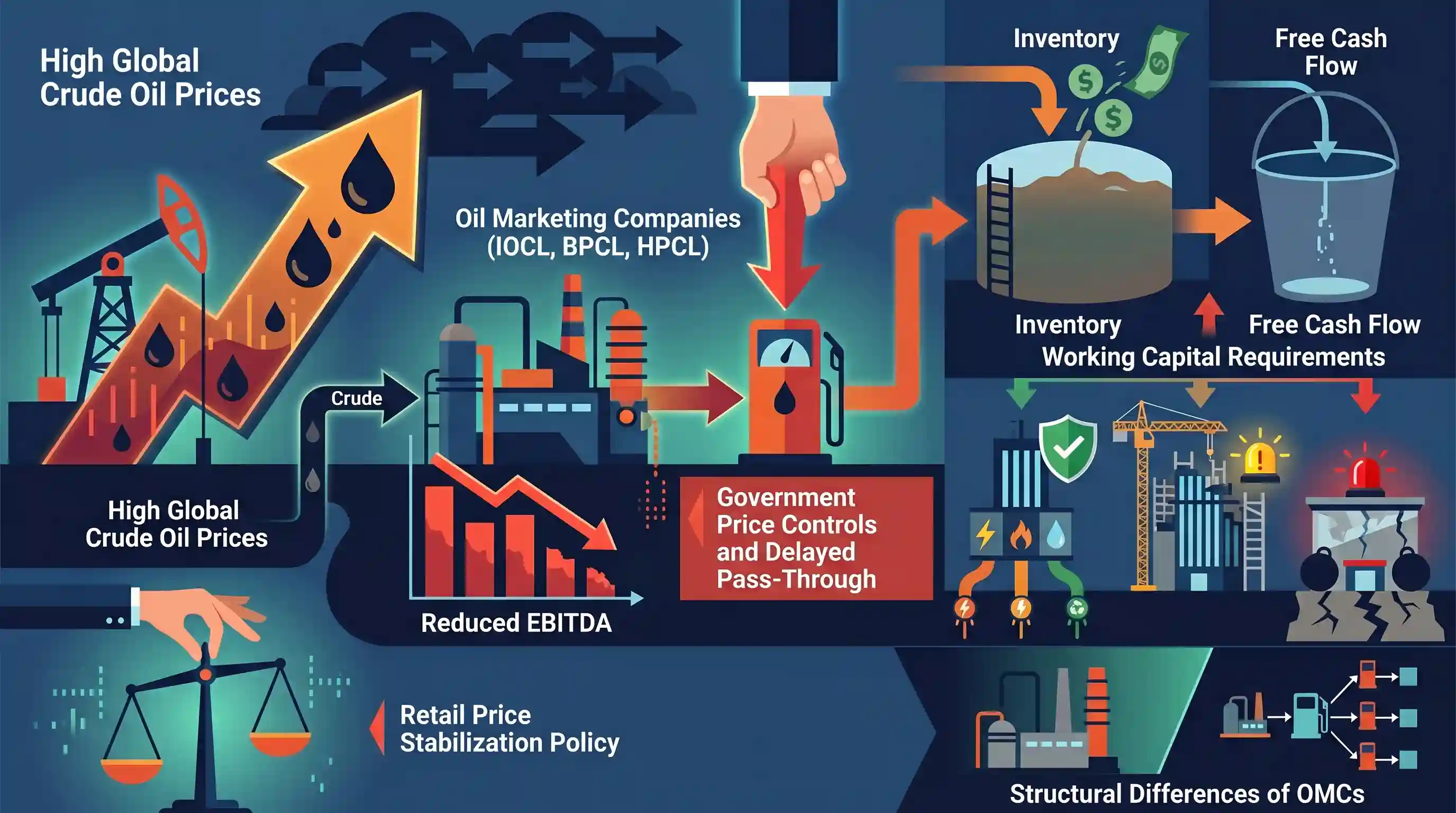
Fitch Ratings has indicated that sustained high global crude oil prices pose a significant credit risk to Indian Oil Marketing Companies (OMCs) like IOCL, BPCL, and HPCL. The primary challenge arises from delayed pass-throughs of input costs to retail pump prices due to informal price controls, which erodes EBITDA. Furthermore, elevated prices inflate the value of inventory and amplify working-capital requirements, subsequently dampening Free Cash Flow (FCF). While diversified entities like IOCL are better positioned, those with aggressive capital expenditures (BPCL) or limited financial headroom (HPCL) face greater vulnerability. Ultimately, government policy on retail price stabilization and the structural differences between pure refiners and integrated marketers will dictate the extent of the impact on their corporate financial health.
Key Points
- Fitch Ratings warned that sustained high global crude oil prices (potentially nearing $100 per barrel by 2026) will create credit strains for Indian Oil Marketing Companies (OMCs).
- The primary risk stems from delayed fuel price pass-throughs, where OMCs cannot immediately hike retail pump prices to match input costs, directly eroding their EBITDA.
- Elevated oil prices also inflate inventory values and increase working-capital requirements, which negatively impacts Free Cash Flow (FCF) for these state-run refiners.
- Among the OMCs, IOCL is deemed more resilient due to business diversification, whereas BPCL is exposed because of aggressive capex/transition spending, and HPCL currently lacks sufficient financial headroom.
- Fitch notes that 'pure refiners' with benchmark-linked margins will outperform 'integrated fuel marketers' that remain exposed to domestic retail price controls.
Important Terms
Oil Marketing Companies (OMCs)

Public sector undertakings (mainly IOCL, BPCL, HPCL) responsible for refining and marketing petroleum products. They ensure pan-India fuel availability and manage retail pricing.
UPSC context
GS Paper III: Energy Security and Infrastructure. Vital for understanding fuel pricing mechanisms and subsidy management.
Under-recoveries
The financial loss incurred by OMCs when they sell fuel at government-regulated prices lower than the international market-linked cost.
UPSC context
GS Paper III: Issues related to subsidies and fiscal deficit. Tests understanding of non-tax revenue and PSU health.
Maharatna Status
A prestigious status granted to top-performing PSUs, providing them greater financial autonomy (up to ₹5,000 crore investment without government approval). IOCL and BPCL are Maharatnas.
UPSC context
GS Paper III: Indian Economy and PSUs. Tests knowledge of administrative reforms and corporate governance in state-owned firms.
Credit Rating Agencies (CRAs)
Global agencies (e.g., Fitch, S&P) that assess the creditworthiness of entities/sovereigns. Their ratings influence borrowing costs and foreign direct investment (FDI) inflows.
UPSC context
GS Paper III: Mobilization of resources. Important for understanding global financial integration and sovereign risk.
Working Capital
The capital used in day-to-day operations, calculated as current assets minus current liabilities. For OMCs, high oil prices increase the cash tied up in inventory.
UPSC context
GS Paper III: Indian Economy. Relevant for understanding the operational efficiency and financial stability of critical infrastructure sectors.
Prelims Trap
Credit Rating Agencies (CRAs) evaluating Indian PSUs are regulated by the Reserve Bank of India.
Credit Rating Agencies (CRAs) operating in India, such as CRISIL, ICRA, and Fitch India, are regulated by SEBI, not by the RBI.
Static Concepts Connected
What is the status of fuel price deregulation and under-recoveries in India?
- Official Deregulation: Petrol (2010) and Diesel (2014) are officially deregulated, allowing OMCs to revise prices based on global benchmarks.
- Informal Controls: The government often informally halts retail price hikes during high inflation or elections, forcing state-run OMCs to absorb input costs.
- Under-recoveries: The financial loss incurred by OMCs when the retail selling price of fuel is lower than the actual cost of purchasing and refining crude oil.
How do EBITDA and Free Cash Flow (FCF) reflect corporate financial health?
- EBITDA: Earnings Before Interest, Taxes, Depreciation, and Amortization. It measures core operational profitability before accounting for financial and tax deductions.
- Free Cash Flow: The actual cash a company generates after accounting for cash outflows to support operations and maintain capital assets.
- Working Capital Impact: Elevated inventory costs tie up funds in day-to-day operations, directly reducing the FCF available for debt repayment or business expansion.
Cross-Topic Patterns
Green Transition Capex vs. Oil Spikes
OMCs face a trilemma: absorbing high crude costs via informal retail price controls, maintaining credit health, and funding massive capital expenditure (capex) for India's green transition (biofuels, EV charging).
Contingent Liabilities and Sovereign Ratings
Credit strains on major Maharatna PSUs (IOCL, BPCL, HPCL) create implicit contingent liabilities for the central government, which credit rating agencies factor into India's overall sovereign rating outlook.

Expect a multi-statement Economy question in 2026 linking informal fuel price controls, under-recoveries, and Free Cash Flow (FCF) erosion.
Linked PYQs · 4
Linked PYQs · 4
- 2022PrelimsGS1
Consider the following statements : 1. In India, credit rating agencies are regulated by Reserve Bank of India. 2. The rating agency popularly known as ICRA is a public limited company. 3. Brickwork Ratings is an Indian credit rating agency. Which of the statements given above are correct?
- 2024PrelimsGS1
With reference to physical capital in Indian economy, consider the following pairs: Items | Category 1. Farmer's plough | Working capital 2. Computer | Fixed capital 3. Yarn used by the weaver | Fixed capital 4. Petrol | Working capital How many of the above pairs are correctly matched?
- 2025PrelimsGS1
Consider the following activities : I. Production of crude oil II. Refining, storage and distribution of petroleum III. Marketing and sale of petroleum products IV. Production of natural gas How many of the above activities are regulated by the Petroleum and Natural Gas Regulatory Board in our country?
- 2022MainsGS3
Do you think India will meet 50 percent of its energy needs from renewable energy by 2030 ? Justify your answer. How will the shift of subsidies from fossil fuels to renewables help achieve the above objective ? Explain.
