India Cement Sector Footprint and Challenges for Net Zero Target
Source:The Hindu ↗
ఇది ఎందుకు ముఖ్యం
Understanding the challenges in hard-to-abate sectors like cement is crucial for evaluating India's industrial decarbonization strategies and its long-term path to net-zero emissions by 2070.
సారాంశం
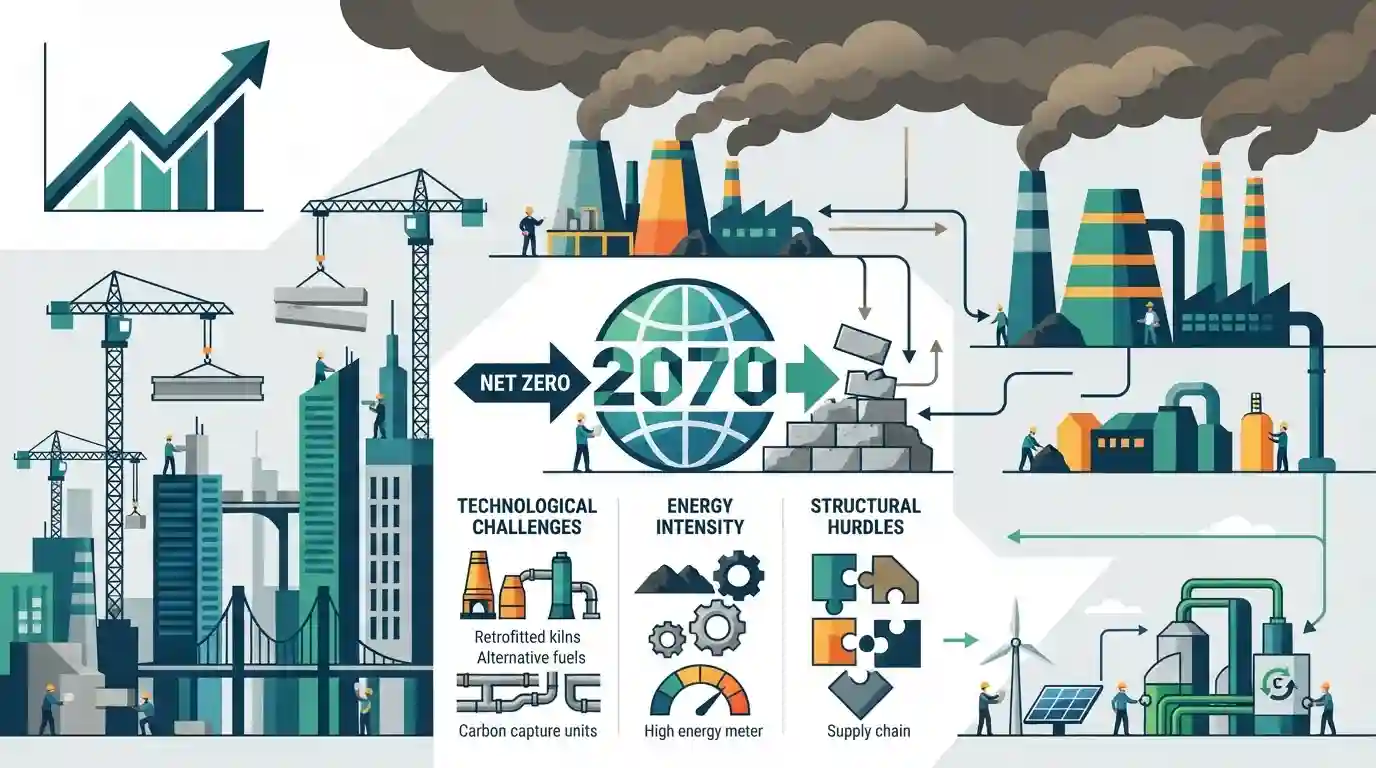
The article explores how India's large and expanding cement footprint poses a critical hurdle to achieving its net-zero emissions target by 2070. It highlights the technological, energy, and structural challenges involved in decarbonizing hard-to-abate sectors like cement amidst rising infrastructure demand.
ముఖ్య అంశాలు
- India's massive cement industry footprint presents a significant challenge to achieving its 2070 net-zero emissions target.
- Cement production is inherently carbon-intensive due to the calcination process and fossil fuel reliance for heat.
- Decarbonizing the cement sector requires shifting to alternative fuels, improving energy efficiency, exploring carbon capture and storage (CCS), and promoting blended cements.
- Balancing rapid infrastructure growth and urbanization with stringent climate commitments remains a core policy challenge for India.
ముఖ్యమైన పదాలు
Long-Term Low Emission Development Strategy (LT-LEDS)

India's official roadmap submitted under the Paris Agreement detailing low-carbon transitions across key economic sectors like energy, transport, and industry to achieve net-zero emissions by 2070.
UPSC context
UPSC Mains GS Paper III (Environment & Climate Change): Tests knowledge of India's domestic policy frameworks and climate commitments for net-zero.
UNFCCC
An international environmental treaty established to coordinate global action on climate change, stabilizing greenhouse gas concentrations and governing mechanisms like Conference of the Parties (COP).
UPSC context
UPSC Prelims and Mains GS Paper III: Frequently tested for core international environmental architecture, conventions, and global climate negotiations.
అనుసంధానమైన స్థిర భావనలు
Why is the cement industry classified as a hard-to-abate sector under climate change frameworks?
- Calcination Chemistry: Process emissions, accounting for roughly half of total cement emissions, arise inherently from the chemical calcination of limestone (CaCO3 to CaO and CO2).
- Thermal Energy Demand: High-temperature kilns traditionally require the combustion of fossil fuels (coal or petcoke) to reach temperatures exceeding 1400°C.
- Technological Limitations: Unlike power generation, renewable electricity alone cannot fully eliminate process emissions without technologies like Carbon Capture and Storage (CCS).
అంతర-అంశ నమూనాలు
Industrial Decarbonization vs. Infrastructure Growth
Hard-to-abate sectors link industrial growth targets directly with India's long-term UNFCCC commitments under the LT-LEDS framework.

Expect statement-based questions on why cement is a 'hard-to-abate' sector (calcination vs energy) alongside India's 2070 net-zero target.
అనుసంధాన PYQలు · 5
అనుసంధాన PYQలు · 5
- 2024MainsGS3
Industrial pollution of river water is a significant environmental issue in India. Discuss the various mitigation measures to deal with this problem and also the government's initiatives in this regard.
- 2022MainsGS3
Do you think India will meet 50 percent of its energy needs from renewable energy by 2030 ? Justify your answer. How will the shift of subsidies from fossil fuels to renewables help achieve the above objective ? Explain.
- 2025MainsGS3
How can India achieve energy independence through clean technology by 2047? How can biotechnology can play a crucial role in this endeavour?
- 2026PrelimsGS1
Consider the following statements with reference to India's response to climate change : I. India's Long-Term Low Emission Development Strategy (LT-LEDS) is a crucial tool for achieving net-zero emissions by 2070. II. India's 4th Biennial Update Report (BUR-4) submitted in December, 2024 recorded around 8% decrease in Greenhouse gas emissions in 2020 over 2019. III. Climate-resilient development necessarily depends on quick and short-term achievement of emission reduction targets. Which of the following relationships among the above statements is/are correct ? 1. Statement I is empirically supported by statement II. 2. Statement III contradicts the approach implicit in statement I. 3. Statement I and statement III together establish the premise of long-term sustainability. Select the answer using the code given below :
- 2025PrelimsGS1
Consider the following statements : I. Carbon dioxide (CO2) emissions in India are less than 0.5 t CO2/ capita. II. In terms of CO2 emissions from fuel combustion, India ranks second in Asia-Pacific region. III. Electricity and heat producers are the largest sources of CO2 emissions in India. Which of the statements given above is/are correct?
