Indian foreign policy and the impact of fiscal limitations
स्रोत:इंडियन एक्सप्रेस ↗
क्यों मायने रखता है
Understanding the financial underpinnings of foreign policy is crucial for UPSC mains, as it explains why India favors multilateralism, soft power, and strategic partnerships over direct economic competition with deeper-pocketed rivals like China.
सारांश
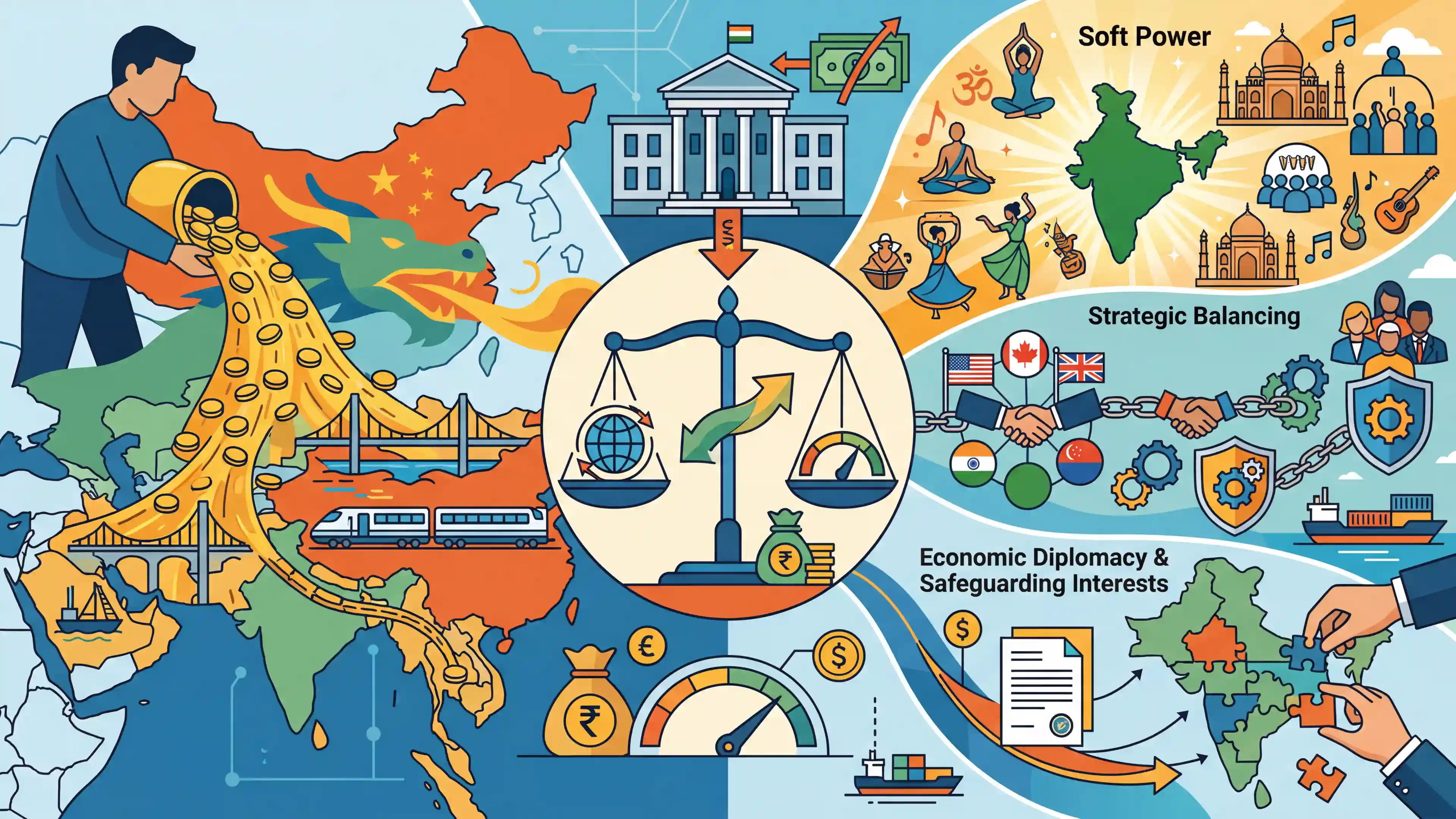
The article analyzes how India's foreign policy is inherently shaped and constrained by its domestic financial limitations. Despite having growing global ambitions and being positioned as a counterweight to China, India's diplomatic machinery (such as the MEA) operates under strict budgetary limits. This economic reality prevents India from matching China's massive financial outreach and infrastructure financing in the neighborhood. Consequently, Indian statecraft relies on strategic balancing, leveraging soft power, and forging economic and security partnerships with the West and regional allies to project influence and safeguard its national interests without overextending its fiscal capacity.
मुख्य बिंदु
- India's diplomatic ambitions are frequently checked by structural financial and budgetary constraints, limiting the scale of its foreign interventions and aid.
- The Ministry of External Affairs operates with a significantly smaller budget than its global counterparts, impacting India's diplomatic footprint and overseas infrastructure projects.
- Unlike China, which leverages its massive economic surpluses for 'chequebook diplomacy' (such as the Belt and Road Initiative), India faces fiscal constraints that limit its neighborhood infrastructure financing.
- To bridge this gap, India increasingly relies on strategic alliances, soft power, cultural diplomacy, and multilateral frameworks to maintain its geopolitical influence in the Indo-Pacific and the Global South.
महत्वपूर्ण शब्द
Belt and Road Initiative (BRI)

A massive China-led global infrastructure project launched in 2013 to enhance connectivity and trade across Asia, Europe, and Africa through land and sea routes.
UPSC context
GS Paper-II (International Relations). Crucial for understanding India-China rivalry, sovereignty issues (CPEC), and debt-trap diplomacy.
Ministry of External Affairs (MEA)
The Indian government agency responsible for implementing foreign policy, managing diplomatic missions, and representing India at international forums like the UN and G20.
UPSC context
GS Paper-II (Governance/IR). Tests awareness of institutional capacity, diplomatic staffing, and budgetary constraints in statecraft.
Quadrilateral Security Dialogue (Quad)
An informal strategic forum comprising India, USA, Japan, and Australia, focused on ensuring a free, open, and inclusive Indo-Pacific region.
UPSC context
GS Paper-II (International Relations). Key for questions on Indo-Pacific security, maritime cooperation, and balancing China's influence.
Soft Power
The ability of a country to influence global preferences through attraction and persuasion (culture, values, diplomacy) rather than military or economic coercion.
UPSC context
GS Paper-II (International Relations). Tests understanding of India's cultural diplomacy, diaspora influence, and non-traditional tools of influence.
Strategic Autonomy
A foreign policy doctrine emphasizing a nation's ability to make independent decisions based on national interest without being constrained by formal alliances.
UPSC context
GS Paper-II (International Relations). Fundamental concept for analyzing India's multi-alignment and balancing act between major global powers.
Neighbourhood First Policy
India's diplomatic priority to foster stable, connected, and cooperative relations with its immediate neighbors to ensure regional security and prosperity.
UPSC context
GS Paper-II (International Relations). Essential for discussing India's role in South Asia and countering external regional influences.
प्रारंभिक ट्रैप
Lines of Credit (LoCs) extended by India to Global South nations are non-repayable grants.
LoCs are concessional soft loans routed through EXIM Bank that mandate repayment. They are distinct from Grants-in-Aid, which are non-repayable financial assistance.
संबंधित अवधारणाएँ
What differentiates Lines of Credit (LoCs) from Grants-in-Aid?
- Lines of Credit: Concessional soft loans extended via EXIM Bank. They mandate repayment and typically require sourcing at least 75% of project goods and services from India.
- Grants-in-Aid: Direct, non-repayable financial assistance. India primarily directs these to immediate neighbors like Bhutan, Nepal, and Mauritius for critical infrastructure and budgetary support.
What are the core pillars of India's development cooperation?
- Capacity Building: Providing civilian and military training, skill development, and scholarships to partner countries through the Indian Technical and Economic Cooperation (ITEC) program.
- Concessional Finance: Extending Lines of Credit (LoCs) to African, Asian, and Latin American nations for infrastructure, agriculture, and energy projects.
- Technology Sharing: Exporting Digital Public Infrastructure (DPI) like UPI and India Stack as a low-cost, high-impact diplomatic tool to the Global South.
अंतर-विषय पैटर्न
Minilaterals as Economic Multipliers
India uses groupings like the Quad and I2U2 not just for security, but to pool capital for Indo-Pacific infrastructure, offsetting its domestic fiscal constraints against China's massive BRI spending.
Delivery Deficit vs. Debt Trap
India's 'delivery deficit' (bureaucratic delays in executing LoC projects) is frequently contrasted in GS2 with China's rapid execution but predatory 'debt-trap' diplomacy in nations like Sri Lanka and the Maldives.

Expect a GS2 Mains question contrasting India's 'capacity-building' diplomacy (ITEC) with China's 'chequebook' diplomacy (BRI).
संबद्ध PYQ · 2
संबद्ध PYQ · 2
- 2024MainsGS2
‘The West is fostering India as an alternative to reduce dependence on China's supply chain and as a strategic ally to counter China's political and economic dominance.’ Explain this statement with examples.
- 2015MainsGS2
Terrorist activities and mutual distrust have clouded India-Pakistan relations. To what extent the use of soft power like sports and cultural exchanges could help generate goodwill between the two countries? Discuss with suitable examples.
