Barakah Nuclear Plant drone strike and critical infrastructure risks
Source:Indian Express ↗
Why It Matters
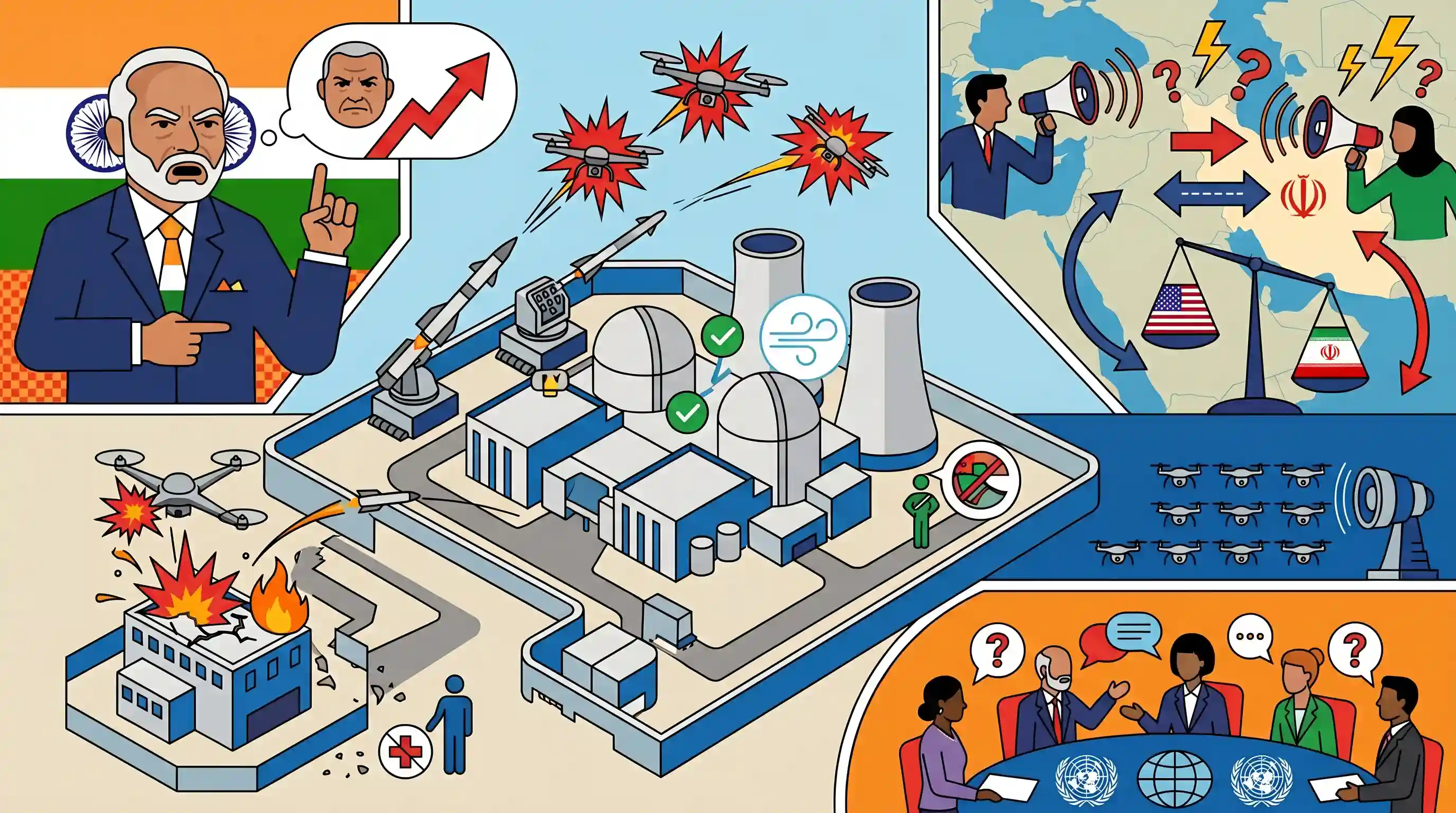
Demonstrates the growing vulnerability of critical infrastructure (like nuclear power plants) to asymmetric drone warfare, which has severe implications for internal and global security. It also highlights India's immense geopolitical and energy stakes in the stability of West Asia.
Summary
India has strongly condemned a drone attack near the UAE's Barakah Nuclear Energy Plant in the Al Dhafra region, terming it a "dangerous escalation" amid rising tensions in West Asia. While UAE air defences intercepted two drones, a third hit a generator outside the plant's inner perimeter, causing no radiation leaks or casualties. The strike, occurring amid a delicate US-Iran ceasefire and heightened rhetoric, highlights the severe security risks posed by asymmetric drone warfare to critical infrastructure in volatile regions.
Key Points
- A drone strike targeted the Barakah Nuclear Energy Plant in the UAE's Al Dhafra region, with one drone hitting an external electrical generator.
- The UAE intercepted two other drones reportedly launched from its "western border," while confirming no radiation leaks or injuries.
- India's Ministry of External Affairs strongly condemned the attack, terming it a "dangerous escalation" and urging a return to diplomacy.
- The incident occurs against the backdrop of a fragile US-Iran ceasefire and heightened rhetorical warnings between US President Donald Trump and Iranian officials.
- The attack underscores the severe and growing threat of asymmetric drone warfare to critical civilian and nuclear infrastructure in conflict zones.
Important Terms
Barakah Nuclear Energy Plant

The Arab world's first commercial nuclear power station, located in Abu Dhabi, UAE. It consists of four reactors designed to meet 25% of the nation's electricity needs.
UPSC context
GS Paper 2 (International Relations) and Paper 3 (Energy). Crucial for regional energy security and India-UAE strategic cooperation.
Asymmetric Drone Warfare
A conflict strategy where low-cost unmanned aerial vehicles (UAVs) are used by smaller forces to target high-value assets, exploiting gaps in sophisticated conventional air defenses.
UPSC context
GS Paper 3 (Internal Security). Tests India's preparedness against non-state actors and proxy threats to sensitive border and inland installations.
West Asia
A geopolitical region (Middle East/Iran) vital to India for energy security, maritime trade routes (Strait of Hormuz), and as home to over 9 million Indian expatriates.
UPSC context
GS Paper 2. Central to India's 'Link West' policy and its role as a regional net security provider.
Ministry of External Affairs (MEA)
The nodal agency responsible for formulating and implementing India's foreign policy, managing diplomatic missions, and safeguarding the interests of the Indian diaspora abroad.
UPSC context
GS Paper 2 (Governance/IR). The primary voice for India's diplomatic stance on global security escalations and international law.
Critical Infrastructure
Vital systems and assets (power, transport, digital) whose destruction would have a debilitating impact on a nation's security, economy, public health, or safety.
UPSC context
GS Paper 3 (Security). Highlights modern vulnerabilities of essential facilities to drone strikes, sabotage, and cyberattacks.
Prelims Trap
Barakah is the Middle East's first nuclear power plant and was built entirely with indigenous UAE technology.
Iran's Bushehr is the first in the broader Middle East; Barakah is the first in the Arab world. Also, Barakah was built by South Korea (KEPCO).
Static Concepts Connected
What are the key operational nuclear power plants in West Asia?
- Barakah (UAE): First commercial nuclear station in the Arab world, located in Abu Dhabi. Built by a South Korean consortium (KEPCO).
- Bushehr (Iran): The first civilian nuclear power plant in the broader Middle East, built with Russian assistance.
How does international law address military attacks on nuclear installations?
- Geneva Conventions: Additional Protocol I prohibits attacks on works containing dangerous forces (like nuclear electrical generating stations) if such attacks may cause severe civilian losses from radiation.
- IAEA Frameworks: The Convention on the Physical Protection of Nuclear Material (CPPNM) legally binds states to protect facilities against sabotage and illicit trafficking.
Cross-Topic Patterns
Asymmetric drones & critical infrastructure
The shift from conventional border skirmishes to drone strikes on deep-state energy assets (like Saudi Aramco in 2019, now Barakah) highlights the rising systemic threat of proxy warfare by non-state actors.
India-UAE ties beyond crude oil
India's swift condemnation underscores its evolving strategic stakes in the UAE, expanding from crude oil dependency to formalized civil nuclear cooperation (NPCIL-ENEC MoU) and the I2U2 multilateral framework.

Expect a Prelims question mapping West Asian nuclear plants (Barakah/Bushehr) or a Mains Q on drone threats to critical infrastructure.
Linked PYQs · 4
Linked PYQs · 4
- 2023MainsGS3
The use of unmanned aerial vehicles (UAVs) by our adversaries across the borders to ferry arms/ammunitions, drugs, etc., is a serious threat to the internal security. Comment on the measures being taken to tackle this threat.
- 2017MainsGS2
The question of India's Energy Security constitutes the most important part of India's economic progress. Analyze India's energy policy cooperation with West Asian countries.
- 2023PrelimsGS1
Consider the following pairs: Area of conflict mentioned in news Country where it is located 1. Donbas : Syria 2. Kachin : Ethiopia 3. Tigray : North Yemen How many of the above pairs are correctly matched?
- 2022PrelimsGS1
The term "Levant" often heard in the news roughly corresponds to which of the following regions?
