India Fiscal Deficit Risks and Revenue Shortfalls
Source:Indian Express ↗
Why It Matters
Understanding fiscal deficit risks, revenue trends, and public expenditure management is crucial for aspirants studying macroeconomic stability and government budgeting in GS3.
Summary
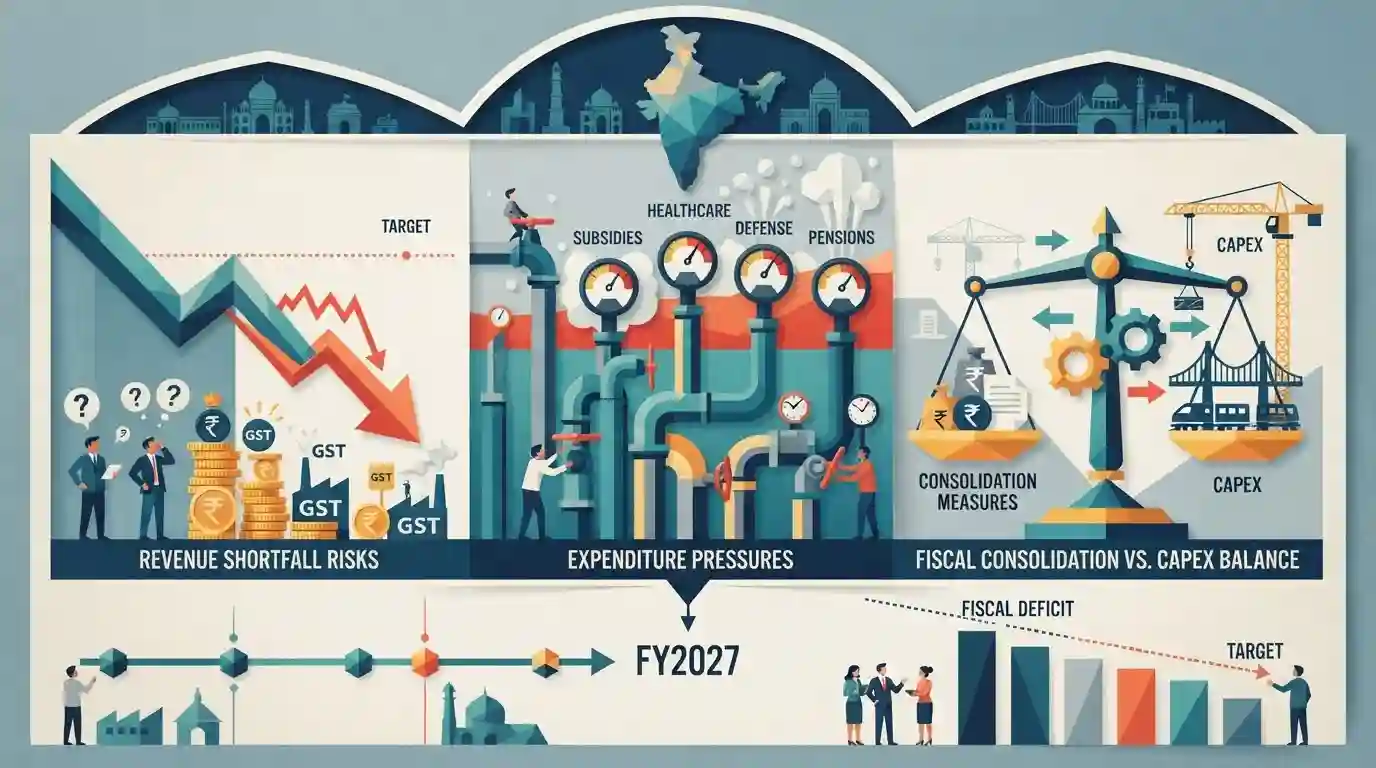
The article examines the fiscal deficit risks confronting India for FY2027, highlighting concerns regarding revenue shortfalls, expenditure pressures, and the delicate balance required between fiscal consolidation and sustaining capital expenditure.
Key Points
- India faces potential fiscal deficit risks for FY2027 driven by potential revenue shortfalls and expenditure pressures.
- Balancing capital expenditure growth with fiscal consolidation remains a central macroeconomic challenge.
- Tax buoyancy assumptions and disinvestment targets require realistic appraisal to protect public investment.
Important Terms
Fiscal Responsibility and Budget Management Act

A legislative act enacted to instill financial discipline, reduce India's fiscal and revenue deficits, and ensure long-term macroeconomic stability through statutory fiscal targets and transparency.
UPSC context
UPSC CSE Prelims and Mains (GS Paper III - Indian Economy): Tested on fiscal consolidation roadmap, deficit targets, and public debt management.
Reserve Bank of India
India's central bank and apex monetary authority established under the RBI Act of 1934, responsible for regulating the money supply, managing currency, and maintaining price stability.
UPSC context
UPSC CSE Prelims and Mains (GS Paper III - Indian Economy): Essential for questions on monetary policy, inflation control, and central banking functions.
Ministry of Finance
A key ministerial department of the Government of India responsible for economic policy, financial administration, taxation, and the formulation of the annual Union Budget.
UPSC context
UPSC CSE Prelims and Mains (GS Paper II/III - Polity and Economy): Tested on government budgeting, fiscal policy formulation, and administrative structures.
Prelims Trap
the FRBM Act mandates a rigid 3% fiscal deficit ceiling for the central government every year without exception.
Aspirants often assume the FRBM Act specifies a rigid 3% fiscal deficit target for the Centre indefinitely, ignoring that current frameworks prioritize a declining path towards debt-to-GDP anchors rather than a fixed annual deficit number.
Static Concepts Connected
What are the key components and statutory targets under the Fiscal Responsibility and Budget Management (FRBM) Act?
- Statutory Targets: Original targets set a fiscal deficit of 3% of GDP and revenue deficit elimination, which were later amended to focus on debt-to-GDP ratios.
- Debt Anchor: The amended framework anchors central government debt to around 40% and combined Centre-State debt to 60% of GDP by 2024-25, later revised for 2030-31.
- Escape Clauses: Escape clauses permit deviation from targets during national security emergencies, structural reforms, or severe economic contractions with specific conditions.
Cross-Topic Patterns
Fiscal Deficit + Centre-State Fiscal Relations
Fiscal consolidation targets must be weighed against state-level borrowing limits (Article 293) and off-budget liabilities that distort true public debt figures.
Capex Quality + Sovereign Ratings
Sustaining high capex while consolidating fiscal deficit directly links macroeconomic stability to sovereign credit ratings and foreign institutional capital inflows.

FRBM medium-term debt anchor (50% debt-to-GDP by 2031) paired with capex-revenue trade-offs will be tested in Prelims/Mains.
Linked PYQs · 3
Linked PYQs · 3
- 2025MainsGS3
Explain how the Fiscal Health Index (FHI) can be used as a tool for assessing the fiscal performance of states in India. In what way would it encourage the states to adopt prudent and sustainable fiscal policies?
- 2019MainsGS3
The public expenditure management is a challenge to the Government of India in the context of budget making during the post-liberalization period. Clarify it.
- 2021MainsGS3
Distinguish between Capital Budget and Revenue Budget. Explain the components of both these Budgets.
