Indian Railways LNG Dual Fuel DEMU Operations
Source:Indian Express ↗
हे का महत्त्वाचे आहे
This development is significant for UPSC aspirants studying sustainable transport, energy transition, and infrastructure optimization in India. It highlights how the transport sector adapts legacy assets to reduce carbon footprints through alternative clean fuels like LNG alongside massive electrification.
सारांश
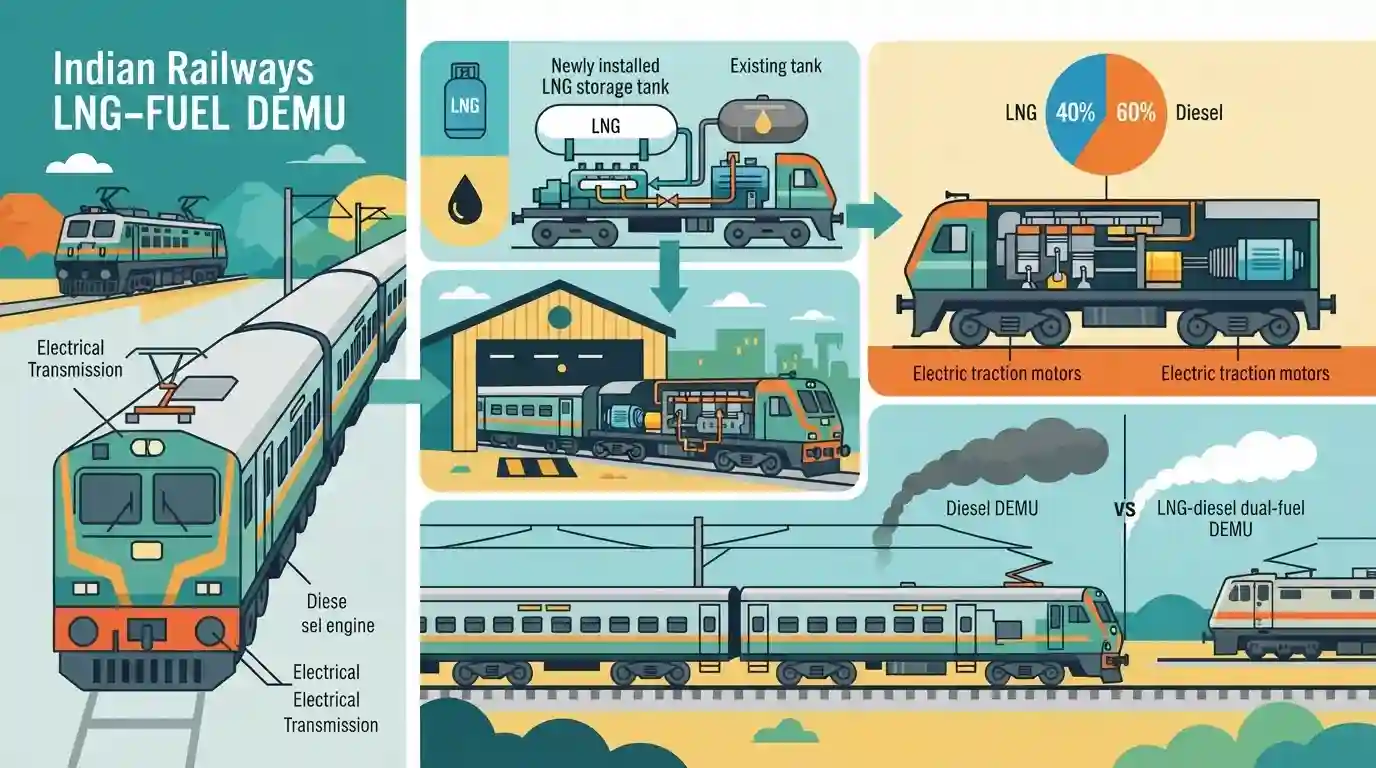
The Indian Railways has launched its first Liquefied Natural Gas (LNG) dual-fuel train by converting an existing Diesel-Electric Multiple Unit (DEMU) rake. Operating on a blend of 40% LNG and 60% diesel, this initiative addresses the challenge of reducing emissions from remaining diesel-powered trainsets—which cannot be hauled by separate electric locomotives due to their self-propelled architecture—while maximizing the utility of existing assets amidst near-complete network electrification.
मुख्य मुद्दे
- Indian Railways launched its first Liquefied Natural Gas (LNG) dual-fuel train, modifying an existing Diesel-Electric Multiple Unit (DEMU) rake.
- The train operates on a dual-fuel mix of 40% LNG and 60% diesel, reducing carbon emissions while utilizing existing rolling stock assets with remaining operational life.
- DEMU trainsets carry integrated power cars (Driving Power Cars) rather than separate locomotives, making them incompatible with standard electric locomotives despite widespread network electrification.
- The conversion initiative complements India's railway electrification and green energy goals, providing operational flexibility and lower emissions on non-fully electrified or backup routes.
महत्त्वाच्या संज्ञा
Diesel-Electric Multiple Unit (DEMU)

A self-propelled train set using electric traction motors powered by diesel generators, now being adapted for dual-fuel operation using Liquefied Natural Gas (LNG) and diesel to lower emissions.
UPSC context
UPSC GS Paper III (Infrastructure / Transport): Evaluates India's transition to alternative, cleaner fossil fuel blends and energy efficiency in railways.
Dual-Fuel Technology
A combustion engine modification that allows an internal combustion engine to run simultaneously on a blend of primary diesel and cleaner Liquefied Natural Gas (LNG), reducing particulate emissions and fuel costs.
UPSC context
UPSC GS Paper III (Environment and Clean Energy): Tests understanding of emission reduction strategies and alternative fuel adoption in transport.
Integral Coach Factory (ICF)
A premier coach manufacturing unit of Indian Railways located in Chennai, known for producing advanced trainsets like LHB coaches, Vande Bharat, and alternative-fuel rail vehicles.
UPSC context
UPSC GS Paper III (Infrastructure and Manufacturing): Important for questions on indigenous rail manufacturing capability, Make in India, and public sector undertakings.
Liquefied Natural Gas (LNG)
A natural gas cooled to liquid state at approximately -162°C, utilized as a cleaner bridge fuel alternative to high-sulfur diesel in heavy transport applications like railways.
UPSC context
UPSC GS Paper III (Energy Security): Relevant for gas-based economy transition, cleaner transport corridors, and energy mix diversification.
संबंधित स्थिर संकल्पना
What is the difference between MEMU and DEMU trainsets operated by Indian Railways?
- Power Source (MEMU):: MEMU (Mainline Electrical Multiple Unit) draws power from overhead traction wires via pantographs, designed for high-density electrified suburban and intercity routes.
- Power Source (DEMU):: DEMU (Diesel-Electric Multiple Unit) houses an onboard diesel generator supplying electricity to traction motors, deployed on non-electrified or low-density routes.
- Architecture:: Unlike traditional locomotive-hauled trains, both feature self-propelled architectures with distributed power units distributed across the rake.
आंतर-विषय नमुने
Rail Electrification vs. Alternative Clean Fuels
Transitioning diesel assets to LNG complements network electrification and national targets to achieve net-zero carbon emissions by 2030 for Indian Railways.
LNG as a Transition Fuel
Using LNG as a bridge fuel helps bridge the energy security gap while domestic gas infrastructure scales up under city gas distribution networks.

Expect match questions on zero-carbon rail targets by 2030 alongside specific tech interventions like dual-fuel DEMUs and hydrogen trains.
संबंधित PYQ · 2
संबंधित PYQ · 2
- 2022MainsGS3
Do you think India will meet 50 percent of its energy needs from renewable energy by 2030 ? Justify your answer. How will the shift of subsidies from fossil fuels to renewables help achieve the above objective ? Explain.
- 2023MainsGS3
The adoption of electric vehicles is rapidly growing worldwide. How do electric vehicles contribute to reducing carbon emissions and what are the key benefits they offer compared to traditional combustion engine vehicles?
