NDMA Releases First Disaster Victim Identification Guidelines
Source:Indian Express ↗
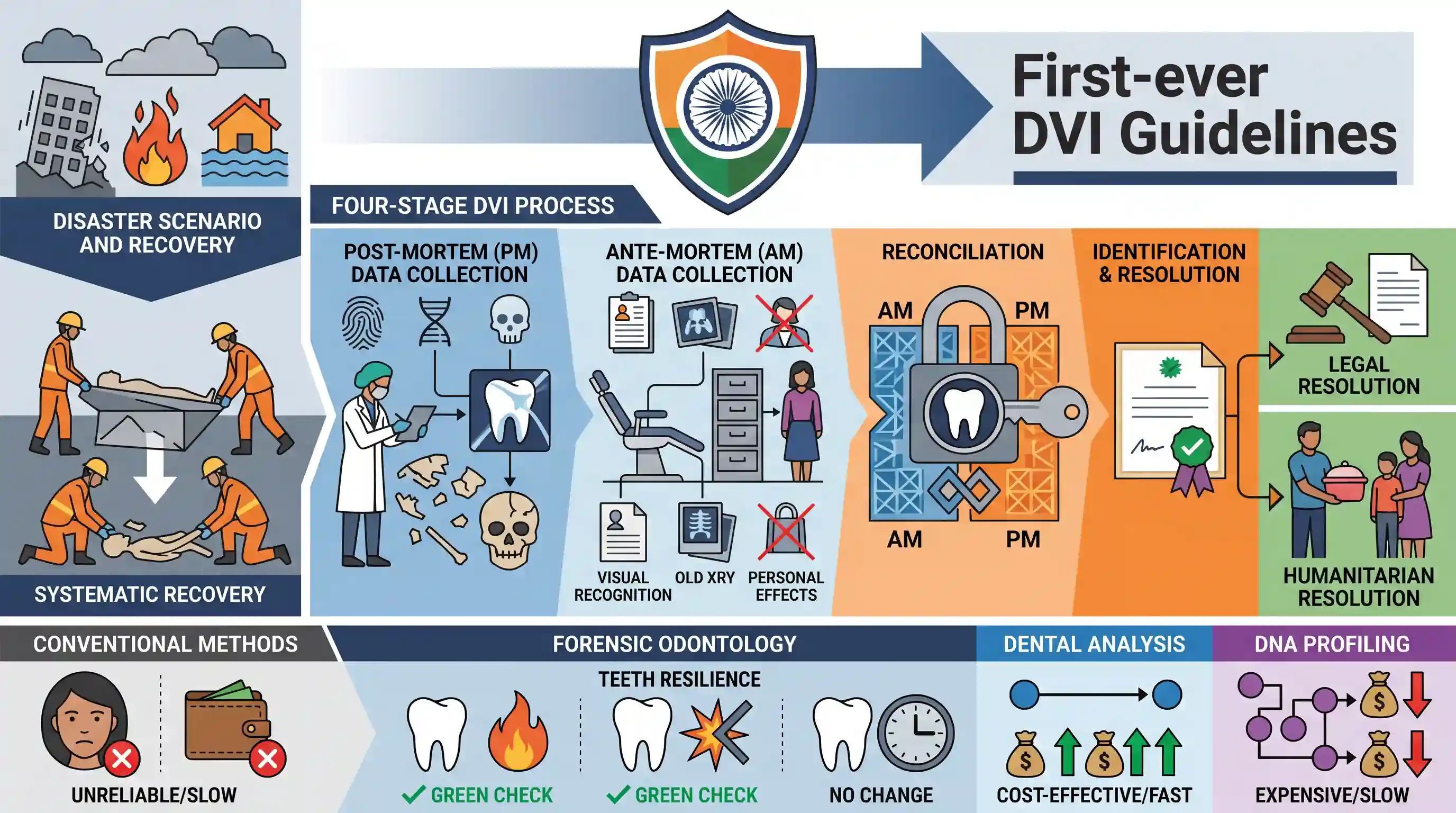
Why It Matters
Standardizing victim identification is a crucial step in the post-disaster recovery phase, ensuring dignity for the deceased and resolving legal and humanitarian issues for survivors. It highlights the intersection of disaster management and applied sciences (forensic odontology), representing an important evolution in India's disaster resilience framework under the NDMA.
Summary
India's National Disaster Management Authority (NDMA) has issued the country's first-ever Disaster Victim Identification (DVI) guidelines, establishing standardized protocols for managing mass casualties. The framework highlights the limitations of conventional identification methods like visual recognition or personal effects in catastrophic scenarios. Instead, it underscores the pivotal role of forensic odontology, noting that teeth and dental records are highly resilient to extreme temperatures, trauma, and decomposition. This makes dental analysis a robust, efficient, and cost-effective alternative to DNA profiling, crucial for expediting the legal and humanitarian resolution of post-disaster recovery.
Key Points
- The National Disaster Management Authority (NDMA) has released India's first set of Disaster Victim Identification (DVI) guidelines.
- The guidelines address the challenges of identifying victims in mass casualty events where bodies may be mutilated, decomposed, or unrecognizable.
- Forensic odontology (dental analysis) is heavily emphasized as a primary, reliable, and cost-effective method for victim identification over DNA profiling.
- Teeth and dental records are highly resilient to extreme environmental conditions, such as high temperatures and decomposition, making them crucial markers for identification.
- Standardizing DVI protocols aims to streamline post-disaster humanitarian, social, and legal processes by ensuring accurate and timely identification of deceased individuals.
Important Terms
Disaster Victim Identification (DVI) Guidelines

Standardized scientific protocol issued by the NDMA for identifying victims in large-scale disasters using methods like DNA, dental records, and fingerprints.
UPSC context
GS Paper III (Disaster Management); tests institutional response frameworks and scientific protocols for mass casualty management.
National Disaster Management Authority (NDMA)
India's apex statutory body for disaster management, established under the Disaster Management Act, 2005, and chaired by the Prime Minister.
UPSC context
GS Paper II (Statutory Bodies) & Paper III (Disaster Management); tests knowledge of policy-making authorities.
Forensic Odontology
The application of dental science to legal investigations, primarily used in DVI because teeth and dental restorations are highly resilient to fire and decomposition.
UPSC context
GS Paper III (Science & Technology); tests applications of forensic science in legal and humanitarian identification.
Mass Fatality Incident (MFI)
An event where the number of fatalities overwhelms local resources, necessitating specialized DVI protocols for the recognition and return of remains.
UPSC context
GS Paper III (Disaster Management); tests terminology and preparedness for large-scale disaster response.
Reconciliation (Forensic)
The critical final phase of DVI where specialists match post-mortem data from the deceased with ante-mortem records provided by families to confirm identity.
UPSC context
GS Paper III (Disaster Management/Forensics); tests technical processes involved in scientific victim identification.
Prelims Trap
"The DVI guidelines mandate DNA profiling as the primary and first-line method for identifying mass casualty victims."
The guidelines actually prioritize forensic odontology (dental analysis) due to its cost-effectiveness, speed, and the extreme resilience of teeth compared to DNA extraction.
Static Concepts Connected
What is the statutory structure and mandate of the NDMA?
- Statutory Origin: Created as the apex disaster management body under the Disaster Management Act, 2005.
- Leadership: The Prime Minister of India serves as the ex-officio chairperson of the NDMA.
- Core Function: Mandated to lay down policies, plans, and guidelines to ensure a timely and effective response to disasters.
Why is forensic odontology highly effective in mass disasters?
- Extreme Resilience: Tooth enamel is the hardest tissue in the human body, capable of withstanding extreme temperatures, severe trauma, and decomposition.
- Speed & Cost: Dental matching relies on comparing ante-mortem and post-mortem records, which is significantly faster and cheaper than DNA extraction.
Cross-Topic Patterns
Forensic Archaeology + WWII History
The guidelines adopt forensic archaeology techniques used in Northeast India for exhuming WWII soldiers, linking GS3 disaster management directly with GS1 historical excavation and heritage preservation.
National Registries + Data Privacy
The proposed National Dental Data Registry overlaps with GS2 fundamental rights and privacy debates, echoing past controversies surrounding the DNA Technology Regulation Bill and national biometric databases.

A 2026 Prelims question will likely contrast forensic odontology's resilience with DNA profiling in a multi-statement S&T/DM hybrid.
Linked PYQs · 3
Linked PYQs · 3
- 2014MainsGS3
Drought has been recognized as a disaster in view of its spatial expanse, temporal duration, slow onset and lasting effects on vulnerable sections. With a focus on the September 2010 guidelines from the National Disaster Management Authority (NDMA), discuss the mechanisms for preparedness to deal with likely El Niño and La Niña fallouts in India.
- 2024MainsGS3
What is disaster resilience? How is it determined? Describe various elements of a resilience framework. Also mention the global targets of Sendai Framework for Disaster Risk Reduction (2015–2030).
- 2023PrelimsGS1
'Microsatellite DNA' is used in the case of which one of the following?
