India First Barrier-Less Multi-Lane Free Flow Toll Plaza In Gujarat
Source:Indian Express ↗
Why It Matters
Directly addresses the transition from traditional electronic toll collection to seamless Multi-Lane Free Flow systems, exactly mirroring the technology evolution asked in the 2024 GS3 Mains paper. Understanding this transition is crucial for analyzing India's logistics efficiency and highway infrastructure modernization.
Summary
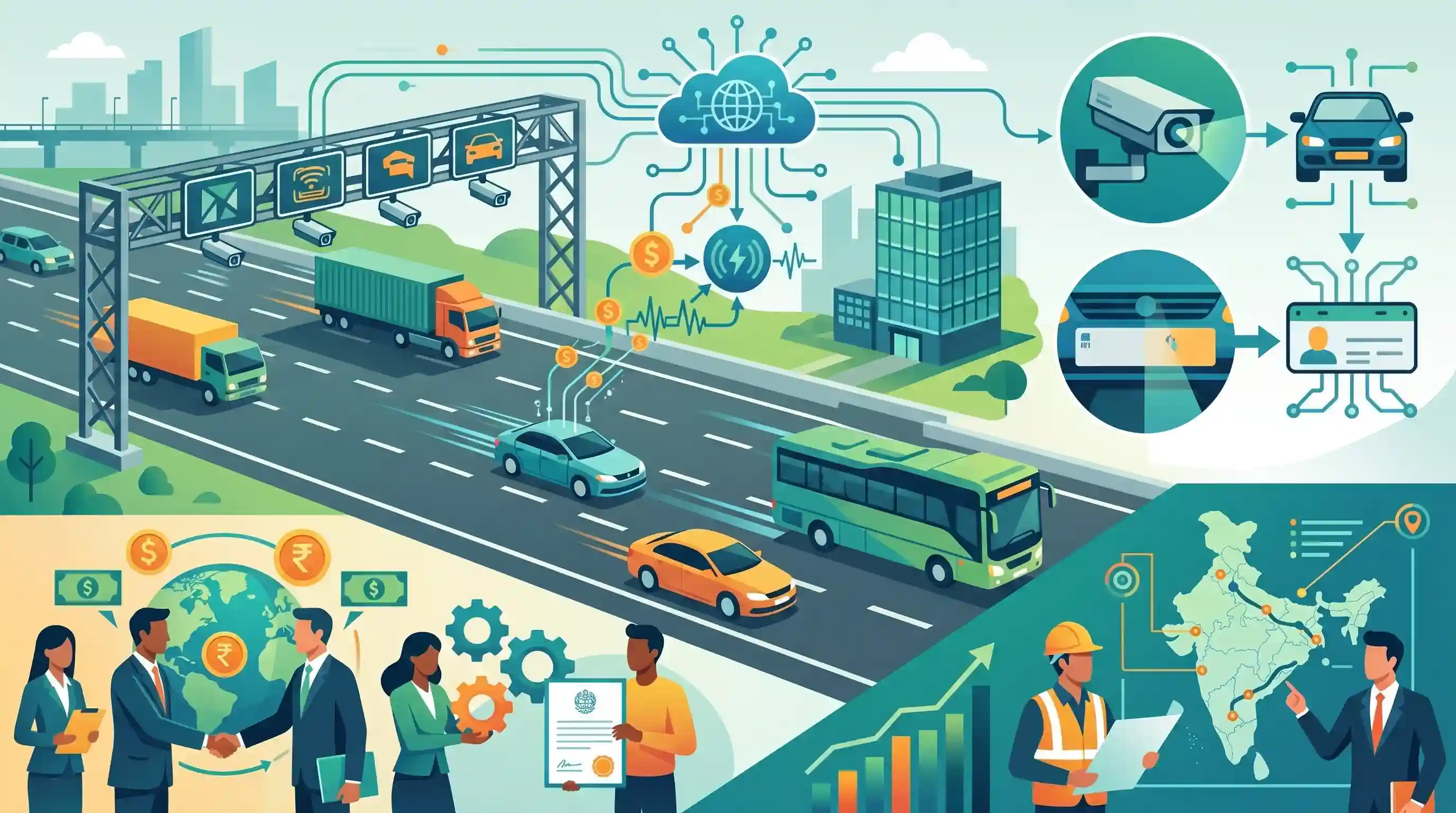
India has launched its first barrier-less Multi-Lane Free Flow (MLFF) toll plaza at Choryasi in Gujarat, marking a significant upgrade from the existing FASTag system. Deployed by the NHAI, the system uses overhead gantries equipped with RFID scanners and Automatic Number Plate Recognition (ANPR) cameras. This allows tolls to be seamlessly deducted from a vehicle's FASTag wallet at highway speeds, eliminating the need for boom barriers and stopping. Supported by amendments to the National Highway Fee rules and linked to the VAHAN database, the MLFF technology is slated to be implemented across all major national highways by March 2029 to enhance transit efficiency and reduce congestion.
Key Points
- The National Highway Authority of India (NHAI) has launched India's first barrier-less Multi-Lane Free Flow (MLFF) tolling system at the Choryasi toll plaza in Gujarat.
- The new system relies on RFID technology (FASTag), Automatic Number Plate Recognition (ANPR) cameras, and High Security Registration Plates (HSRP) linked to the VAHAN database to automatically deduct tolls without requiring vehicles to stop.
- The MLFF infrastructure features overhead gantries and was developed by ICICI Bank under an OpEx (Operating Expense) model, enabling toll collection at highway speeds and drastically reducing congestion.
- According to the Economic Survey 2025-26, the barrier-less MLFF system is targeted to be operational across all 4-lane and above National Highways and expressways in India by March 2029.
- To provide a legal backing for barrier-less toll collection, the Ministry of Road Transport and Highways recently notified the National Highway Fee (Determination of Rates and Collection) Amendment Rules, 2024.
Important Terms
National Electronic Toll Collection (NETC) system

A nationwide interoperable electronic payment framework operated by NPCI that enables automated, cashless tolling via RFID-based FASTags linked to bank accounts or wallets.
UPSC context
GS Paper III (Infrastructure/Digital Economy); tests knowledge of India's digital public infrastructure and financial technology integration.
National Highway Fee (Determination of Rates and Collection) Amendment Rules, 2024
Policy changes allowing for distance-based tolling and the introduction of Global Navigation Satellite System (GNSS) technology to facilitate a 'pay-as-you-use' highway fee model.
UPSC context
GS Paper II & III (Government Policies/Infrastructure); tests understanding of regulatory shifts toward technology-driven governance and logistics efficiency.
VAHAN Registry
A centralized national vehicle registry under MoRTH that collates data from RTOs nationwide, used in MLFF to verify vehicle ownership and enforce unpaid toll notices.
UPSC context
GS Paper II (E-governance/Citizen-centric services); crucial for understanding state-led data centralization and its application in public enforcement.
Indian Highway Management Company Limited (IHMCL)
A technical subsidiary of NHAI mandated to implement the FASTag program and manage electronic tolling infrastructure and clearinghouse services across India's highways.
UPSC context
GS Paper III (Infrastructure); tests awareness of specialized institutional bodies created to modernize transport logistics.
National Highway Authority of India (NHAI)
An autonomous agency under MoRTH established by the NHAI Act, 1988, responsible for the development, maintenance, and management of India’s national highway network.
UPSC context
GS Paper III (Infrastructure/Growth); a staple institutional term for questions on road transport and connectivity.
Ministry of Road Transport and Highways (MoRTH)
The apex central ministry responsible for formulating and administering policies related to road transport, national highways, and the overall legislative framework for motor vehicles.
UPSC context
GS Paper II (Governance); relevant for understanding the administrative structure behind major national infrastructure projects.
Prelims Trap
The MLFF tolling system entirely replaces the FASTag (RFID) mechanism with ANPR cameras.
MLFF does not replace FASTag; it combines existing RFID-based FASTag technology with ANPR cameras and the VAHAN database to completely eliminate physical boom barriers.
Static Concepts Connected
What is the VAHAN database and what is its primary utility?
- Centralized Registry: It is the national centralized registry of all vehicle registration certificates (RCs) across India, managed by the Ministry of Road Transport & Highways (MoRTH).
- Inter-agency Integration: It integrates with FASTag, insurance databases, and police networks to trace stolen vehicles, monitor taxation, and issue electronic challans (e-challans).
How does Radio Frequency Identification (RFID) used in FASTag work?
- No Line-of-Sight: Unlike barcodes, RFID uses radio waves and does not require direct optical line-of-sight, allowing readers to scan tags from a distance or through windshields.
- Passive Technology: FASTags are 'passive' RFID tags. They have no internal battery; instead, they draw power from the electromagnetic waves emitted by the overhead reader (gantry) to transmit their data.
Cross-Topic Patterns
OpEx PPPs in digital infrastructure
Unlike traditional BOT or HAM models for physical roads, this tech infrastructure uses an Operating Expense (OpEx) model where banks invest upfront and recover costs via a share of tolls.
Mobility as Digital Public Infrastructure (DPI)
The integration of FASTag, ANPR, and VAHAN showcases how India's DPI stack is expanding beyond financial inclusion (UPI) into physical mobility, transit governance, and carbon reduction.

Expect a 2026 prelims question merging the tech principles of RFID/ANPR with their e-governance applications in VAHAN and FASTag.
Linked PYQs · 3
Linked PYQs · 3
- 2024MainsGS3
What is the technology being employed for electronic toll collection on highways? What are its advantages and limitations? What are the proposed changes that will make this process seamless? Would this transition carry any potential hazards?
- 2022PrelimsGS1
Consider the following communication technologies: 1. Closed-circuit Television 2. Radio Frequency Identification 3. Wireless Local Area Network Which of the above are considered Short-Range devices/technologies?
- 2021MainsGS3
“Investment in infrastructure is essential for more rapid and inclusive economic growth.” Discuss in the light of India's experience.
