India Federalism Fiscal Transfers and Delimitation Policy Challenges
Source:Indian Express ↗
Why It Matters
The debate over delimitation and Finance Commission transfers sits at the core of GS Paper 2 (Federalism). Understanding the friction between demographic changes, political representation, and fiscal devolution is crucial for answering Mains questions on Centre-State relations, cooperative federalism, and constitutional mechanisms for dispute resolution.
Summary
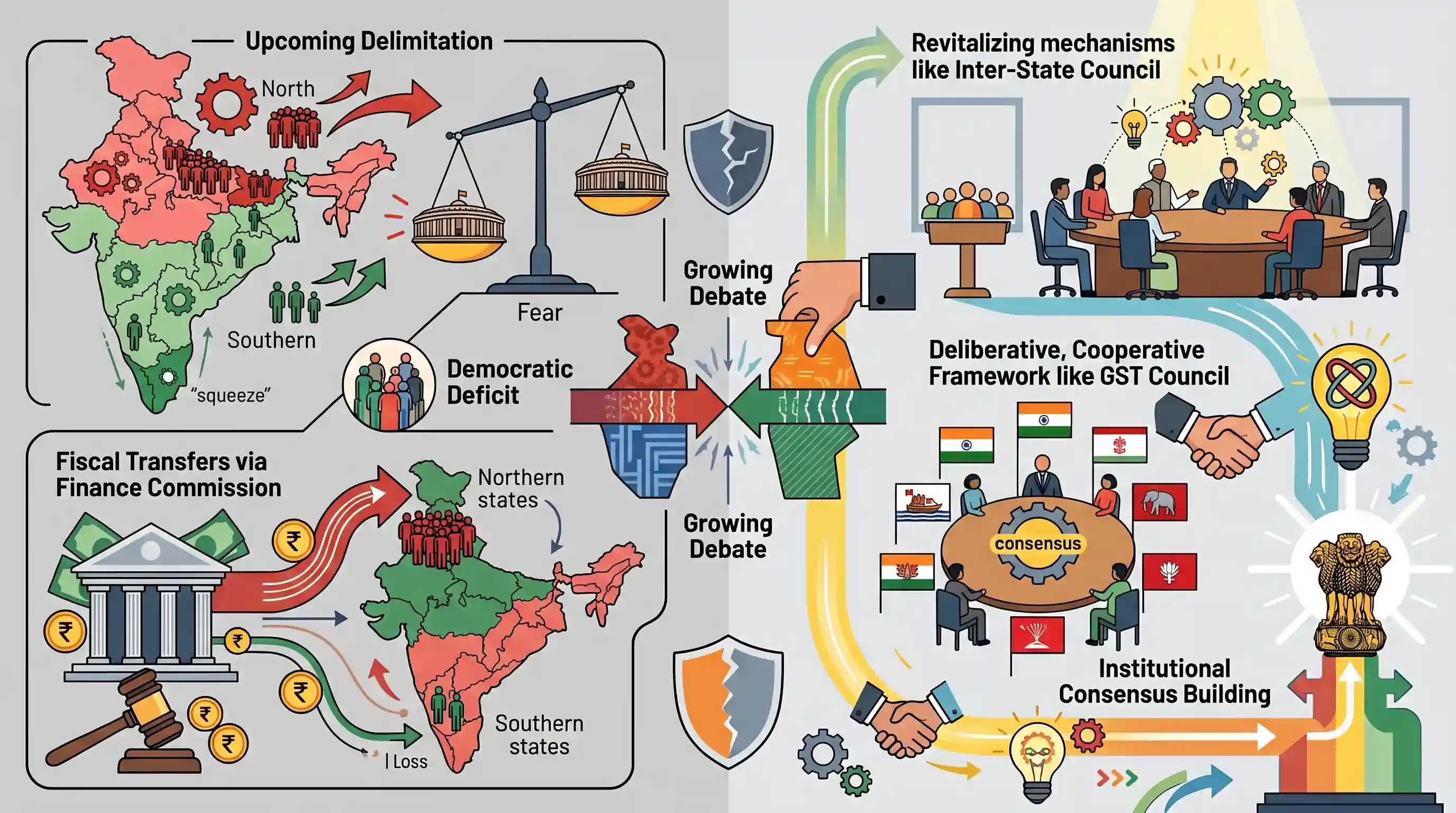
The article analyzes the growing debate around India's federal structure, highlighting two major challenges: the upcoming delimitation exercise and the criteria for fiscal transfers via the Finance Commission. Demographic divergence has led to fears among Southern states that their success in population control will result in a loss of political representation (a 'democratic deficit') and an unfair reduction in central tax devolution. To preserve the Union's stability, the article argues for shifting away from majoritarian approaches toward institutional consensus-building. It advocates for revitalizing mechanisms like the Inter-State Council and adopting deliberative, cooperative frameworks akin to the GST Council to resolve Centre-State disputes.
Key Points
- India's federal architecture faces dual pressure points: impending political delimitation and contention over fiscal resource allocation.
- The upcoming delimitation exercise risks creating a 'democratic deficit' for Southern states, penalizing them politically for successfully stabilizing their populations.
- Fiscal federalism is strained as economically high-performing states express dissatisfaction with the Finance Commission's tax devolution criteria, perceiving it as a disincentive for growth and demographic management.
- To resolve these Centre-State frictions, India must rely on institutional consensus-building rather than simple majoritarianism.
- Strengthening cooperative federalism requires empowering bodies like the Inter-State Council and drawing lessons from the deliberative framework of the GST Council.
Important Terms
Finance Commission

A constitutional body (Article 280) that recommends the distribution of tax revenues between the Union and States, ensuring fiscal equilibrium and equitable resource sharing.
UPSC context
GS II (Constitutional Bodies) and GS III (Fiscal Federalism); tests understanding of financial devolution.
Inter-State Council
A constitutional body (Article 263) chaired by the Prime Minister to facilitate coordination between the Union and States through deliberation on shared policy interests.
UPSC context
GS II (Federal Structure); tests knowledge of institutional mechanisms for resolving Centre-State disputes.
GST Council
A joint forum of the Centre and States (Article 279A) that makes recommendations on Goods and Services Tax rates, exemptions, and administrative rules.
UPSC context
GS II & III (Polity/Economy); evaluates consensus-based decision-making in India's indirect tax regime.
Delimitation
The process of redrawing electoral constituency boundaries based on the latest census to ensure proportionate political representation as population shifts.
UPSC context
GS II (Legislature); critical for understanding the "democratic deficit" and regional representation challenges.
Cooperative Federalism
A governance model where the Union and States work as partners to resolve issues through consensus, moving away from a hierarchical or competitive structure.
UPSC context
GS II (Federalism); a core concept testing administrative harmony and the balance of power.
Prelims Trap
"The constitutional freeze on the allocation of Lok Sabha seats among states ends exactly in 2026."
The 84th Amendment froze allocation until the figures for the first Census taken *after* the year 2026 are published (likely 2031), not exactly in 2026 itself.
Static Concepts Connected
What is the mandate and composition of the Inter-State Council?
- Constitutional Basis: Established under Article 263 by Presidential order (based on Sarkaria Commission), making it an advisory, non-permanent constitutional body.
- Composition: Chaired by the Prime Minister, comprising all Chief Ministers, administrators of UTs, and six Union Cabinet Ministers.
- Core Function: Investigates inter-state disputes and recommends actions for better coordination of policy and action across the Union and States.
How does the Finance Commission determine horizontal tax devolution?
- Income Distance: Carries the highest weight; allocates more funds to states with lower per capita income compared to the highest-income state to ensure equitable development.
- Population Weightage: Recent commissions transitioned to using 2011 Census data, prompting concerns from Southern states over being penalized for successful population control.
- Demographic Performance: A specific criterion introduced (from the 15th FC) to explicitly reward states for lower fertility rates, balancing the controversial shift to 2011 population data.
Cross-Topic Patterns
Demographics + Regionalism + Delimitation
Ties GS1 (Population issues) to GS2 (Federalism). The fear of a 'democratic deficit' in Southern states could trigger sub-nationalism, making this a prime GS1/GS2 overlapping Mains theme.
GST Council as a Federal Model
The GST Council's unique voting structure (States 2/3rd weight, Centre 1/3rd) and consensus mandate is increasingly cited as a deliberative template for reforming other unitary-leaning institutions.

Expect a 2026 Prelims question pairing the 84th Amendment's post-2026 delimitation freeze with the 16th Finance Commission's ToR.
Linked PYQs · 5
Linked PYQs · 5
- 2025MainsGS2
Examine the evolving pattern of Centre-State financial relations in the context of planned development in India. How far have the recent reforms impacted the fiscal federalism in India?
- 2024MainsGS2
What changes has the Union Government recently introduced in the domain of Centre-State relations ? Suggest measures to be adopted to build the trust between the Centre and the States and for strengthening federalism.
- 2018MainsGS2
How is the Finance Commission of India constituted? What do you know about the terms of reference of the recently constituted Finance Commission? Discuss.
- 2015MainsGS2
The concept of cooperative federalism has been increasingly emphasized in recent years. Highlight the drawbacks in the existing structure and the extent to which cooperative federalism would answer the shortcomings.
- 2022MainsGS2
“While the national political parties in India favour centralisation, the regional parties are in favour of State autonomy.” Comment.
