Foreign Direct Investment Inflows Surge and Macroeconomic Impact
Source:Indian Express ↗
Why It Matters
Understanding the distinction between FDI and FPI, the calculation of REER, and the mechanics of RBI's currency interventions are fundamental concepts for the UPSC Economics syllabus. This article provides a real-world application of how global geopolitical shocks translate into domestic macroeconomic volatility.
Summary
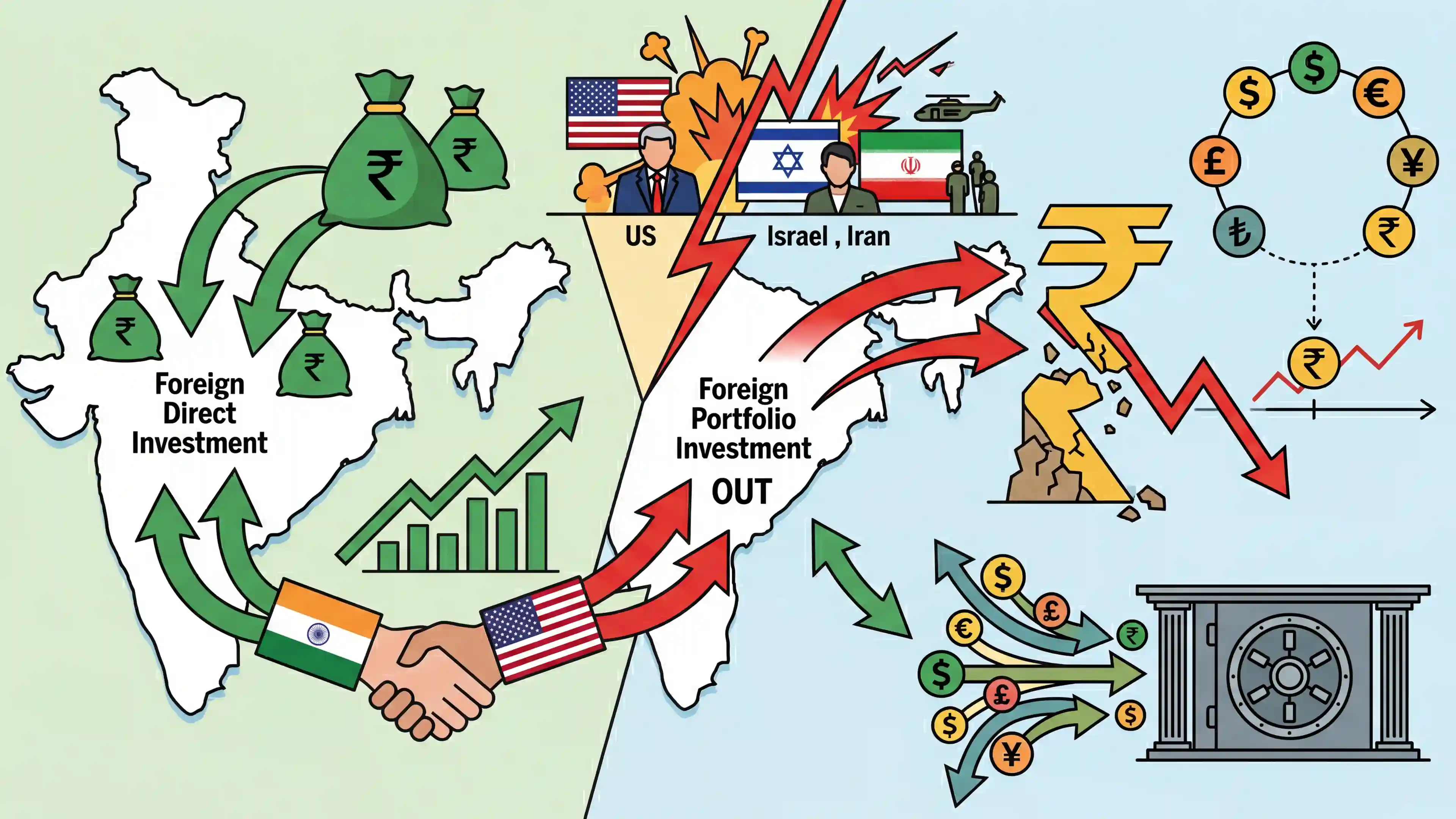
Before the recent escalation of geopolitical tensions in West Asia (involving the US, Israel, and Iran), India recorded a four-year high in net Foreign Direct Investment (FDI) inflows, reaching $4.6 billion in February 2026. This surge was facilitated by an interim trade deal between India and the US. However, the subsequent geopolitical conflict triggered massive Foreign Portfolio Investment (FPI) outflows in March, putting severe depreciative pressure on the Indian rupee. To counter this volatility, the Reserve Bank of India (RBI) heavily intervened by selling foreign currency from its reserves. Furthermore, India's Real Effective Exchange Rate (REER) fell to a 12-year low, suggesting that the rupee is currently undervalued by 8-9% against a basket of 40 trading partner currencies.
Key Points
- India's net FDI inflows reached a 4-year high of $4.6 billion in February 2026, boosted by an interim trade agreement with the US that reduced tariffs.
- Net FDI is calculated as gross FDI inflows minus repatriation of FDI (like profits and dividends) and outward investments by domestic firms.
- Subsequent geopolitical tensions in West Asia led to heavy Foreign Portfolio Investment (FPI) outflows of $13.6 billion in March, causing the rupee to depreciate.
- The RBI actively intervened in the foreign exchange market, selling dollars from its reserves to stabilize the rupee against these shocks.
- India's 40-currency, trade-weighted Real Effective Exchange Rate (REER) dropped to a 12-year low of 92.72 in March, indicating the rupee is undervalued by 8-9%.
Important Terms
Real Effective Exchange Rate (REER)

A weighted average of a country's currency relative to a basket of major currencies, adjusted for inflation. A lower REER indicates increased export competitiveness but potential currency undervaluation.
UPSC context
GS Paper 3: Indian Economy. Key for understanding exchange rate management, external sector stability, and export-import dynamics.
Foreign Direct Investment (FDI)
Long-term capital investment by a foreign entity into an Indian company, typically involving management control. It is considered more stable than portfolio investment for financing the current account.
UPSC context
GS Paper 3: Investment Models. Tested for its impact on economic growth, balance of payments, and sectoral limits.
Foreign Portfolio Investment (FPI)
Short-term investments by foreign entities in Indian financial assets like stocks and bonds. Often termed 'hot money' due to its high volatility during geopolitical or economic shifts.
UPSC context
GS Paper 3: Indian Economy. Important for studying market volatility and its relationship with the Rupee's value.
Repatriation
The process of foreign investors sending profits, dividends, or invested capital from India back to their home country, which reduces the final 'net' FDI figure.
UPSC context
GS Paper 3: External Sector. Critical for distinguishing between 'Gross' and 'Net' capital inflows in the Balance of Payments.
Interim Trade Deal (India-US)
A February 2026 framework that reduced reciprocal tariffs between India and the US to 18%, eliminated certain US penalty tariffs, and boosted investor sentiment.
UPSC context
GS Paper 2: Bilateral Relations. Highlights trade diplomacy, tariff barriers, and strategic economic partnerships.
RBI Foreign Exchange Management
India's central bank's actions—such as selling dollars from reserves—to curb excessive Rupee volatility and ensure orderly conditions in the foreign exchange market.
UPSC context
GS Paper 3: Monetary Policy. Relates to the RBI's role as the custodian of foreign exchange and its mandate for currency stability.
Morgan Stanley
A global financial services firm whose research reports on India's capital flows, FDI acceleration, and domestic equity ownership are widely cited in economic analysis.
UPSC context
UPSC Prelims/Mains. Often used as a reliable source for data trends on foreign investment and market outlook.
Prelims Trap
"A steady decrease in India's Real Effective Exchange Rate (REER) indicates that the rupee is overvalued and exports are losing competitiveness."
A falling REER signifies real-term depreciation against trading partners. This makes Indian goods cheaper abroad, thereby increasing export competitiveness, not decreasing it.
Static Concepts Connected
What are the differences between NEER and REER?
- NEER (Nominal): An unadjusted weighted average rate at which the domestic currency exchanges for a basket of foreign currencies.
- REER (Real): NEER adjusted for inflation differentials with trading partners. It is the true macroeconomic indicator of a country's export competitiveness.
- Value interpretation: A REER below 100 indicates the domestic currency is undervalued, while a REER above 100 implies relative overvaluation.
How does the RBI intervene under a 'managed float' regime?
- Market-driven basics: The exchange rate is primarily determined by market forces of demand and supply without a fixed numerical target.
- Dollar selling: To curb sharp depreciation from sudden FPI outflows, the RBI sells dollars from its forex reserves, absorbing excess rupee supply.
- Sterilization: The RBI may conduct Open Market Operations (OMOs) to inject rupee liquidity back into the system, neutralizing the money supply impact of its forex intervention.
Cross-Topic Patterns
Geopolitical shocks and hot money flight
West Asian conflicts instantly impact Indian markets via FPI ("hot money") withdrawals. This contrasts sharply with long-term FDI, which relies on structural trade agreements rather than immediate geopolitical panic.
Forex depletion and external sector metrics
Heavy RBI dollar-selling stabilizes the rupee but shrinks forex reserves. This links directly to macroeconomic vulnerability metrics like falling import cover ratios and increased short-term external debt servicing risks.

Expect a 2026 multi-statement question combining REER undervaluation effects, Net FDI calculation, and RBI forex sterilization.
Linked PYQs · 5
Linked PYQs · 5
- 2011PrelimsGS1
Both Foreign Direct Investment (FDI) and Foreign Institutional Investor (FII) are related to investment in a country. Which one of the following statements best represents an important difference between the two?
- 2021PrelimsGS1
Consider the following : 1. Foreign currency convertible bonds 2. Foreign institutional investment with certain conditions 3. Global depository receipts 4. Non-resident external deposits Which of the above can be included in Foreign Direct Investments?
- 2020PrelimsGS1
With reference to Foreign Direct Investment in India, which one of the following is considered its major characteristic?
- 2022PrelimsGS1
With reference to the Indian economy, consider the following statements: 1. An increase in Nominal Effective Exchange Rate (NEER) indicates the appreciation of rupee. 2. An increase in the Real Effective Exchange Rate (REER) indicates an improvement in trade competitiveness. 3. An increasing trend in domestic inflation relative to inflation in other countries is likely to cause an increasing divergence between NEER and REER. Which of the above statements are correct?
- 2022PrelimsGS1
With reference to the Indian economy, consider the following statements: 1. If the inflation is too high, Reserve Bank of India (RBI) is likely to buy government securities. 2. If the rupee is rapidly depreciating, RBI is likely to sell dollars in the market. 3. If interest rates in the USA or European Union were to fall, that is likely to induce RBI to buy dollars. Which of the statements given above are correct?
