India seeks bilateral trade agreement during US tariff pause window
Source:The Hindu ↗
Why It Matters
It offers a real-world example of the global economic shift from multilateralism (WTO frameworks) to bilateralism and protectionism, a frequent UPSC Mains theme. Furthermore, it highlights India's strategic positioning to attract global supply chains amid Western efforts to decouple from China.
Summary
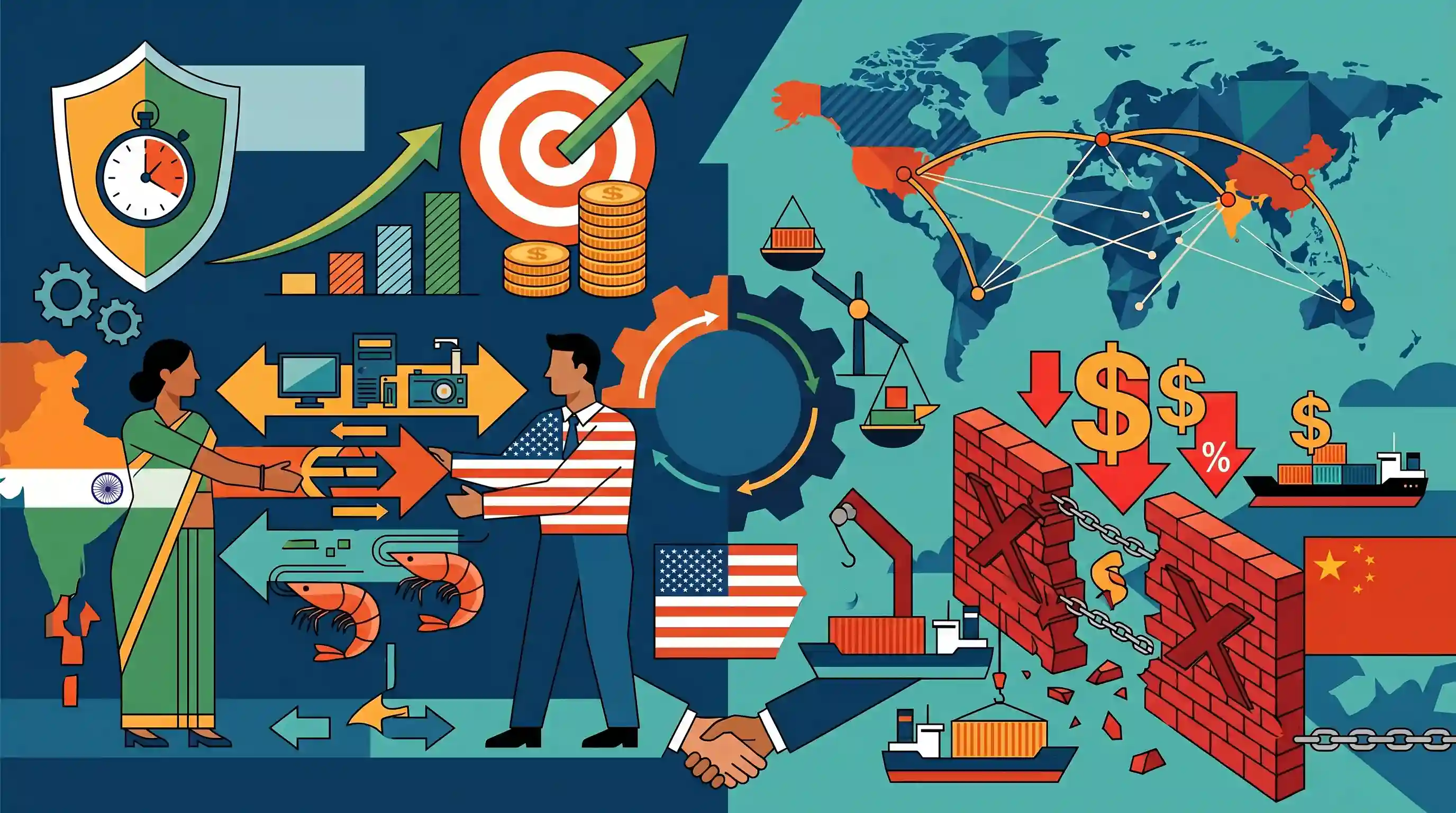
India is pushing for a rapid conclusion to a bilateral trade deal with the United States, seizing the opportunity presented by President Donald Trump's 90-day pause on reciprocal tariffs. While the US continues to levy heavy tariffs on China (up to 125%), the temporary relief for India avoids a 10% reciprocal tariff, heavily benefiting Indian exporters, particularly in the shrimp industry. Both nations aim to scale bilateral trade to $500 billion by 2030. This development underscores the broader global trend of retreating from multilateralism in favor of protectionist, balanced bilateral agreements, and positions India strategically amid the ongoing US-China trade war.
Key Points
- India aims to fast-track a bilateral trade deal with the US, targeting the conclusion of the first phase by autumn 2025.
- The push follows US President Donald Trump's 90-day pause on reciprocal tariffs for several nations, while continuing high tariffs on Chinese imports.
- The tariff pause provides immediate relief to Indian exporters, particularly in the shrimp and seafood sectors, avoiding a potential 10% reciprocal tariff.
- The US focus has shifted from multilateral frameworks to balanced bilateral trade, with India and the US targeting $500 billion in two-way trade by 2030.
- The geopolitical environment highlights the 'China Plus One' strategy, where the West uses tariffs to incentivize supply chain diversification to allies like India.
Important Terms
China Plus One (C+1) Strategy

A global business strategy where companies diversify supply chains by investing in countries other than China to reduce over-reliance and mitigate geopolitical risks.
UPSC context
GS Paper 3 (Economy); vital for India's manufacturing ambitions and capturing shifted global production.
Reciprocal Tariffs
A trade policy where a nation imposes import duties equal to those levied by a trading partner on its own exports, aiming for "balanced" trade.
UPSC context
GS Paper 2 (IR) and GS Paper 3 (Economy); marks a protectionist shift in global trade dynamics.
Bilateralism
The conduct of economic or political relations between two sovereign states, typically involving direct negotiations and targeted pacts rather than broad global forums.
UPSC context
GS Paper 2 (International Relations); focuses on India's strategic preference for faster, sovereign-controlled trade negotiations.
Mission 500
A joint strategic objective between India and the United States to increase their bilateral trade volume to $500 billion annually by the year 2030.
UPSC context
GS Paper 2 (Bilateral Groupings); a key benchmark for evaluating the depth of India-US economic ties.
Protectionism
Economic policies, such as tariffs or quotas, designed to restrict international trade to shield domestic industries from foreign competition.
UPSC context
GS Paper 3 (Economy); central to debates on trade wars, domestic industry growth, and global economic integration.
Free Trade Agreement (FTA)
An agreement between two or more countries to reduce or eliminate trade barriers like tariffs and quotas to facilitate the exchange of goods and services.
UPSC context
GS Paper 3 (Economy); basic concept for trade integration levels and India’s foreign trade policy.
Prelims Trap
Reciprocal tariffs are a recognized trade remedy mechanism under standard WTO rules.
Reciprocal tariffs are unilateral retaliatory tools, not official WTO remedies like Anti-Dumping Duties. They generally violate the Most-Favored-Nation (MFN) principle.
Static Concepts Connected
What is the WTO's MFN principle and its major exceptions?
- Core Principle: Countries cannot normally discriminate between trading partners. Under WTO rules, a trade favor granted to one nation must be given to all.
- FTA Exception: Countries in Free Trade Agreements or Customs Unions can apply lower/zero tariffs among themselves, bypassing MFN rules under Article XXIV.
- Developing Nations Exception: The Generalized System of Preferences (GSP) allows developed countries to grant non-reciprocal preferential tariff treatment to developing countries.
What defines India's marine export profile?
- Dominant Commodity: Frozen shrimp, specifically the cultivated L. Vannamei species, dominates the sector, comprising over 70% of total marine export earnings by value.
- Primary Markets: The United States is historically the largest destination for Indian marine products, making the sector highly vulnerable to US tariff policies.
Cross-Topic Patterns
Blue Revolution + US Trade Barriers
PMMSY aims to double seafood exports. Relying heavily on the US market for shrimp makes India's coastal rural incomes highly vulnerable to US protectionist policies and reciprocal tariffs.
China Plus One + Trade Bilateralism
The shift from WTO multilateralism to bilateral FTAs reflects a geopolitical strategy where Western markets use tariffs to actively force supply chain decoupling from China toward allies like India.

Expect a multi-statement question on WTO exceptions (MFN vs reciprocal tariffs) linked directly to India's marine export vulnerabilities.
Linked PYQs · 4
Linked PYQs · 4
- 2025MainsGS3
What are the challenges before the Indian economy when the world is moving away from free trade and multilateralism to protectionism and bilateralism? How can these challenges be met?
- 2024MainsGS2
‘The West is fostering India as an alternative to reduce dependence on China's supply chain and as a strategic ally to counter China's political and economic dominance.’ Explain this statement with examples.
- 2018MainsGS3
How would the recent phenomena of protectionism and currency manipulations in world trade affect macroeconomic stability of India?
- 2018MainsGS2
What are the key areas of reform if the WTO has to survive in the present context of "Trade War', especially keeping in mind the interest of India?
