DG Shipping Introduces New Maritime Training Standards
Source:The Hindu ↗
Why It Matters
The maritime sector is crucial for India's trade and economic growth. Reforming maritime training and aligning operations with green shipping standards are vital for enhancing human capital (seafarers) and meeting global climate commitments, directly relevant to GS3 (Infrastructure and Environment) and GS2 (Governance).
Summary
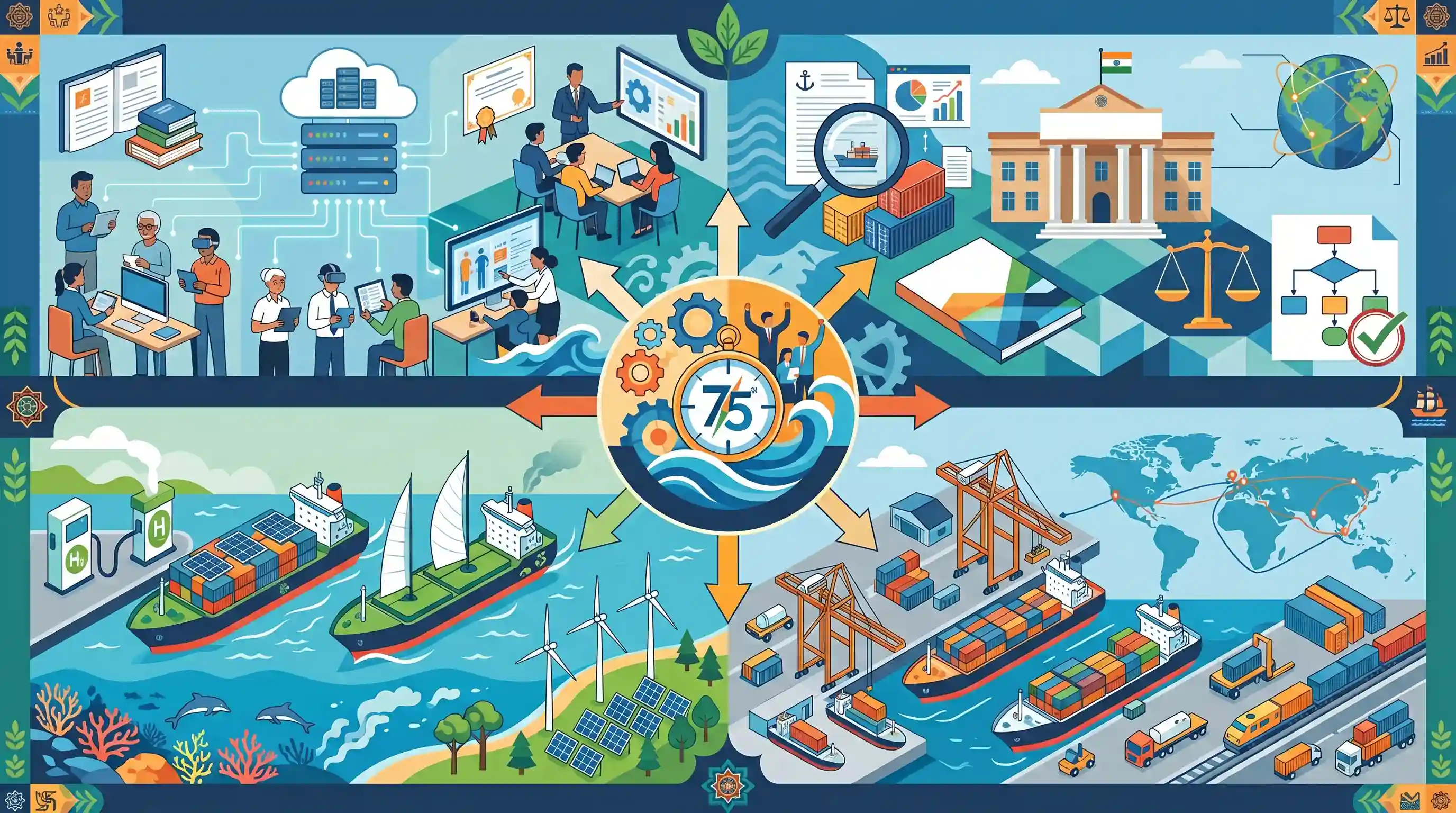
India is undergoing a significant transformation in its maritime sector, driven by new training standards, digital learning initiatives, and climate preparedness. On its 75th anniversary, the Directorate General of Shipping (DG Shipping) hosted a conference focusing on 'Training, Transition, and Transformation'. Key measures include the rollout of a Learning Management System (LMS) to standardize maritime education, the launch of the Comprehensive Inspection Programme (CIP) Report 2025, and strict validation protocols for foreign-issued competencies. Furthermore, India is aligning its maritime policies with global sustainability goals, emphasizing a 'Just Transition' towards green shipping, renewable energy adoption, and climate adaptation in maritime operations.
Key Points
- The Directorate General of Shipping (DG Shipping) marked its 75th anniversary with a Knowledge Sharing Conference themed around 'T³: Training, Transition, Transformation'.
- The Comprehensive Inspection Programme (CIP) Report 2025 and STCW Nautical and Engineering Reports were launched to ensure rigorous oversight of maritime training.
- A new Learning Management System (LMS) has been rolled out to standardize and digitize maritime training, ensuring consistent quality across maritime institutes.
- To enhance safety and counter fraud, foreign-issued maritime competencies will now only be recognized after validation by DG Shipping.
- India is emphasizing a 'Just Transition' in maritime operations, focusing on sustainability, climate adaptation, and the adoption of green shipping practices.
Important Terms
Directorate General of Shipping (DG Shipping)

An attached office under the Ministry of Ports, Shipping and Waterways; it serves as India’s apex regulatory body for maritime administration, safety, and training under the Merchant Shipping Act.
UPSC context
GS-II (Statutory Bodies) and GS-III (Infrastructure). Tests knowledge of India's maritime governance and regulatory institutions.
STCW Convention
An International Maritime Organization (IMO) convention that sets global qualification standards for masters, officers, and watch personnel on merchant ships to ensure safety and prevent human error.
UPSC context
GS-III (Infrastructure) and GS-II (International Conventions). Crucial for understanding global safety and labor standards in shipping.
Comprehensive Inspection Programme (CIP)
A DG Shipping regulatory framework that employs standardized grading and inspections by Recognized Organizations (ROs) to monitor and ensure quality across India’s Maritime Training Institutes (MTIs).
UPSC context
GS-II (Governance) and GS-III (HRD). Important for regulatory reforms in vocational training and education quality assurance.
National Green Shipping Policy (NGSP)
India’s strategic framework targeting net-zero maritime emissions by 2070; it emphasizes renewable energy adoption, green fuels (like hydrogen/ammonia), and sustainable port infrastructure.
UPSC context
GS-III (Environment and Infrastructure). Relates to India's climate commitments, energy transition, and the "Blue Economy."
International Maritime Organization (IMO)
The UN specialized agency responsible for the safety and security of global shipping and the prevention of marine and atmospheric pollution from ships.
UPSC context
GS-II (International Organizations). Essential for understanding global maritime law and India's participation in multilateral regimes.
Just Transition (Maritime)
In a maritime context, ensuring the shift to green technology is fair and inclusive, protecting workers' rights and providing training for small operators and marginalized groups.
UPSC context
GS-III (Environment and Inclusive Growth). Critical for discussing the social equity of climate and economic policies.
Prelims Trap
"The STCW Convention is a global treaty administered by the International Labour Organization (ILO) for maritime workers."
The STCW is an International Maritime Organization (IMO) convention for technical and safety qualifications. The ILO administers the separate Maritime Labour Convention (MLC) for seafarer labor rights.
Static Concepts Connected
What is the statutory role of the Directorate General of Shipping (DG Shipping)?
- Parent Ministry: It is an attached office operating under the Ministry of Ports, Shipping and Waterways.
- Statutory Basis: It exercises statutory powers under the Merchant Shipping Act, 1958, to enforce national shipping and navigation policies.
- Core Functions: It oversees maritime education, ensures maritime safety, regulates maritime training institutes, and implements IMO conventions in India.
How does the 'Just Transition' framework apply to the maritime sector?
- Green Technologies: Shifting toward zero-emission alternative fuels and energy-efficient shipping practices to align with the IMO's greenhouse gas reduction strategy.
- Workforce Reskilling: Providing targeted training and certification to seafarers and port workers to prevent structural unemployment during the industry's shift to green tech.
- Social Equity: Ensuring the economic and social costs of climate adaptation in the shipping industry do not disproportionately impact vulnerable maritime labor.
Cross-Topic Patterns
Blue Economy + Green Hydrogen Hubs
India's maritime skill transformation supports parallel infrastructure initiatives, such as the Green Tug Transition Programme and the development of major domestic ports into Green Hydrogen bunkering hubs.
Internal Security + Credential Validation
Mandating DG Shipping validation for foreign-issued maritime competencies reflects a broader national security pivot against fraudulent credentials, safeguarding critical transport logistics from unqualified personnel.

IMO conventions (STCW, MARPOL, MLC) combined with India's Green Shipping policy are highly likely to form a 2026 prelims MCQ.
Linked PYQs · 4
Linked PYQs · 4
- 2025MainsGS3
Why is maritime security vital to protect India's sea trade? Discuss maritime and coastal security challenges and the way forward.
- 2022MainsGS3
What are the maritime security challenges in India ? Discuss the organisational, technical and procedural initiatives taken to improve the maritime security.
- 2024PrelimsGS1
According to the Environmental Protection Agency (EPA), which one of the following is the largest source of sulphur dioxide emissions?
- 2022PrelimsGS1
Which one of the following statements best describes the 'Polar Code'?
