Indiaing Roadmap to a Ten Trillion Dollar Economy by 2047
Source:Indian Express ↗
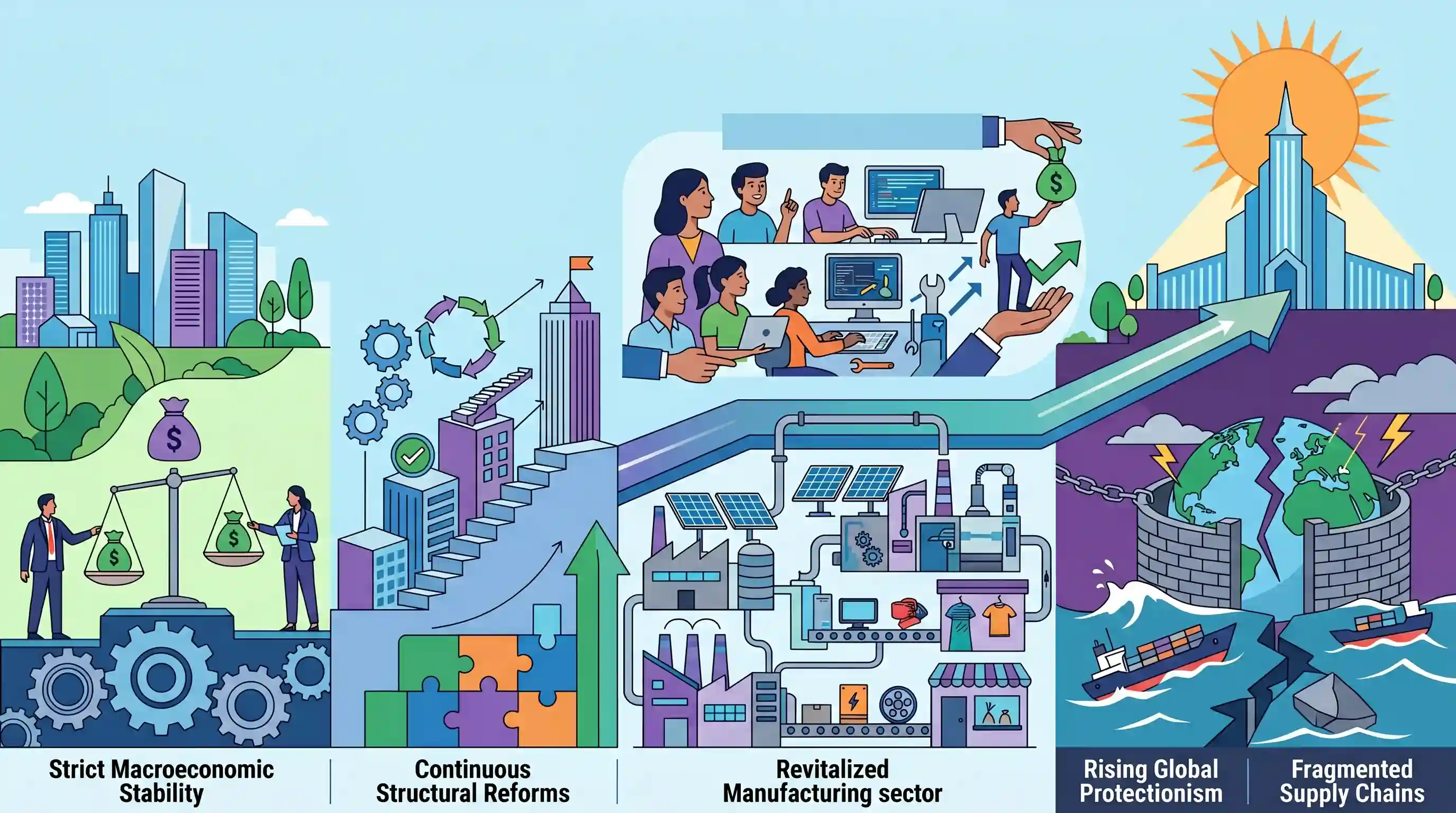
Why It Matters
The vision for a $10 trillion economy is central to India's long-term strategic economic planning (Viksit Bharat 2047). For UPSC aspirants, understanding the foundational requirements—such as boosting manufacturing, ensuring macroeconomic stability, and overcoming the skills deficit—is crucial. Mains questions frequently assess the viability of such ambitious targets against constraints like global protectionism, structural unemployment, and MSME challenges.
Summary
Chief Economic Advisor V. Anantha Nageswaran outlined India's trajectory to becoming a $10 trillion economy by 2047. Realizing this vision requires a multi-pronged approach encompassing strict macroeconomic stability, continuous structural reforms, and a revitalized manufacturing sector, particularly MSMEs. Nageswaran highlighted that leveraging the demographic dividend through intensive skilling is imperative to improve labour productivity. Furthermore, India must navigate external challenges like rising global protectionism and fragmented supply chains to sustain its growth momentum and achieve the objectives of 'Viksit Bharat'.
Key Points
- India is targeting a $10 trillion economy by 2047, corresponding to the centenary of its independence and the vision for a developed nation.
- Chief Economic Advisor V. Anantha Nageswaran emphasized that maintaining macroeconomic stability is a non-negotiable prerequisite for sustained long-term growth.
- Skilling the youth and effectively utilizing the demographic dividend remain critical to enhancing labour productivity and reducing structural unemployment.
- Boosting the manufacturing sector, particularly integrating MSMEs into global value chains, is essential to absorb the growing workforce.
- Global headwinds, including a shift toward protectionism and away from multilateralism, pose external risks to India's export-led growth trajectory.
Important Terms
Viksit Bharat 2047

The Government of India’s long-term vision to transform the country into a developed, prosperous, and self-reliant nation by the centenary of its independence.
UPSC context
GS Paper III (Economy/Growth). Tests understanding of long-term economic roadmaps and resource mobilization strategies.
Micro, Small and Medium Enterprises (MSMEs)
Enterprises classified by investment and turnover; widely considered the 'backbone' of India's economy for providing employment and driving approximately 45% of total exports.
UPSC context
GS Paper III (Industrial Policy). Key for topics on inclusive growth, employment, and rural industrialization.
Demographic Dividend
Economic growth potential arising from shifts in a population's age structure, specifically when the working-age population (15-64) outnumbers the non-working-age population.
UPSC context
GS Paper I (Society) and III (Economy). Tests ability to link population trends with productivity and employment challenges.
Macroeconomic Stability
An economic state where a nation has minimized vulnerability to external shocks, characterized by low inflation, sustainable debt levels, and stable exchange rates.
UPSC context
GS Paper III (Economy). Fundamental for questions on fiscal policy, monetary policy, and resilience against global shocks.
Structural Reforms
Long-term policy measures designed to improve economic efficiency by changing the underlying legal or institutional framework, such as labor reforms or privatization.
UPSC context
GS Paper III (Liberalization). Tests knowledge of post-1991 reforms and modern supply-side constraints on growth.
Global Protectionism
Policies like tariffs and quotas used by countries to shield domestic industries from foreign competition, often disrupting global value chains and trade flows.
UPSC context
GS Paper II (IR) and III (Economy). Crucial for analyzing trade wars and India's export-led growth strategy.
Labour Productivity
A measure of economic performance comparing the total volume of output (GDP) produced per unit of labor (hours worked or number of workers).
UPSC context
GS Paper III (Economy/Employment). Relevant for discussions on manufacturing competitiveness and avoiding 'jobless growth.'
Prelims Trap
"Skilling programs in India are primarily designed to address cyclical unemployment."
Skilling addresses structural unemployment (mismatch between worker skills and industry needs). Cyclical unemployment requires macroeconomic demand-side stimulus, not just training.
Static Concepts Connected
What is structural unemployment and how is it resolved?
- Root Cause: Caused by a fundamental mismatch between the skills workers possess and the skills demanded by employers, often due to technological shifts.
- Remedy: Cannot be fixed by simply boosting economic growth; it requires targeted education, vocational training, and industry-aligned upskilling.
What are the key pillars of Macroeconomic Stability?
- Price Stability: Keeping retail inflation anchored within the RBI's mandated 4% (+/- 2%) target band to protect purchasing power.
- Fiscal Prudence: Managing government debt sustainably and adhering to Fiscal Responsibility and Budget Management (FRBM) deficit targets.
- External Sector: Maintaining a manageable Current Account Deficit (CAD) supported by robust and diversified foreign exchange reserves.
Cross-Topic Patterns
Protectionism vs. MSME Integration
Global shifts away from multilateralism undermine India's ability to replicate the export-led growth models of East Asia, forcing a reliance on domestic consumption and localized MSME integration.
Skilling and the Demographic Dividend
Connects GS1 Population dynamics to GS3 Economy. India's youth bulge transitions from a 'dividend' to a 'disaster' if structural unemployment isn't tackled via manufacturing job creation.

Expect a GS3 question evaluating Viksit Bharat 2047 targets against the dual headwinds of structural unemployment and global protectionism.
Linked PYQs · 4
Linked PYQs · 4
- 2023MainsGS3
Faster economic growth requires increased share of the manufacturing sector in GDP, particularly of MSMEs. Comment on the present policies of the Government in this regard.
- 2020MainsGS3
Define potential GDP and explain its determinants. What are the factors that have been inhibiting India from realizing its potential GDP?
- 2022MainsGS3
Economic growth in the recent past has been led by increase in labour productivity." Explain this statement. Suggest the growth pattern that will lead to creation of more jobs without compromising labour productivity.
- 2025MainsGS3
What are the challenges before the Indian economy when the world is moving away from free trade and multilateralism to protectionism and bilateralism? How can these challenges be met?
