India Extends Airspace Ban for Pakistani Carriers Amid Tensions
Source:The Hindu ↗
Why It Matters
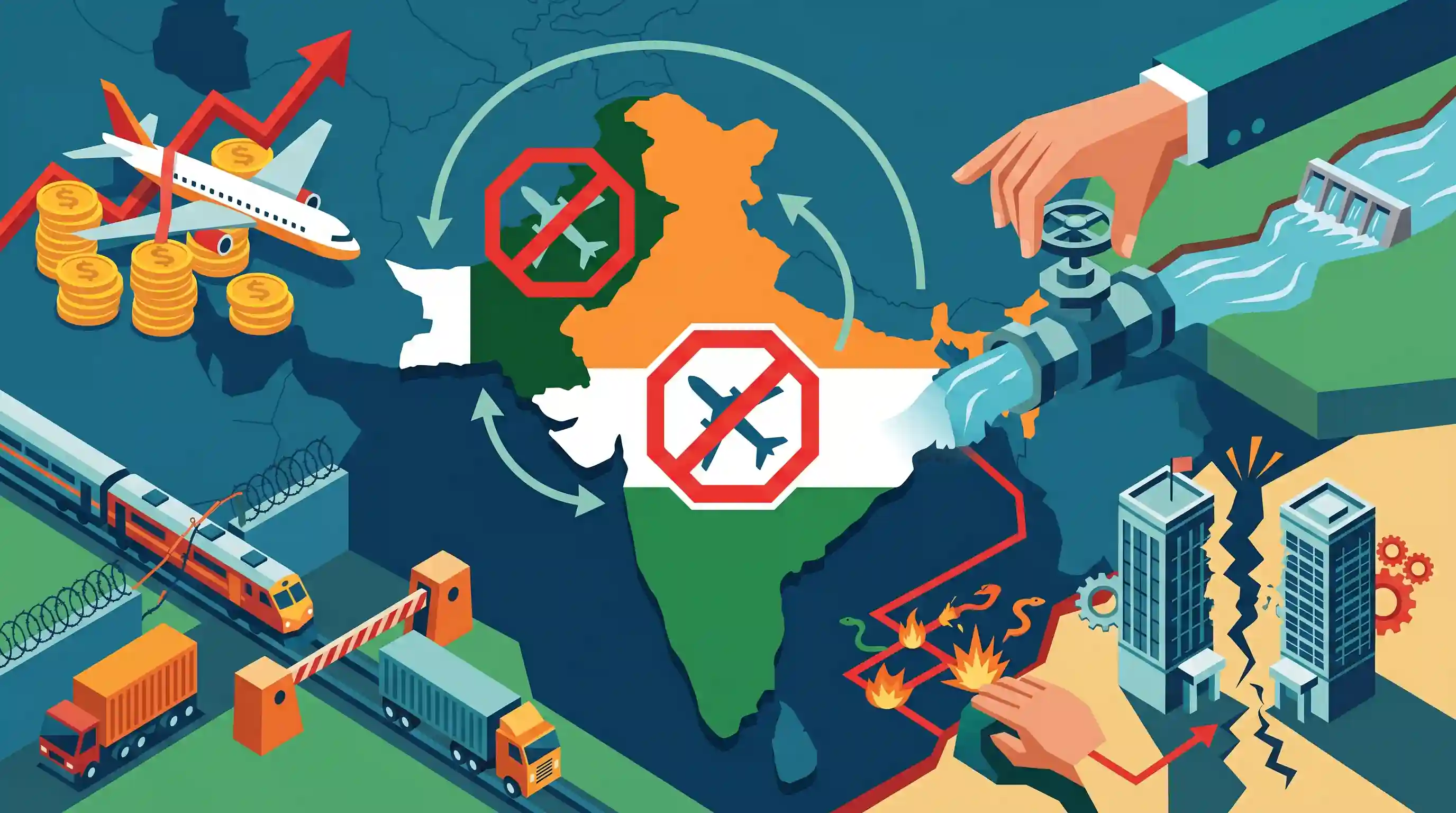
Highlights extreme diplomatic measures (such as airspace bans and the suspension of the historic Indus Waters Treaty) taken in response to cross-border terrorism, showcasing the geopolitical constraints on connectivity and infrastructure.
Summary
India has extended its airspace ban on Pakistan airlines until June 23, a measure initially taken following the deadly Pahalgam terror attack. Pakistan responded in kind with a ban lasting until June 24. The airspace closures, which add an estimated $600 million to Air India's operating costs, are part of a broader diplomatic breakdown that includes India's punitive suspension of the Indus Waters Treaty, the closure of the Attari land border, and a downgrade in diplomatic ties due to Pakistan's links to cross-border terrorism.
Key Points
- India extended its airspace ban on Pakistan airlines until June 23 as part of ongoing diplomatic and strategic countermeasures.
- The airspace ban is a consequence of the Pahalgam terror attack, which led to India suspending the Indus Waters Treaty and shutting the Attari border.
- Pakistan responded with a reciprocal airspace ban on Indian flights until June 24.
- The airspace closure has massive financial implications for the aviation sector, with Air India estimating a $600 million cost over 12 months due to flight rerouting.
Important Terms
Indus Waters Treaty (IWT)

A 1960 water-sharing pact between India and Pakistan, brokered by the World Bank, governing the Indus river system. It grants India control over Eastern rivers and Pakistan control over Western rivers.
UPSC context
GS Paper II (International Relations). Tests knowledge of hydro-diplomacy, treaty provisions, and the role of international mediators.
Cross-border Terrorism
Terrorist activities where one country's territory is used to launch attacks against another. It involves state-sponsored proxies or non-state actors aimed at destabilizing a nation through sustained violence.
UPSC context
GS Paper III (Internal Security). Tests understanding of external threats and the impact of state-sponsored militancy on neighborhood stability.
Attari-Wagah Border
The primary land transit point between India and Pakistan near Amritsar. It is the sole permitted route for trade and passenger movement between the two nations.
UPSC context
GS Paper III (Border Management). Crucial for trade policy, regional connectivity, and managing security at sensitive land borders.
Freedom of the Air
A set of international aviation rights (Chicago Convention) allowing airlines to fly over or land in foreign territories. These are frequently suspended as diplomatic leverage during conflicts.
UPSC context
GS Paper II (International Agreements). Relevant for civil aviation policy and understanding how airspace acts as a diplomatic tool.
Integrated Check Post (ICP)
Modern border facilities housing all regulatory agencies (customs, immigration, security) under one roof. The ICP at Attari facilitates the only land-based trade ecosystem with Pakistan.
UPSC context
GS Paper III (Infrastructure/Security). Focuses on border modernization and balancing trade facilitation with national security requirements.
Air India
India's flag carrier airline, now owned by the Tata Group. It faces significant economic losses during airspace bans due to the high cost of rerouting long-haul flights.
UPSC context
GS Paper III (Economy). Illustrates the economic vulnerability of the aviation sector to geopolitical shifts and neighborhood instability.
Prelims Trap
The Indus Waters Treaty contains an explicit clause allowing India to unilaterally suspend or withdraw from the agreement.
The IWT actually lacks any unilateral exit or suspension clause. India's suspension is a strategic move invoking broader international law principles (like material breach), rather than a treaty-based provision.
Static Concepts Connected
What are the key water-sharing provisions of the Indus Waters Treaty (1960)?
- Western Rivers: The Indus, Jhelum, and Chenab are allocated primarily to Pakistan.
- Eastern Rivers: The Ravi, Beas, and Sutlej are allocated for exclusive use by India.
- India's Limited Rights: India is permitted to construct run-of-the-river hydroelectric projects and use water for limited agricultural purposes on the Western rivers.
What are the foundational principles of international airspace under the Chicago Convention?
- Absolute Sovereignty: Every sovereign state has complete and exclusive sovereignty over the airspace directly above its territory.
- First Freedom: The right to fly across a foreign country's territory without landing (disrupted by these bans).
- Second Freedom: The right to land in a foreign country for non-traffic, technical purposes (like refueling or maintenance).
Cross-Topic Patterns
Water as a strategic weapon
Suspending the IWT shifts India's stance from strictly defensive to utilizing transboundary river geography as a coercive diplomatic tool against state-sponsored terrorism.
Geo-economics of airspace closures
Reciprocal airspace closures heavily burden national carriers (e.g., Air India's $600M loss), illustrating how geopolitical security measures directly disrupt domestic logistics and corporate profitability.

Expect a multi-statement Prelims question testing the 'Freedoms of the Air' alongside the Indus Waters Treaty's dispute mechanisms.
Linked PYQs · 3
Linked PYQs · 3
- 2015MainsGS2
Terrorist activities and mutual distrust have clouded India-Pakistan relations. To what extent the use of soft power like sports and cultural exchanges could help generate goodwill between the two countries? Discuss with suitable examples.
- 2016MainsGS2
Increasing cross-border terrorist attacks in India and growing interference in the internal affairs of several member-states by Pakistan are not conducive for the future of SAARC (South Asian Association for Regional Cooperation)." Explain with suitable examples.
- 2012MainsGS2
The situation today is far different to that prevalent fifty years back when the Indus Water Treaty was signed." Highlight the complexity of the current challenges on both sides of the border in this regard. Do you think that a review of the Treaty is in India's best interests?
