India Bangladesh Hilsa Fish Trade Flow Reversal and Exports
Source:businesstoday ↗
Why It Matters
The reversal of traditional fish trade flows between India and Bangladesh offers important context on regional trade dynamics, bilateral economic ties, and shifting agro-climatic and market conditions in South Asia.
Summary
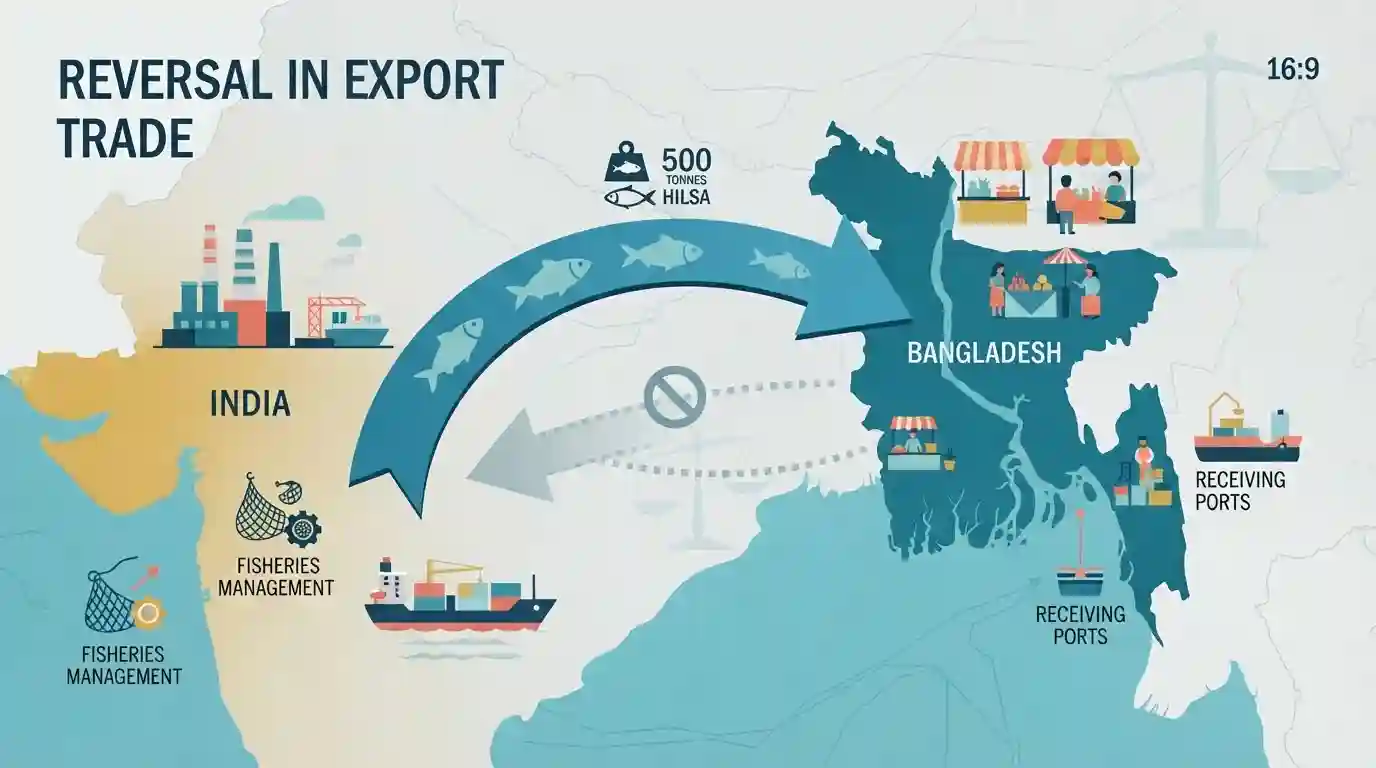
A notable reversal in regional trade has occurred as India exported 500 tonnes of Hilsa fish to Bangladesh, moving away from the conventional pattern where Bangladesh exported the prized fish to India. This development highlights shifting cross-border trade flows and fisheries management in South Asia.
Key Points
- In a reversal of traditional trade patterns, India exported 500 tonnes of Hilsa fish to Bangladesh.
- Hilsa, a highly prized fish in both nations, is historically exported from Bangladesh to India, particularly around festive seasons like Durga Puja.
- The shift highlights changing dynamics in regional fish supply, domestic production variations, and bilateral commerce between India and Bangladesh.
Important Terms
Hilsa fish

A prized anadromous fish native to South Asia that migrates up rivers to spawn, highly sought after in West Bengal and Bangladesh, particularly during the Durga Puja festival.
UPSC context
WBCS Paper V (Economy and Geography of West Bengal) — Tests knowledge of regional fisheries, agro-exports, and cross-border riverine trade dynamics.
Fish Trade Flow Reversal
A rare cross-border trade shift where India exported approximately 500 tonnes of Hilsa fish to Bangladesh to cover a domestic production shortfall, inverting traditional supply chains.
UPSC context
WBCS Paper V (International Relations & Bilateral Trade) — Important for questions on India-Bangladesh economic ties and trade imbalances.
Government of India
The executive branch of the Indian federal republic, which manages national economic policies, international trade protocols, and bilateral relations with neighboring countries.
UPSC context
WBCS Paper I & Paper IV (Indian Polity and Governance) — Tests administrative frameworks, foreign policy execution, and trade agreements.
Government of Bangladesh
The sovereign governing authority of the People's Republic of Bangladesh, responsible for framing fisheries management policies, export quotas, and commercial regulations.
UPSC context
WBCS Paper V (International Relations & South Asian Diplomacy) — Crucial for understanding regional cooperation, water resource sharing, and trade policies.
Prelims Trap
India has traditionally been the largest net exporter of Hilsa fish to Bangladesh.
Aspirants assume Bangladesh always imports Hilsa from India, missing that Bangladesh produces 70-75% of global Hilsa and traditionally exports to India, making this Gujarat-origin export a rare reversal.
Static Concepts Connected
What are the key biological and geographical characteristics of the Hilsa fish (*Tenualosa ilisha*) in the Bengal delta?
- Migration Pattern: Anadromous species that spends most of its life in marine waters and migrates upstream into rivers like the Padma, Meghna, and Hooghly to spawn.
- GI Tag Status: Padma River Hilsa of Bangladesh was granted Geographical Indication (GI) status in August 2017 due to its unique culinary properties.
Cross-Topic Patterns
Fisheries Trade Meets Transboundary River Ecology
The Hilsa export reversal connects trade economics with riverine ecology, linking the Ganga-Brahmaputra-Meghna basin's transboundary water sharing and anadromous fish migration patterns.
GI Tags and Regional Bilateral Diplomacy
GI tags like the Padma Hilsa connect international trade protocols with intellectual property rights and regional identity in South Asian bilateral relations.

Expect a multi-statement question on anadromous species migration (Padma/Meghna/Hooghly systems) and GI tags in South Asian trade.
Linked PYQs · 1
Linked PYQs · 1
- 2008WBCS_PRELIMSGS1
India's dispute over sharing of water with Bangladesh arises out of the distribution of water from
