Saudi-Pakistan Defence Pact and Implications for Indian Diplomacy
Source:The Hindu ↗
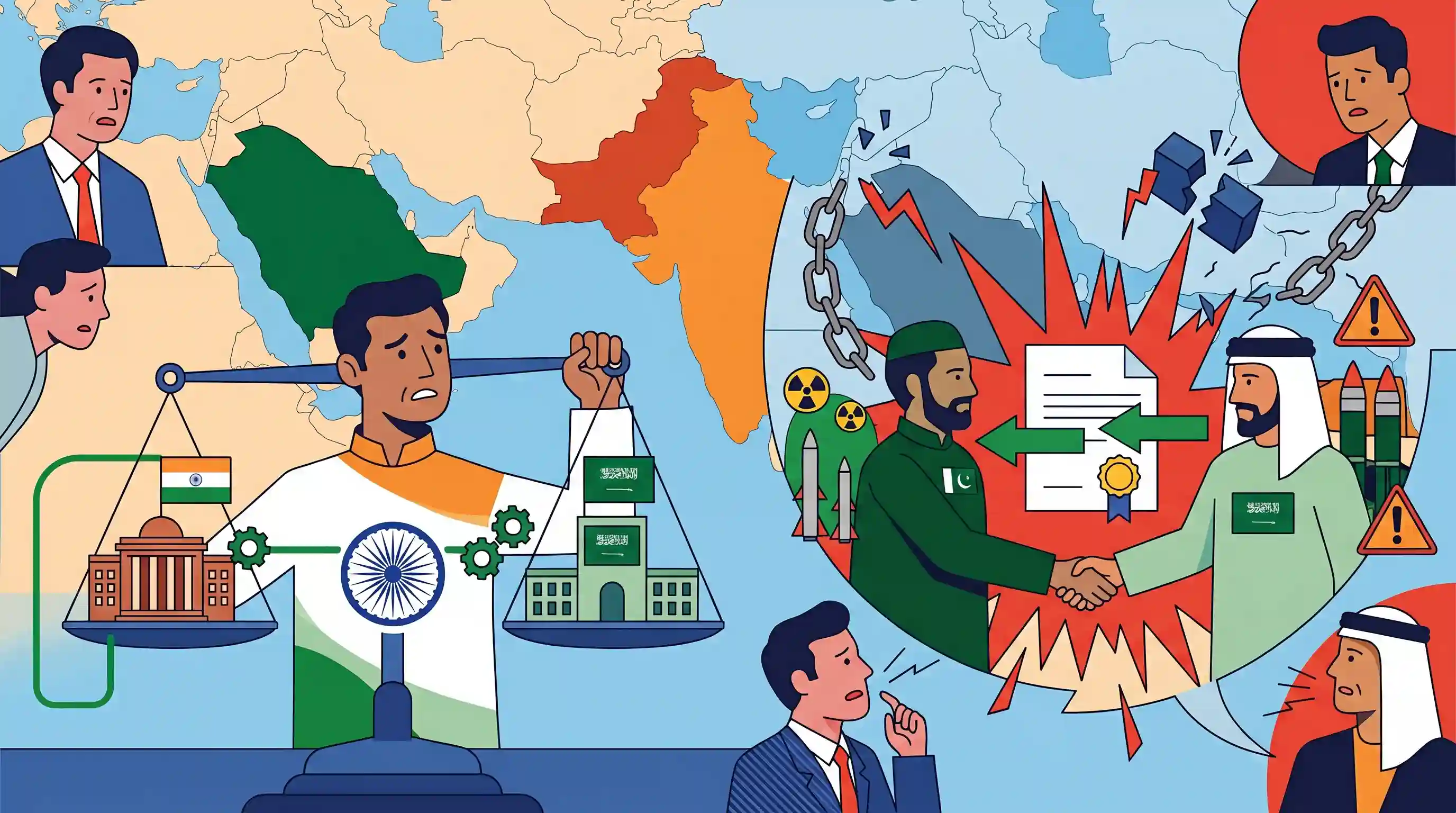
Why It Matters
The integration of a nuclear dimension into the Saudi-Pakistan defence pact significantly alters the security architecture of the Middle East and South Asia. For UPSC aspirants, it is a key case study in International Relations (GS2), illustrating the complexities of India's 'Look West' policy, the limits of de-hyphenating relationships, and the persistent challenges of nuclear proliferation in India's neighborhood.
Summary
India's Ministry of External Affairs (MEA) expressed expectations that Saudi Arabia will remain mindful of mutual interests and sensitivities following its recent "Strategic Mutual Defence Agreement" with Pakistan. The controversial pact includes a mutual defense clause and notably features Pakistan's offer to make its nuclear program available to Saudi Arabia. Despite India's own robust strategic partnership with Riyadh, this new development raises significant security, geopolitical, and nuclear proliferation concerns in the region, testing India's diplomatic balancing act in West Asia.
Key Points
- Saudi Arabia and Pakistan have signed a Strategic Mutual Defence Agreement, which includes a mutual defense clause treating aggression against one as aggression against both.
- Pakistan has offered to make its nuclear programme available to Saudi Arabia under the new defence pact, raising serious regional security and proliferation concerns.
- India's Ministry of External Affairs reacted by reminding Saudi Arabia of their wide-ranging strategic partnership, expecting Riyadh to respect mutual interests and sensitivities.
- The development poses a diplomatic challenge for India's West Asia policy, complicating its successful outreach to Gulf nations with the enduring Pakistan-Saudi security nexus.
Important Terms
Strategic Mutual Defence Agreement (SMDA)

A 2025 security pact between Riyadh and Islamabad establishing collective defense, where an attack on one is treated as an attack on both.
UPSC context
GS Paper II (International Relations). Tests knowledge of regional security alliances and their impact on India's neighborhood policy.
India-Saudi Strategic Partnership
A diplomatic framework (formalized via the Strategic Partnership Council in 2019) involving high-level cooperation in defense, energy, and investment between New Delhi and Riyadh.
UPSC context
GS Paper II. Crucial for questions on India's West Asia Policy and balancing rival regional interests.
Extended Nuclear Deterrence
A security guarantee where a nuclear-armed state (Pakistan) pledges to use its nuclear arsenal to deter attacks on a non-nuclear ally (Saudi Arabia).
UPSC context
GS Paper III (Internal Security/Science & Tech). Relevant to nuclear doctrine, global non-proliferation, and regional stability.
Nuclear Proliferation
The spread of nuclear weapons, fissionable material, and weapons-applicable nuclear technology and information to nations not recognized as "Nuclear Weapon States."
UPSC context
GS Paper II & III. Concerns India’s stance on the NPT and the risk of a nuclear arms race in West Asia.
Collective Security
A security arrangement in which each state in the system accepts that the security of one is the concern of all, committing to a collective response.
UPSC context
GS Paper II. Fundamental concept in International Relations; tests understanding of alliances vs. individual state sovereignty.
Ministry of External Affairs (MEA)
The government body responsible for India's foreign relations, managing diplomatic missions, and articulating India's official stance on global developments.
UPSC context
GS Paper II. Primary actor in Indian foreign policy; its statements are the basis for analyzing official diplomatic strategy.
Prelims Trap
"Pakistan, as an NPT signatory, is legally permitted to share its nuclear umbrella with Saudi Arabia under mutual defence pacts."
Pakistan is NOT a signatory to the Non-Proliferation Treaty (NPT). Its offer of a nuclear umbrella raises severe illicit proliferation concerns outside international regulatory frameworks.
Static Concepts Connected
What is the NPT's stance on nuclear sharing and who are the key non-signatories?
- Non-Signatories: India, Pakistan, Israel, and South Sudan have never signed the NPT. North Korea withdrew in 2003.
- Articles I & II: Article I forbids nuclear-weapon states from transferring weapons to any recipient; Article II forbids non-nuclear states from acquiring them.
- Nuclear Umbrella Ambiguity: While NATO's 'nuclear sharing' keeps control with the US, Pakistan extending its umbrella to Riyadh raises questions of illicit proliferation outside NPT norms.
What characterizes India's 'De-hyphenation' policy in West Asia?
- Independent Ties: Pursuing independent, merit-based bilateral relations with countries in the region, completely detached from their rivalries with third nations.
- Classic Examples: Successfully maintaining robust concurrent partnerships with mutually antagonistic states (e.g., Israel and Palestine, or Saudi Arabia and Iran).
- Strategic Partnership Council: Established in 2019, it anchors the India-Saudi relationship, elevating it beyond buyer-seller energy dynamics to encompass defence, security, and trade.
Cross-Topic Patterns
Energy security limits hardline diplomacy
India relies on the Gulf for over 50% of its crude oil. This energy dependence forces New Delhi to use diplomatic nudges rather than hardline stances when addressing Saudi-Pakistan security ties.
Iran's nuclear breakout vs. Saudi deterrence
Pakistan's nuclear umbrella offer to Riyadh is a direct counterweight to Iran's uranium enrichment. This links South Asia's nuclear proliferation risks directly to the Persian Gulf's balance of power.

Mains 2026 is highly likely to test the limits of India's 'de-hyphenation' strategy in West Asia amidst emerging Saudi-Pakistan axes.
Linked PYQs · 2
Linked PYQs · 2
- 2025MainsGS2
"Energy security constitutes the dominant kingpin of India's foreign policy, and is linked with India's overarching influence in Middle Eastern countries.” How would you integrate energy security with India's foreign policy trajectories in the coming years?
- 2017MainsGS2
The question of India's Energy Security constitutes the most important part of India's economic progress. Analyze India's energy policy cooperation with West Asian countries.
