SIPRI estimates India nuclear arsenal expansion to around 190 warheads
Source:The Hindu ↗
Why It Matters
The article underscores the shifting dynamics of India's nuclear deterrence strategy (focusing more on China), the evolving nature of hybrid warfare (cyber ops in active military conflicts), and ongoing challenges with defense indigenization given high arms import rankings. These are core topics for GS3 (Security/Technology) and GS2 (International Relations).
Summary
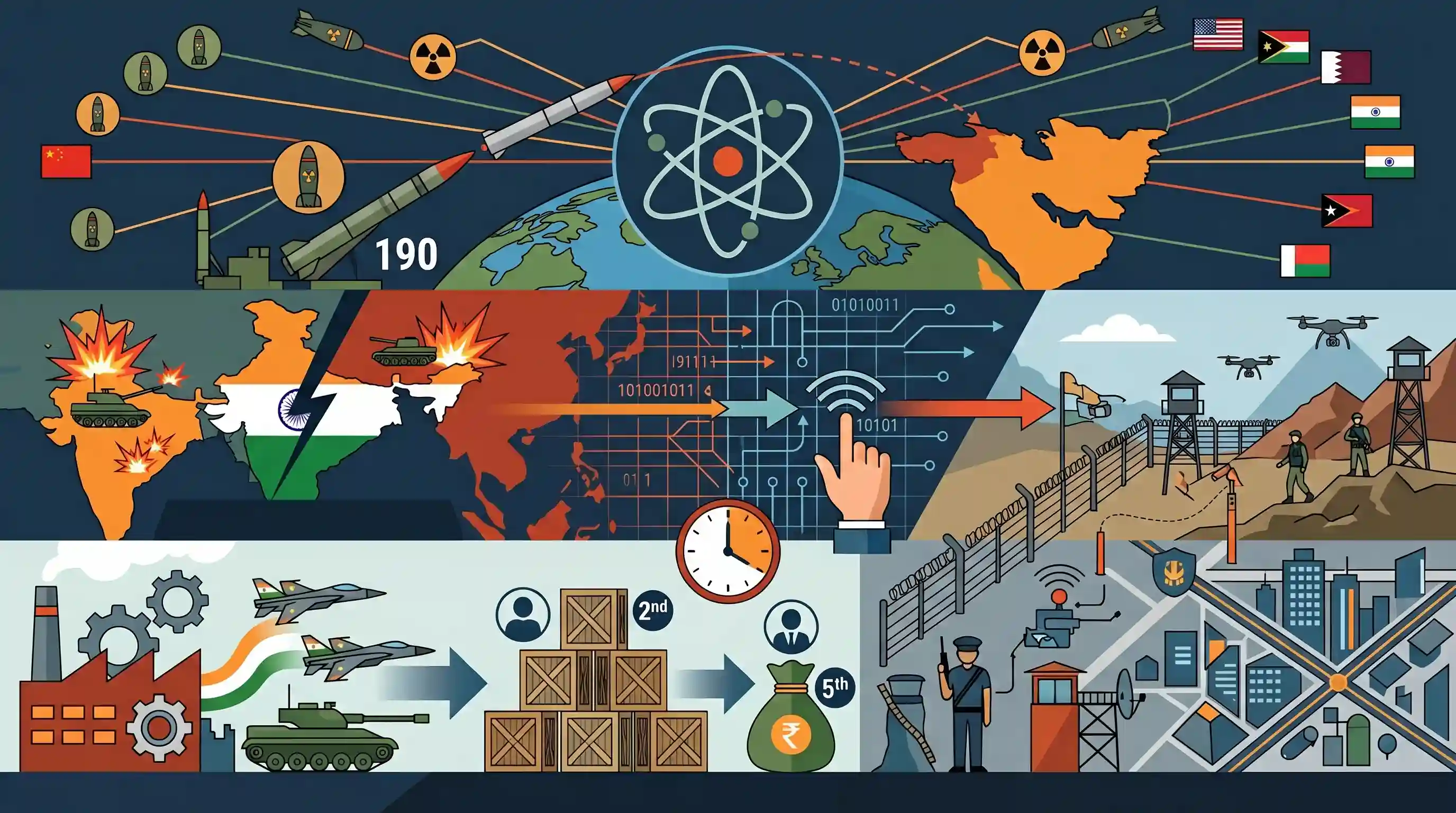
According to the SIPRI Yearbook 2026, India has expanded its nuclear arsenal to approximately 190 warheads, focusing on longer-range delivery systems capable of reaching China. The report also highlighted the May 2025 India-Pakistan "Operation Sindoor" confrontation, calling it an unusually severe military crisis involving strikes on suspected nuclear-related sites and a novel integration of cyber operations into kinetic conflict. Additionally, India remains the world's fifth-largest military spender and second-largest arms importer amidst a global trend of all nine nuclear-armed states modernizing their arsenals.
Key Points
- SIPRI Yearbook 2026 estimates India's nuclear arsenal has expanded to approximately 190 warheads, with a growing focus on longer-range weapons capable of reaching China.
- The May 2025 India-Pakistan military confrontation, "Operation Sindoor", saw India striking Pakistani air and missile bases with suspected nuclear-related roles.
- "Operation Sindoor" marked a significant evolution in warfare, featuring the unprecedented integration of offensive cyber operations alongside conventional kinetic strikes by both nations.
- Globally, all nine nuclear-armed states are actively modernizing their arsenals, with global warheads estimated at 12,187 at the start of 2026.
- India continues to be a major military power, ranking as the world's fifth-largest military spender ($92.1 billion) and the second-largest arms importer.
Important Terms
SIPRI (Stockholm International Peace Research Institute)

An independent international institute based in Sweden that monitors global armaments, military spending, and arms transfers to provide data and analysis on international security.
UPSC context
GS Paper 2 (International Relations) and GS Paper 3 (Security). Crucial for citing data on military spending and nuclear arsenals.
Operation Sindoor
A severe May 2025 military crisis between India and Pakistan characterized by conventional strikes on suspected nuclear-related sites and the novel integration of cyber operations into kinetic combat.
UPSC context
GS Paper 3 (Internal Security & Neighborhood Relations). Analyzes modern escalation dynamics and the role of non-traditional warfare in South Asia.
Cyber-Kinetic Integration
The simultaneous and coordinated use of offensive cyber operations alongside physical military force (kinetic strikes) to disrupt an adversary's command, control, and critical infrastructure.
UPSC context
GS Paper 3 (Cyber Security). Tests understanding of hybrid warfare and the evolving nature of the battlefield in the 21st century.
Nuclear Triad
A military strategy allowing a country to launch nuclear strikes from three platforms: land-based missiles, sea-based submarines (SSBNs), and strategic aircraft.
UPSC context
GS Paper 3 (Security/Science & Tech). Essential for discussing India's strategic deterrence and "No First Use" credibility.
MIRV (Multiple Independently Targetable Re-entry Vehicles)
A missile technology allowing a single ballistic missile to carry multiple nuclear warheads, each capable of hitting a different target independently.
UPSC context
GS Paper 3 (Science & Tech). Relevant for India's technological advancements like the Agni-V and maintaining strategic parity.
Nuclear Doctrine (No-First-Use)
India’s core strategic policy promising never to initiate a nuclear strike but ensuring a massive, unacceptable retaliatory strike if attacked with nuclear weapons.
UPSC context
GS Paper 3 (Security). Key to evaluating India's responsible nuclear state status and deterrence posture against China and Pakistan.
Arms Importer Ranking
India's global standing in purchasing defense equipment; as of 2026, India remains the world's second-largest importer, primarily sourcing from Russia, France, and Israel.
UPSC context
GS Paper 3 (Defense Indigenization). Highlights the gap between military needs and the 'Atmanirbhar Bharat' goal in defense production.
Prelims Trap
"SIPRI is a specialized agency of the United Nations monitoring global arms."
SIPRI is an independent international institute based in Stockholm, Sweden, not a UN body. UPSC frequently tests institutional affiliations to catch candidates off-guard.
Static Concepts Connected
What are the core pillars of India's 2003 Nuclear Doctrine?
- No First Use: Nuclear weapons will only be used in retaliation against a nuclear attack on Indian territory or on Indian forces anywhere.
- Massive Retaliation: Retaliation to a first strike will be massive and designed to inflict unacceptable damage.
- CBRN Exception: India retains the option of a nuclear response in the event of a major attack by biological or chemical weapons.
Why does India refuse to sign the Nuclear Non-Proliferation Treaty (NPT)?
- Discriminatory Nature: India views the NPT as inherently flawed, creating an arbitrary divide between recognized nuclear "haves" (tested before 1967) and "have-nots".
- Universal Disarmament: India advocates for universal, non-discriminatory, and verifiable global nuclear disarmament rather than regional or selective non-proliferation controls.
Cross-Topic Patterns
Cyber-kinetic hybrid warfare
The integration of cyber operations in 'Operation Sindoor' merges traditional conventional border conflicts (GS3) with critical infrastructure cybersecurity vulnerabilities and NCIIPC mandates.
Import reliance vs Atmanirbhar Bharat
India's stubborn status as the world's 2nd largest arms importer exposes the gap between policy intent (Positive Indigenisation Lists) and actual defence manufacturing capacity.

Expect a multi-statement Prelims question on SIPRI rankings, hybrid cyber-kinetic warfare, and caveats in India's No First Use policy.
Linked PYQs · 4
Linked PYQs · 4
- 2021MainsGS3
Keeping in view India's internal security, analyse the impact of cross-border cyber attacks. Also discuss defensive measures against these sophisticated attacks.
- 2023PrelimsGS1
Consider the following statements: 1. Ballistic missiles are jet-propelled at subsonic speeds throughout their flights, while cruise missiles are rocket-powered only in the initial phase of flight. 2. Agni-V is a medium-range supersonic cruise missile, while BrahMos is a solid-fuelled intercontinental ballistic missile. Which of the statements given above is/are correct?
- 2014MainsGS3
Foreign Direct Investment (FDI) in the defence sector is now set to be liberalized. What influence this is expected to have on Indian defence and economy in the short and long run?
- 2016MainsGS2
Increasing cross-border terrorist attacks in India and growing interference in the internal affairs of several member-states by Pakistan are not conducive for the future of SAARC (South Asian Association for Regional Cooperation)." Explain with suitable examples.
